


Introduction
Chaos testing has emerged as a crucial component of present-day software engineering, particularly for organizations focused on developing resilient systems. This methodology involves the intentional introduction of failures within a system to identify vulnerabilities and verify that effective recovery mechanisms are established. Despite the significant benefits of chaos testing, it also presents inherent risks associated with unintended outcomes. This is where the notion of “blast radius” becomes relevant. Grasping and controlling the blast radius is essential for executing chaos experiments in a manner that is both effective and secure.
What is Blast Radius in Chaos Testing?
In chaos testing, the concept of “blast radius” pertains to the range or degree of influence exerted by a failure introduced during a chaos experiment. In essence, it delineates the potential reach of the consequences stemming from a test. It includes:
- The impacted systems: Identifying which components, services, or nodes within the infrastructure are affected by the test.
- The duration of impact: Assessing how long the failure persists and whether it triggers cascading effects.
- The business impact: Evaluating how the failure influences end-users, customers, or internal teams.
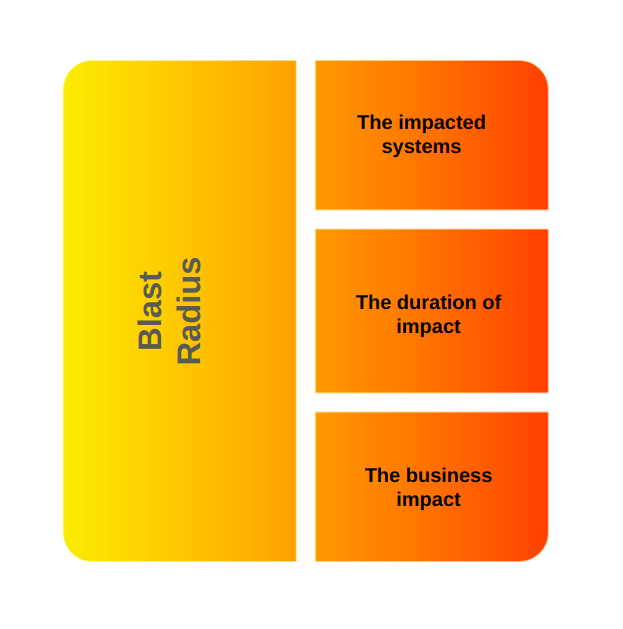
By managing the blast radius, we can concentrate on particular segments of our systems and mitigate the risks linked to chaos testing. This approach ensures that while faults are deliberately introduced to reveal vulnerabilities, the overall system continues to function, and essential business operations remain uninterrupted.
Why is Managing Blast Radius Important?
Effective management of the blast radius is crucial for various reasons:
Risk reduction: Uncontrolled chaos experiments may unintentionally cause significant outages if they do not properly manage the blast radius.
Securing stakeholder support: Teams tend to endorse chaos testing initiatives when they minimize the associated risks.
Targeted learning: By constraining the scope, we can conduct more focused experiments, facilitating the identification of root causes and the implementation of solutions.
Regulatory compliance and safety: Unregulated chaos experiments in industries subject to regulations can lead to breaches of compliance requirements.
A clearly defined blast radius allows us to effectively balance the risks of potential failures with the reliability of the system.
How Does Blast Radius Work?
Effective management of the blast radius requires careful planning and the implementation of controls that delineate the parameters of chaos experiments. The following are the essential components of this process:
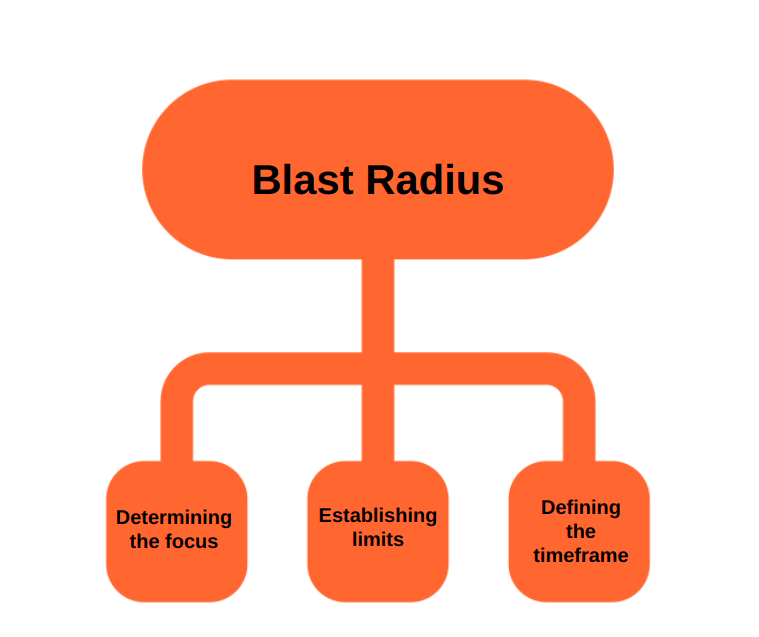
1. Defining the Blast Radius
Before conducting a chaos experiment, it is essential for us to explicitly outline its parameters. This includes:
Determining the focus: Determining which elements, services, or dependencies the experiment will impact. For example, will the test concentrate on an individual microservice, a particular geographical area, or an entire cluster?
Establishing limits: Clearly define what the experiment excludes from its scope. For instance, omitting critical services such as payment processing or user authentication systems may be prudent to prevent significant disruptions.
Defining the timeframe: Establish the duration to simulate the failure. Shorter experiments can mitigate the risk of cascading failures.
2. Limiting the Blast Radius
Methods to restrict the blast radius include:
Fault injection granularity: Initiate with minor, localized failures. For instance, emulate the failure of an individual instance instead of an entire service.
Feature flags: Implement feature flags to manage the injection of failures and to swiftly deactivate the experiment should any unforeseen issues occur.
Traffic routing: Channel a small portion of traffic (e.g., 1%) to the impacted service during the experiment. This approach reduces the effect on end-users.
Scoping tools: Chaos engineering platforms such as Gremlin and Chaos Monkey enable teams to precisely adjust the blast radius through pre-configured settings.
3. Monitoring and Observability
An essential aspect of controlling the blast radius involves establishing comprehensive monitoring and observability. Teams are encouraged to:
Oversee impacted systems: Employ metrics, logs, and tracing tools to analyze the system’s performance throughout the experiment.
Establish alerts: Develop alerts for metrics including latency, error rates, and resource usage to identify when the test surpasses acceptable limits.
Implement guardrails: Introduce automated checks to halt the experiment if critical thresholds are violated.
4. Measuring the Blast Radius
At the end of the experiment, evaluating the blast radius necessitates a thorough analysis of its effects. Essential metrics to consider include:
Service Impact: What is the number of services that experienced degradation or outages?
User impact: How many users were impacted, and what type of impact did they experience (e.g., increased response times, errors)?
Recovery time: What duration was required for the system to return to a stable condition?
Cascading failures: Did the failure extend to other components of the system?
By quantifying the blast radius, we can evaluate the success of our chaos experiments and enhance the strategies for future assessments.
5. Establishing a Blast Radius Score (BRS)
The scoring system is as follows:
- 0-2: Minimal impact (for instance, a singular failure with no observable consequences)
- 3-5: Moderate impact (such as service degradation without total failure)
- 6-8: Severe impact (including partial outages that affect several services)
- 9-10: Critical impact (characterized by complete system downtime or significant data corruption)
Real-World Examples of Blast Radius Management
It is beneficial to examine several real-world examples to better understand the concept of blast radius.
1. E-commerce Platform
An e-commerce organization aims to evaluate the robustness of its checkout service. We have resolved to:
- Restrict the impact area to a specific region.
- Divert merely 2% of user traffic to the experimental phase.
- Track essential metrics, including transaction success rates and latency.
By confining the impact area, we identify a misconfiguration in the payment gateway while ensuring that the majority of users remain unaffected.
2. Video Streaming Service
A streaming service evaluates the failure of a content delivery network (CDN) node. To control the impact of this test:
The team conducts the assessment exclusively during non-peak hours.
The failure is simulated for 5 minutes.
They monitor the effectiveness of the traffic rerouting systems.
The results indicate a requirement for more rapid failover mechanisms, enabling the team to make enhancements prior to peak usage periods.
Best Practices for Managing Blast Radius
To guarantee the safety and efficacy of chaos experiments, adhere to the following best practices:
Initiate on a small scale: Commence with experiments that have a limited impact, progressively expanding the scope as confidence is established.
Engage stakeholders: Clearly communicate the objectives, scope, and protective measures of chaos testing to secure support from teams and leadership.
Conduct preliminary tests in staging: Execute experiments within a staging environment before deploying them in production.
Automate rollback procedures: Establish systems that allow for rapid reversion of changes or termination of the experiment in the event of issues.
Document and disseminate insights: Create a comprehensive knowledge repository of previous experiments, their results, and the insights gained.
Conclusion
The concept of blast radius is essential in chaos testing, as it enables us to strike a balance between identifying vulnerabilities and ensuring system reliability. By precisely defining, constraining, and assessing the blast radius, organizations can perform chaos experiments effectively while minimizing the risk of significant disruptions. As chaos engineering methodologies advance, the comprehension and management of the blast radius will continue to be fundamental in the development of resilient systems.