



Introduction
In private banking, portfolio management systems empower relationship managers and high-net-worth clients to monitor and optimize investment strategies. As personalization and transparency become essential, Digital Proposal platforms are now integral to modern portfolio systems.
These platforms allow relationship managers to create proposals, share investment insights, and collect client feedback through digital channels. However, to ensure both functional accuracy and user experience, a well-defined testing strategy is critical.
Portfolio + Proposal: An Integrated Workflow
A typical end-to-end flow includes:
- Relationship managers builds the proposed investment portfolio within the portfolio management system.
- The system calculates expected performance and evaluates asset allocation.
- A Digital Proposal is generated with charts, portfolio details, and disclaimers.
- The client receives a notification and reviews or approves the proposal via the digital portal.
Each stage requires validation—both backend processing and front-end display.
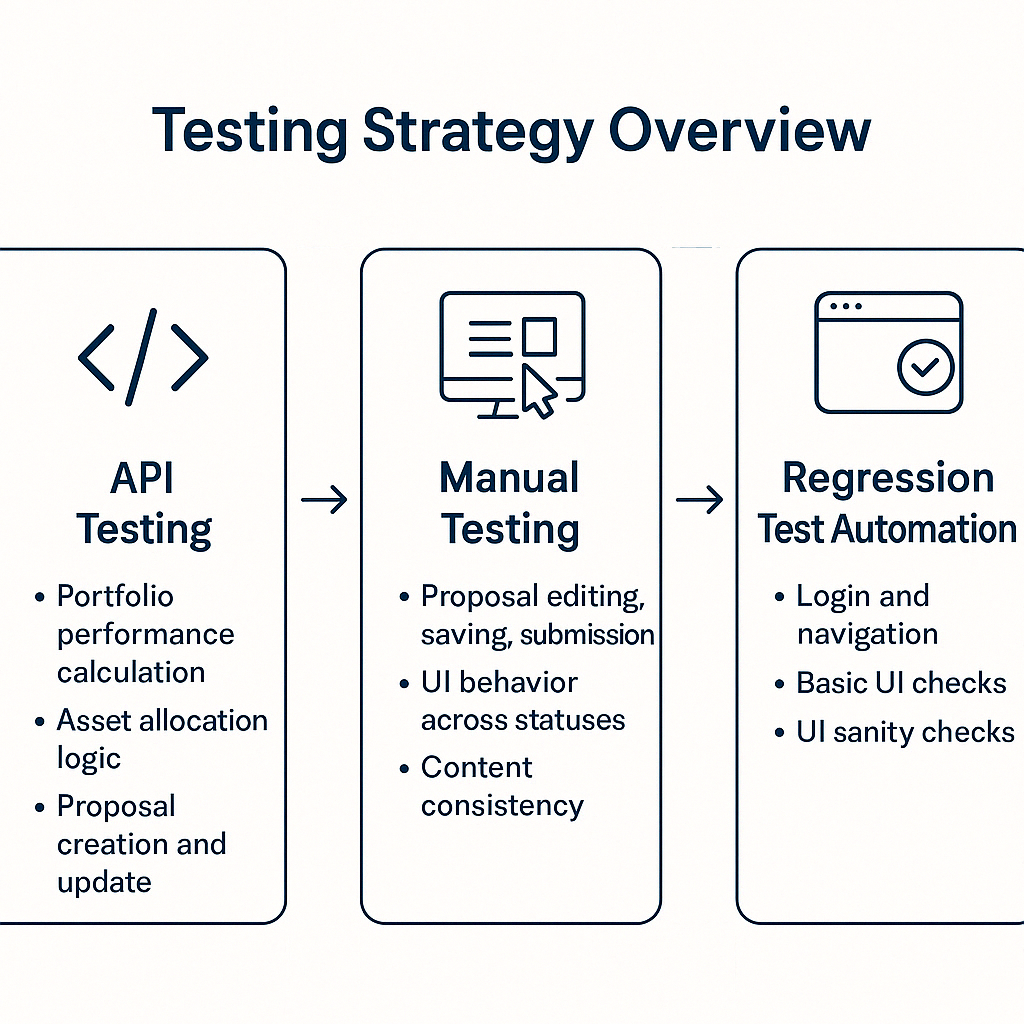
Testing Strategy Overview
Based on practical experience, the testing strategy should focus on three pillars:
1. API Testing – Verifying Business Logic
Firstly, API testing ensures core calculations and logic work as expected:
- Portfolio performance calculations
- Asset allocation logic
- Proposal creation and updates
- PDF report retrieval
- Client approval workflows
Tools like Postman or ReadyAPI can help validate request/response and data accuracy.
2. Manual Testing – Ensuring Workflow and Usability
Next, manual testing validates user flows and real-world behaviors:
- Creating, editing, and submitting proposals
- Checking state transitions (Draft, Approved, Rejected)
- Verifying content between portal and generated PDF
- Testing multilingual support and formatting
- Handling UI errors and edge cases
Additionally, testers should walk through flows from both Relationship managers and client perspectives.
3. Regression Test Automation – Maintaining Stability
In parallel, a lightweight automation suite supports ongoing stability:
- Login and navigation on the portal
- Listing and status validation of proposals
- Sanity checks across UI components
Playwright, Selenium, or Cypress are great options depending on the stack.
Validating Proposal Reports (PDF)
Beyond functional testing, proposal documents require thorough inspection:
- Data accuracy in charts and tables
- Layout validation per language and region
- Dynamic content (client name, proposal ID, QR codes)
- Matching content between the PDF and on-screen view
For automated PDF checks, tools like PyMuPDF or PDFMiner can be leveraged.
Special Considerations for Private Banking
Unlike standard applications, private banking platforms demand:
- Absolute financial accuracy
- Regulatory compliance such as GDPR
- Premium-grade UI and branding
- Complete audit trails for client and Relationship manager actions
Conclusion
In summary, testing a Portfolio Management system integrated with Digital Proposal is not just a technical checkpoint—it is a foundation for trust.
Combining API validation, manual test execution, and targeted automation ensures that the platform runs reliably and meets client expectations.
In private banking, where each proposal can influence million-dollar decisions, delivering a stable, error-free experience is not optional—it is essential.
📚 References
Documents, articles, blogs and image on internet