



Automated testing is now the foundation of continuous integration and delivery pipelines in the fast-paced world of software development. But there are drawbacks to test automation as well, particularly with regard to faulty tests brought on by UI modifications. Here, self-healing automation comes into play, providing a more intelligent approach to test reliability maintenance without requiring frequent human upgrades.
Healx vs Healenium are two well-known programs that deal with self-healing automation. Healx is clearly the superior option, even though both seek to strengthen automation. In this article, we will be discussing overcoming Healenium limitations with Healx.
Healx vs Healenium: Overview and Core Features
Healenium is an open-source self-healing test automation library designed to enhance the stability and maintainability of Selenium-based tests. It addresses the common challenge of test failures due to dynamic changes in web application elements, such as updated locators (IDs, XPaths, CSS selectors).
Healx vs Healenium: Key Limitations of Healenium
1. Healing Starts Too Early (Before Full Page Load)
- Healenium attempts to heal locators even if the web page hasn’t fully loaded, leading to false healing, unnecessary errors, and unstable test runs.
2. Low Healing Accuracy
- It relies on a single healing method — mainly tree traversal — to find matching elements.
- This simple matching often fails when UI structures change deeply, causing healing to be inaccurate or incomplete.
3. Overwrites Original Locators
- If you enable automatic updating with the Healenium plugin, it replaces the original locators with healed locators.
- If UI changes are temporary, this leads to loss of original locators, making the test scripts corrupted and hard to maintain over time.
4. Limited Machine Learning Use
- Healenium uses only basic ML techniques based on historical data without advanced heuristics or multi-layered learning.
- It cannot predict or adapt well to complex or unpredictable UI changes.
5. No Retry or Reload Mechanism
- It does not retry if a page is loading slowly or if elements are delayed.
- Instead, it immediately attempts healing, causing unnecessary failures during tests on slow or unstable networks.
6. Limited Healing Strategies
- Only historical locator matching is used.
- It doesn’t attempt:
- Alternate locators
- Attribute-based healing
- Position-based healing
- Attribute priority combinations
- Result: If one method fails, the test fails entirely instead of trying multiple recovery strategies.
7. Not Scalable for Highly Dynamic Applications
- In dynamic apps (like those built with React, Angular, or heavy SPAs), where the DOM structure frequently changes, Healenium’s single healing strategy is often not enough to maintain test stability.
8. Limited Database and Learning
- Healing information is stored in a basic form and does not evolve much between test runs.
- No intelligent learning or historical pattern analysis is done to improve future healing.
9. Difficult Handling of Temporary Changes
- If locator changes are temporary, healing still happens and locators are permanently modified, leading to unnecessary script maintenance once the site reverts.
HealX is a Selenium-based self-healing automation framework designed to solve the common problems of flaky and failing tests caused by UI changes. Unlike traditional solutions like Healenium, HealX combines AI/ML technologies with advanced heuristic techniques to adapt dynamically to locator changes and ensure robust, resilient test execution.
HealX not only detects broken locators but also predicts, heals, and resolves locator issues automatically using intelligent strategies. It dramatically reduces manual maintenance and keeps automated tests running reliably even in highly dynamic web environments.
Key Features of Healx
1. Multiple Heuristic Techniques
Uses retry mechanisms, alternate locators, attribute combinations, and attribute prioritization to recover from failures.
2. Preserves Original Locators
Heals dynamically during runtime without forcing constant script changes.
3. Dedicated Database
Stores locator histories, healing records, and learning patterns for smarter, scalable healing over time.
4. AI/ML-Driven Healing
Learns from previous failures and improves healing decisions dynamically.
5. Healing Approaches
- Healing Approaches:
- Retry Mechanism for late-loading elements
- Alternate Locator fallback
- Attribute Combination to strengthen element identification
- Attribute Priority for smarter locator selection
- Retry Mechanism for late-loading elements
6. Minimal Manual Intervention
Testers spend less time fixing scripts after UI changes.
7. Designed for Modern Dynamic Applications
Performs exceptionally well with complex and frequently changing UIs like React and Angular.
Healx Workflow Design
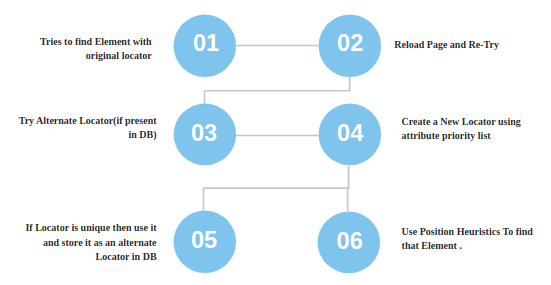
Advantages of HealX Over Healenium (or Disadvantages of Healenium)
1. Healing Before Full Page Load (Problem in Healenium)
- Issue in Healenium: Healing starts even before the web page has finished loading, leading to false healing attempts and unnecessary failures.
- HealX Advantage: HealX waits intelligently using a Reload/Retry mechanism to give the page time to load properly before attempting to find or heal elements.
Result: More accurate healing and fewer false negatives.
2. Low Accuracy Due to Single ML Approach in Healenium
- Issue in Healenium: Healenium uses a simple tree traversal method with only one ML technique for healing locators. This limits healing success, especially when elements change deeply in the DOM.
- HealX Advantage: HealX uses Multiple Heuristic Techniques (retry, alternate locators, attribute combination, attribute priority, positional identification) along with AI/ML models, making the healing much more accurate and reliable.
Result: HealX can heal more complicated changes with higher success rates compared to Healenium.
3. Loss of Original Locator After Healing (Healenium Problem)
- Issue in Healenium: Healenium overwrites the original locator with the healed locator. If the change is temporary (e.g., during a maintenance window), your test scripts get corrupted permanently.
- HealX Advantage: HealX preserves the original locator at all times. It dynamically heals during runtime without overwriting your source code, keeping your original scripts intact.
Result: Your automation scripts stay clean, reliable, and future-proof.
4. No Support for Complex Healing Strategies (Healenium Limitation)
- Issue in Healenium: If healing based on a single historical locator fails, it doesn’t attempt smarter strategies like trying attribute combinations, using backup locators, or checking positional info.
- HealX Advantage: HealX applies a layered healing strategy:
- Retry/Reload handling for slow pages
- Try alternate locators from the database
- Use attribute priority combinations
- Use positional identification when needed
- Retry/Reload handling for slow pages
Result: Multiple fallback options ensure that the test case rarely fails.
5. Inflexibility with Dynamic Websites
- Issue in Healenium: Healenium struggles when dynamic websites (React, Angular, SPAs) change DOM structures heavily.
- HealX Advantage: HealX is designed for dynamic applications with smart locator healing and adaptability.
Result: Higher success rate on modern websites with frequent UI changes.
6. No Structured Database Support in Healenium
- Issue in Healenium: Healing data is not well-organized, leading to loss of healing intelligence across test runs.
- HealX Advantage: HealX maintains a dedicated database that stores:
- All locator attributes from the first successful run
- Alternate locators
- Positions of elements
- Healing success history
- All locator attributes from the first successful run
Result: HealX learns and gets smarter over time, not just during one execution.
7. Better Handling of Temporary Changes
- Issue in Healenium: Temporary DOM changes can destroy test scripts permanently when healing overwrites locators.
- HealX Advantage: HealX dynamically adjusts without hardcoding temporary changes, ensuring long-term test reliability.
Result: Much lower maintenance effort for test automation teams.
Conclusion
HealX tackles important real-world issues encountered during automation testing, it performs considerably better than conventional self-healing solutions like Healenium. Higher accuracy, more intelligent recovery, and less interference with test scripts are guaranteed by HealX’s combination of AI/ML flexibility and several heuristic healing strategies. In contrast to Healenium, it uses a specialized database system to continually learn, handles dynamic UI changes robustly, maintains original locators, and waits intelligently for page loads.
HealX is a future-ready, robust, and extremely effective framework for contemporary test automation requirements because of its all-encompassing and tiered approach, which also greatly lowers maintenance costs while increasing the stability and dependability of automated test suites across projects.