


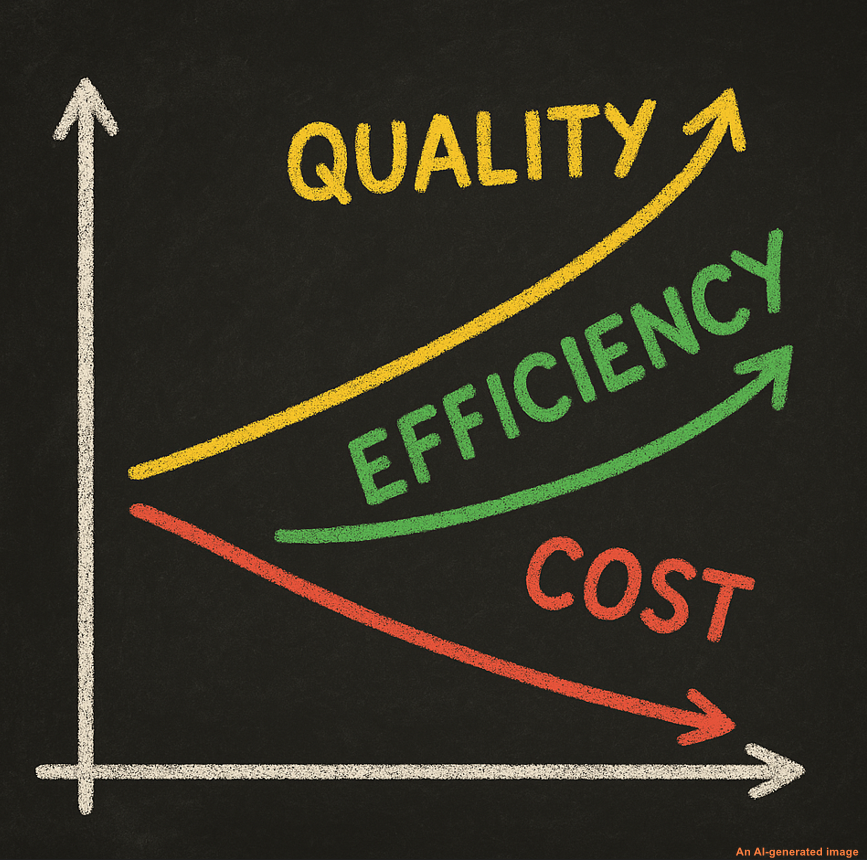
As software development speeds up, testing remains a critical step to ensure stability and quality. Yet, testing can quickly become one of the most expensive phases if not managed properly. Long execution cycles, costly tools, and inefficient processes often result in overspending without significantly improving quality. The key lies in cost optimization—finding smarter ways to test that maximize value while keeping expenses under control.
Impact of high testing costs
When testing becomes too expensive, the consequences ripple across the entire development cycle and the project:
- Reduced ROI (Return on Investment): When testing costs exceed the planned budget, the profitability of the software decreases. The project may struggle to achieve the financial targets.
- Resource wastage: Over-allocation of testers, tools, or environments without proper optimization leads to inefficiency. Resources that could be invested in new features or innovation are wasted.
- Quality does not improve proportionally: High costs don’t always mean better outcomes. Without optimized test strategies (e.g., eliminating duplicate test cases, leveraging automation), product quality may stagnate despite high spending.
- Competitive risks: Expensive and slow testing processes delay time-to-go-live.
- Team morale and productivity decline: High pressure from extended cycles and costly processes can demotivate testers and developers. This often results in lower productivity and burnout.
In short: Overspending on testing not only impacts budgets but also slows delivery, reduces profitability, and weakens competitive advantage.
The following are practical strategies to reduce testing costs while maintaining quality.
Testing cost optimization strategies
Prioritize what we test
Not all tests are created equal. To reduce cost:
- Focus on high-risk areas: Identify modules or features that are business-critical or prone to defects.
- Use risk-based testing: Allocate resources based on the likelihood and impact of failure.
- Avoid over-testing: Eliminate redundant or low-value test cases.
This approach ensures that our testing efforts are aligned with business priorities and resource constraints.
Manage test data efficiently
Test data setup can be time-consuming and costly.
- Reuse test data across multiple test cases.
- Use data masking to protect sensitive information.
- Generate synthetic data to simulate real-world scenarios without relying on production data.
Automated test data management tools can streamline this process and reduce manual effort.
Monitor and refine our test suite
Continuous improvement is key to cost optimization.
- Use dashboards and analytics to track test execution time, failure rates, and resource usage.
- Identify and remove flaky or obsolete tests.
- Regularly review test coverage to ensure alignment with current requirements.
This helps maintain a lean and effective test suite
Foster collaboration
Cross-functional collaboration can reduce duplication and improve efficiency.
- Share test environments, data, and automation scripts across teams.
- Encourage DevOps practices to align development, testing, and operations.
- Document and share learnings to avoid repeating mistakes.
Collaboration reduces silos and maximizes resource utilization.
Shift left testing
According to Wikipedia, Shift-left testing is an approach to software testing and system testing in which testing is performed earlier in the lifecycle (i.e., moved left on the project timeline). The earlier we catch bugs, the cheaper it is to fix them.
- Integrate testing into the development pipeline using CI/CD tools.
- Encourage developers to write unit tests and perform code reviews.
- Use static analysis tools to detect issues before runtime.
Shifting left reduces the need for extensive downstream testing and rework.
Optimize infrastructure usage
Infrastructure is often one of the biggest cost drivers in testing. Here’s how to manage it smartly:
Use cloud-based environments
- Adopt ‘pay-as-you-go’ cloud models to avoid upfront hardware investments.
- Use auto-scaling to match resource allocation with demand.
Containerization
- Use Docker or similar tools to create lightweight, reusable test environments.
- Containers reduce setup time and improve consistency across environments.
Server shutdown practices
- Automatically shut down idle servers during non-working hours or when tests are not running.
- Use scheduling tools to start and stop environments based on test execution windows.
- Monitor usage patterns to identify underutilized resources.
These practices can significantly reduce cloud bills and improve resource efficiency.
After adopting practical strategies to reduce testing expenses, it’s important to track and assess the results. The techniques below can be used to measure the effectiveness of cost optimization:
Techniques to measure the impact of cost optimization
Optimizing testing costs is not just about applying strategies—it’s about proving their effectiveness. Here are ways to measure impact:
Baseline vs. post-optimization comparison
- How it works: Capture current testing costs and performance before changes, then compare after optimization.
- Metric to Track: Execution time per cycle, cost per test cycle.
- Example: Regression suite runtime reduced from 12 hours to 4 hours, cutting cloud usage costs by 65% per cycle.
Trend analysis over time
- How it works: Use dashboards and reporting tools (e.g., Jira, TestRail, Power BI) to track progress monthly or quarterly.
- Metric to Track: Defect leakage, execution time, environment utilization.
- Example: Defect leakage dropped by 40% over three months after introducing shift-left testing, saving rework costs in production.
Cost-benefit analysis
- How it works: Compare investment in optimization (e.g., automation, infrastructure) against savings.
- Metric to Track: Automation ROI, cost per test cycle.
- Example: $50K invested in automation reduced manual regression hours by 1,200 annually, saving $120K per year.
Defect cost avoidance
- How it works: Estimate the cost of fixing defects in production vs. during earlier testing stages.
- Metric to Track: Defect leakage rate.
- Example: Catching 10 critical defects in system testing (instead of production) saved $70K in hotfix and downtime costs.
Environment utilization tracking
- How it works: Monitor usage of cloud environments, containers, or on-prem servers to eliminate idle resources.
- Metric to Track: Environment utilization rate, infrastructure cost per test cycle.
- Example: Enforcing auto-shutdown on idle servers reduced monthly cloud bills by 30%.
Conclusion
Optimizing testing costs isn’t about cutting corners—it’s about working smarter. By prioritizing tests, using automation strategically, managing infrastructure and data efficiently, and fostering cross-team collaboration, organizations can reduce waste and accelerate delivery. In the end, cost optimization in testing ensures a win-win outcome: delivering high-quality software faster, while keeping budgets sustainable.