



1. When testing is more than just running test cases:
In many teams, testing is often seen as a process of following steps, running test cases, and marking results as “Pass” or “Fail.” People who find important bugs know they often appear when you go beyond the checklist.
That’s where Exploratory Testing comes in – the art of exploring software with curiosity, critical thinking, and a real user’s perspective.
2. What is Exploratory Testing?
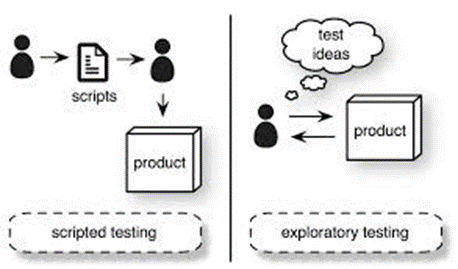
- Normally, in scripted testing, you design the test cases first and then execute them later.
In contrast, exploratory testing is a simultaneous process — test design and test execution happen at the same time. - In scripted testing, testers usually just follow predefined steps and check whether the actual results match the expected ones.
This kind of testing can easily be automated and doesn’t need much thinking or creativity. - Manual testing = “Follow the test cases and mark Pass/Fail.”
Exploratory testing = “Explore the product and find bugs that the test cases don’t think of.”
Optional citation: James Bach and Cem Kaner – two leading experts who advocate for Exploratory Testing.
James Bach promotes skilled, thoughtful testing that goes beyond scripts, while Cem Kaner highlights the importance of learning and discovery in software testing.
In short, exploratory testing is not random clicking — it’s a structured approach to discovering insights about your product that scripted tests might miss.
3. Why Exploratory Testing Matters?
- Finds truly important bugs – the ones that scripted tests often miss.
- Increases flexibility – especially in Agile environments where requirements change frequently.
- Helps testers understand the product more deeply – not just testing, but thinking like a user.
- Saves time in early testing stages – when full test cases are not yet available.
With Examples:
- A tester following a test case checks the “Submit” button and sees it works. But when exploring, they try uploading a large file and discover the system crashes — a critical bug the script didn’t cover.
- In an Agile sprint, the login flow was just updated. Instead of waiting for new test cases, the tester explores the login with different browsers and devices, quickly spotting UI inconsistencies.
- At the start of a new feature, test cases aren’t ready yet. The tester explores the feature, finding bugs and providing feedback to developers before formal test scripts exist
4. Skills Needed for Exploratory Testing
- Creativity: Exploratory testing encourages creativity and requires testers to use imagination and reasoning to find potential test scenarios.
- No prior plan: In exploratory testing, there is no detailed test plan beforehand. Testers are free to explore the application based on their knowledge and experience.
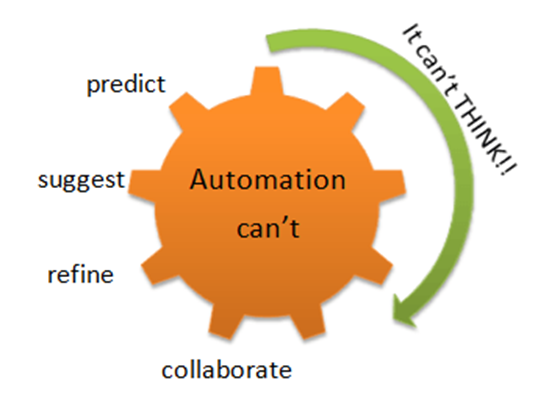
- Not automated: Exploratory testing is usually not automated. Instead, testers focus on manual testing to find issues that automation might miss.
- Documentation: To ensure the integrity of the testing process, testers usually record the steps they take and the test results so that any found bugs can be reproduced.
Although the current trend in software testing is to promote automation, automated testing also has its limits. Exploratory testing is a new way of thinking and is truly essential for testers.
Differences between Scripted Testing and Exploratory Testing
| Scripted Testing | Exploratory Testing |
| Based on requirements | Based on requirements and exploration during testing |
| Test cases are defined before the testing process | Test cases are defined during the testing process |
| Aims to verify tests against requirements | Aims to investigate and understand the system or application |
| Emphasizes prediction and decision-making | Emphasizes adaptability and learning |
| Involves confirmed testing | Involves investigation |
| Focuses on test control | Focuses on improving test design |
| Controlled by test scripts | Controlled by the tester’s mind |
5. When should exploratory testing be used?
In the early stages of the software development lifecycle, when code changes happen quickly, exploratory testing can be highly effective.
Developers can use this technique for unit testing, while testers can familiarize themselves with the application through exploratory testing. The experience gained from exploratory testing can be valuable in preparing test scripts and performing additional tests in later stages of the development cycle.
In rapid development models, there are short Scrum cycles with limited time to create formal test designs and scripts. Exploratory testing fits well in this model because it can keep up with the short Scrum cycles.
While performing exploratory testing, quickly developed test plans save testers a lot of time. At the end of each Scrum cycle, important exploratory tests can be documented for the next Scrum cycle.
6. How to Improve Exploratory Testing Skills
- Start Small – Think Like a User
- Pick a small feature.
- Ask: “If I were a user, what would I do differently?”
- Focus on real user experience, not just the standard flows.
- Take Notes and Organize Thoughts
- Record all observations while testing.
- Use a mind map or bug journal to capture ideas and spot patterns.
- Share Insights with the Team
- Discuss test results with developers or the PO.
- Learn to turn discoveries into actionable insights for the team.
- Observe Colleagues
- Watch how they ask questions and test unexpected flows.
- Pick up new techniques or perspectives for your own testing.
- Challenge Yourself
- Always ask: “Are there any bugs I haven’t thought of yet?”
- Build a habit of creative thinking beyond standard test cases.
7. Drawbacks of Exploration Testing
Exploration Testing is great for finding unexpected bugs and improving user experience, but it also has some drawbacks. Unlike regular test cases, it depends a lot on the tester’s creativity and intuition, which can cause issues with consistency, coverage, and measurement. Here are the main drawbacks:
- Tests are random and exploratory, so it’s hard to plan them in advance or decide exactly which tests to run
- Results depend heavily on the tester’s knowledge, skill, and experience.
- Learning a new application takes time, so bugs may be missed if the tester is not familiar with it.
- Not suitable for applications that require long execution times.
Conclusion – Exploratory Testing is a mindset, not a technique. A good tester doesn’t just execute test cases correctly – they also know how to question their own test cases.