


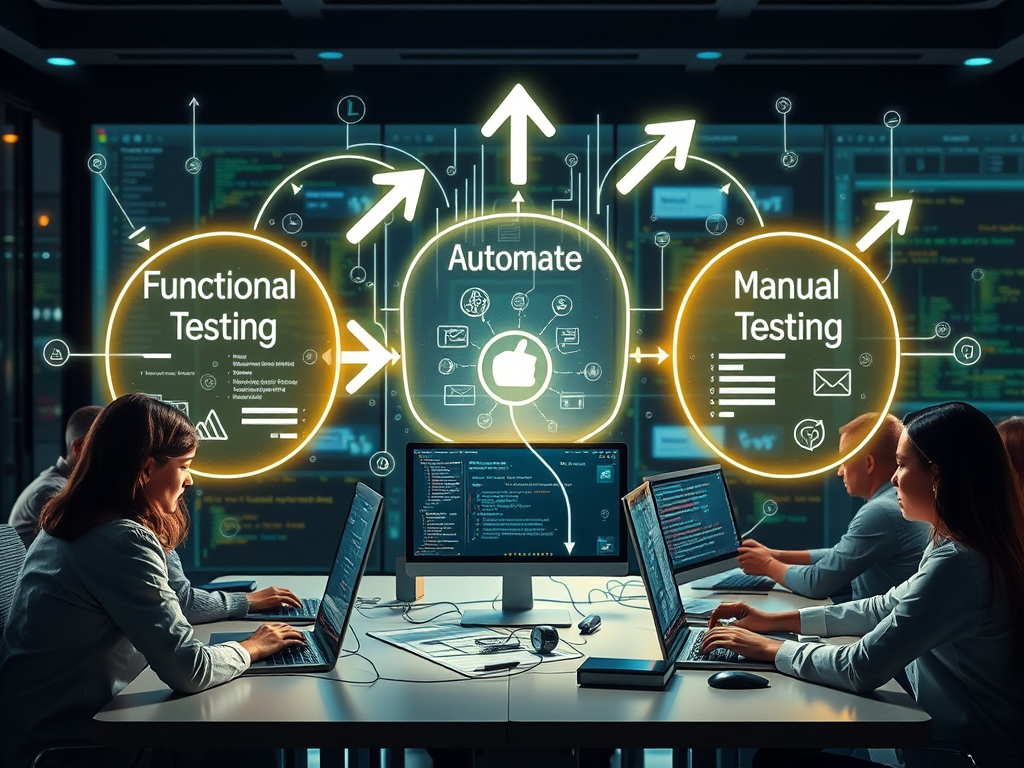
In modern software development, testing is no longer a separate phase that happens after coding — it’s an integral part of the entire lifecycle. However, many teams still struggle with a lack of strong connection between Functional Testing (by developers), Automation Testing, and Manual Testing.
When these areas work in isolation, teams risk miscommunication, duplicated effort, and slower delivery. But when they are well connected and aligned, the outcome is clear: higher quality, faster feedback, and more reliable releases.
Functional Testing in CI/CD: Building Quality from the Start
One of the most significant improvements in modern development is integrating functional testing directly into CI/CD pipelines. By embedding functional tests into the build process, developers can catch defects immediately, ensuring that code changes do not break existing functionality.

Every commit is automatically validated, identifying logic errors, integration problems, and unexpected behaviors before they escalate to later stages. While this approach may require more development time upfront, the trade-off is substantial: improved stability, smoother release cycles, and higher confidence in the software — especially for complex systems such as insurance platforms, banking applications, or healthcare management systems, where even minor errors can have large-scale consequences.
Integrating functional tests into CI/CD also ensures that quality starts at the very code level, rather than being an afterthought. This proactive approach reduces technical debt, prevents defect accumulation, and helps teams maintain a high level of confidence in every release.
Automation Testing: Power Amplified Through Integration
Automation testing truly shows its full potential when it extends beyond isolated components and is applied to integrated systems and real products. While functional tests focus on the correctness of individual modules, automation can validate the behavior of the entire application, ensuring that all components work seamlessly together.
Take, for example, an insurance management system. Such a platform involves multiple interconnected modules: policy management, claims processing, payment handling, and customer communication. Testing each module independently ensures that the core functions work, but real users interact with the system end-to-end, moving through multiple modules in a single workflow.
By implementing automation for E2E scenarios, teams can:
- Verify integrated workflows — ensuring that data flows correctly between modules, e.g., from policy issuance to claim processing.
- Detect regressions across systems — preventing changes in one module from inadvertently breaking another.
- Run large-scale repetitive tests — such as validating hundreds of policy combinations or claim scenarios, impossible to do manually.
- Simulate real-world usage — including edge cases, concurrent users, and system integrations with external services like payment gateways or third-party APIs.
This approach maximizes the ROI of automation. Instead of only confirming that a component works in isolation, automation validates the product as users experience it, making the feedback from CI/CD pipelines far more actionable. Teams gain early, reliable insight into system-wide quality, reducing surprises in production and enhancing confidence in releases.
In essence, automation becomes a strategic tool for integration testing, bridging the gap between developer-level functional testing and manual, exploratory testing by QA teams. By combining component tests, integration tests, and E2E automation, organizations can achieve comprehensive coverage while maintaining speed and reliability — particularly critical in complex systems like insurance, banking, or healthcare platforms.
Manual Testing: The Human Edge
Despite the rise of automation, manual testing remains irreplaceable. Human testers bring intuition, creativity, and empathy, qualities that no automated script can replicate.
Manual testing excels at:
Edge cases and unexpected behaviors — identifying scenarios that automated tests might miss.
Exploratory testing — discovering issues beyond predefined test scenarios.
User experience evaluation — assessing usability, workflow, and visual elements.
Rather than being replaced by automation, manual testing complements it, focusing on areas where human judgment has the greatest impact. This ensures that software is not only functional but also intuitive and user-friendly.
In complex applications, manual testers often act as the voice of the end user, providing insight into interactions that automated scripts cannot measure, such as emotional responses, clarity of instructions, or unexpected user paths. By combining automation and manual testing, teams can maximize both efficiency and quality.
The Power of Connection: Uniting Functional, Automation, and Manual Testing
The true value emerges when all three approaches are connected in a unified strategy:
Manual testing preserves the human perspective, detecting subtle issues and improving the user experience.
Functional tests integrated into CI/CD catch issues at the earliest stage.
Automation tests provide speed, reliability, and repeatable coverage across builds.
Together, this connected ecosystem reduces risk, enhances maintainability, and ensures consistent quality for complex systems. For domains like insurance or banking, this strategy not only minimizes the chance of defects reaching end users but also simplifies long-term maintenance, as every release is built on a foundation of reliable, validated code.
Conclusion
Functional, Automation, and Manual Testing are most effective when treated as complementary, interconnected elements rather than isolated practices.
- Automation accelerates delivery and ensures consistency.
- Manual testing captures nuance and human insight.
- Functional testing in CI/CD guarantees quality from the very first line of code.
By connecting these approaches, teams transform testing from a routine task into a strategic advantage, improving software quality, reducing risk, and delivering a better, more reliable experience for end users.
In the modern era of software development, connected testing is not optional — it’s essential. The ability to integrate functional, automation, and manual testing seamlessly is what separates high-performing teams from the rest.
Reference:
- https://www.testscenario.com/advantages-and-disadvantages-of-manual-testing/
- https://katalon.com/resources-center/blog/benefits-continuous-integration-delivery
- https://www.lambdatest.com/learning-hub/cicd-testing