


When people talk about software testing, they often think of websites or mobile apps. Testing usually focuses on checking whether the system works as expected and meets its requirements. However, software is not limited to apps on a screen. Many everyday devices around us also run software, such as washing machines, air conditioners, car ABS systems, smartwatches, and even robots.
This type of software is called embedded software. Unlike web or mobile applications, embedded software works closely with hardware and controls how a device behaves in the real world. Because of this direct interaction with physical components, testing embedded software can be more challenging. In this article, we’ll introduce the basics of embedded software testing and explain how it differs from traditional software testing.
1. Overview
Web/Applications testing and usage
Web/Application Testing is the process of verification and validation (V&V) performed on a software system. It focuses on checking whether an application works as expected, meets its requirements, and is free from defects. Through testing, teams can identify bugs, inconsistencies, or missing requirements before the software is released to users.
When to use Web/Application Testing: This type of testing is suitable for applications running on general-purpose platforms such as desktop computers, mobile devices, and web browsers. It helps ensure correct functionality, good usability, and acceptable performance.
Embedded software and Embedded software testing
Embedded software is software that is designed to run inside electronic devices, rather than on a regular computer. It interacts directly with:
- Sensors
- Microcontrollers
- Electrical circuits
- Mechanical components (motors, pumps, etc.)
- Communication modules (Bluetooth, CAN bus, Wi-Fi)
Embedded software testing is the process of validating software that runs on dedicated hardware devices. In the field of software testing, embedded testing is a specialized profession that checks the performance, dependability, and functionality of embedded systems.
When to use Embedded Testing: For software tightly integrated with hardware (cars, medical devices, electronics) to ensure smooth operation and meet real-time requirements.
Example: Embedded Testing in Automotive
Car infotainment and navigation systems are a prime example of embedded software, as they must operate in tandem with hardware and multiple other systems in the vehicle. When testing, testers usually focus on the following aspects:
- Software Functionality: Test core features like radio, music, navigation, and software updates.
- Connectivity: Ensure proper communication with hardware, smartphones, GPS, and CAN bus.
- User Interaction: Verify UI responsiveness and smooth multitasking for a good user experience.
- Hardware Integration: Check software interaction with screens, sensors, and other hardware components.
- Performance & Reliability: Ensure fast response, stability, and no crashes during extended use.
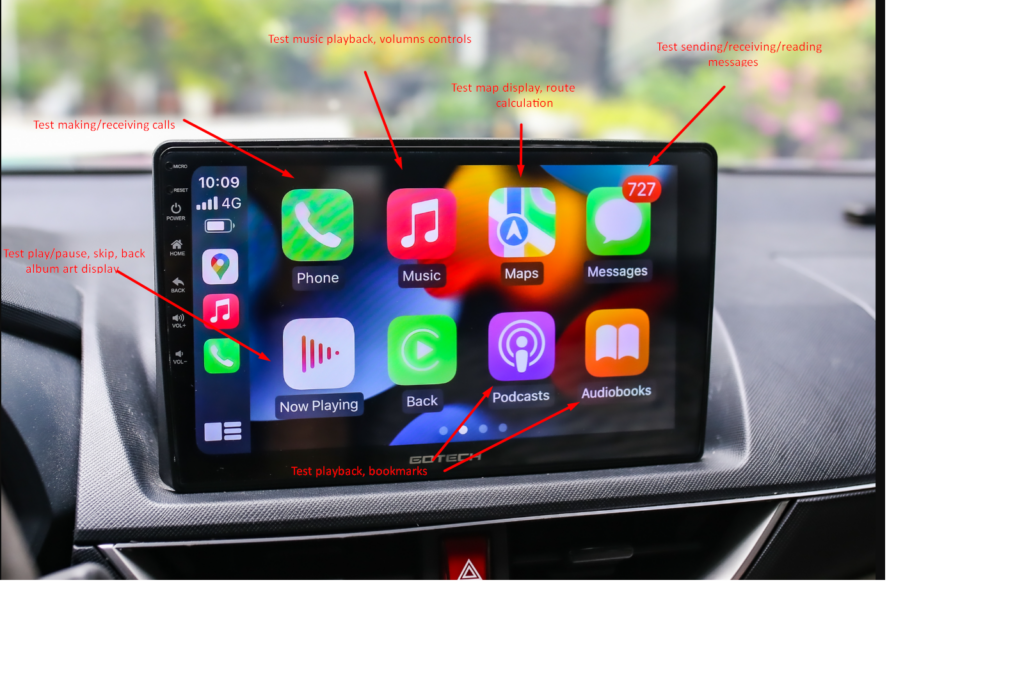
Example of testing the car infotainment system (testing will be performed on a hardware simulator)
2. Difference between Web/Applications Testing and Embedded Testing
| Aspect | Web/Applications Testing | Embedded Testing |
| Scope of Testing | Focuses on the software application only | Focuses on both software functionalities and hardware behaviors |
| Testing Environment | Runs in browsers, servers, emulators, mobile devices | Runs on embedded boards, MCUs, sensors, hardware simulations |
| Testing type | Functional testing and usability testing | Interaction between software and hardware, real-time performance |
| Testing Methods | Can be manual or automated | Mostly manual, automation limited due to hardware constraints |
| Testing of database | Database can be tested | Not applicable in most embedded systems |
| Automation Feasibility | It can be manual or automated. | It is majorly manual. |
| Testing time | Usually faster, can be tested on staging servers, simulators, or real devices. | Usually slower, requires testing on real hardware under real-world conditions. |
| Cost | Generally lower, mainly requires computers and virtual environments. | Can be higher due to hardware/tools but manageable with simulations or existing hardware |
3. Essential skills for beginner Embedded Software Testers
Basic understanding of hardware
- Become familiar with the main hardware components, such as chips, sensors, memory, and circuit boards.
- Understand how software communicates with and controls these components.
Understanding how Embedded Systems work
Key concepts including:
- Firmware
- Drivers
- RTOS (Real-Time Operating System)
- Interrupts
These concepts help identify issues and test systems effectively.
Familiarity with communication protocols
- Embedded devices use protocols such as UART, SPI, I2C, CAN.
- Important for detecting data transmission or communication issues
Strong knowledge of software testing fundamentals
Core tester skills are still important:
- Writing test cases
- Knowing testing techniques (boundary, equivalence, state-based…)
- Regression testing
- Reporting bugs clearly
4. Conclusion
Both Web/Applications Testing and Embedded Testing aim to ensure the quality and reliability of a product, but they differ in focus. Software Testing focuses on software that runs in standard environments, while Embedded Testing covers both software and hardware to ensure they work smoothly together in specialized systems
Understanding these differences is important for testers, as each type of testing requires different tools and approaches. With more software being integrated with hardware across industries, it’s crucial to know when and how to apply each type of testing for the best results.