


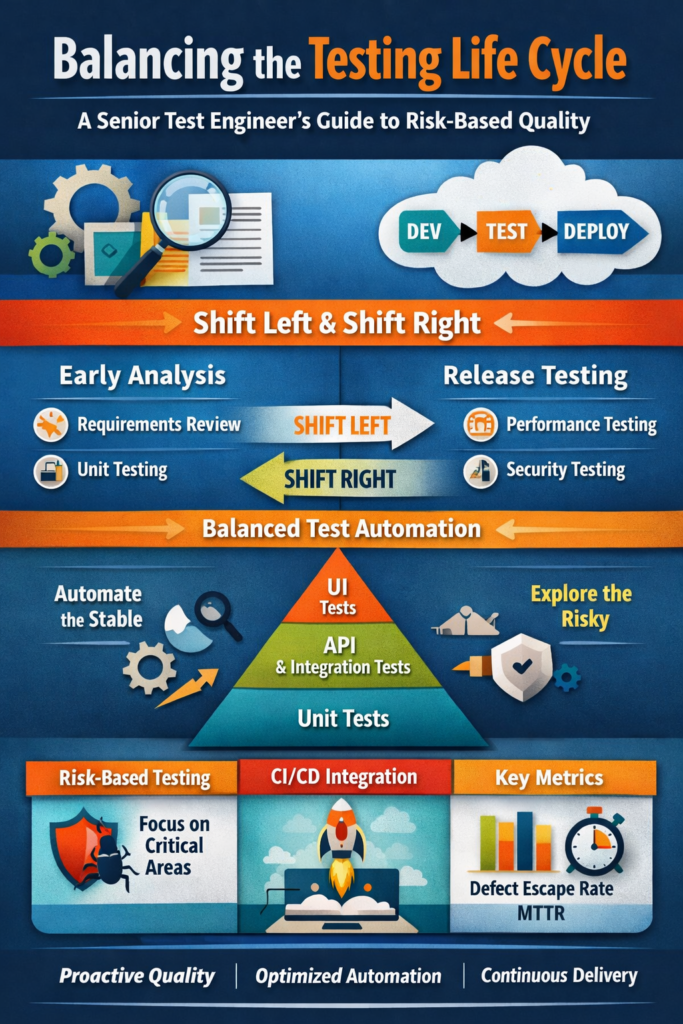
Balancing the testing life cycle is a critical responsibility for senior test engineers operating in modern software delivery environments. As systems grow more complex and release cycles accelerate, an unbalanced testing life cycle quickly becomes either a bottleneck or a source of hidden risk.
This article explores how balancing the testing life cycle through risk-based decisions, intelligent automation, and outcome-focused metrics enables sustainable quality without slowing delivery.
Why Balancing the Testing Life Cycle Matters
Balancing the testing life cycle means aligning testing effort, depth, and timing with business and technical risk. When testing is either too late, too heavy, or too shallow, teams experience:
- Late defect discovery
- Low confidence releases
- Unstable CI/CD pipelines
- Inefficient automation maintenance
Senior test engineers must treat the testing life cycle as a continuous quality system, not a final validation phase.
Balancing the Testing Life Cycle as a Continuous System
Alt text: balancing the testing life cycle across CI/CD stages
Rather than thinking in phases, balancing the testing life cycle requires designing fast and reliable feedback loops across:
- Requirements and design validation
- Development and integration testing
- System, performance, and release validation
In one SaaS organization (40+ microservices), restructuring testing into continuous feedback loops reduced Mean Time to Detect defects from 5 days to under 24 hours, primarily by improving early integration visibility.
Metric to monitor:
Mean Time to Detect (MTTD) defects across environments
Shift Left Without Losing Right-Side Confidence
Alt text: balancing the testing life cycle with shift-left and shift-right testing
Shifting left is essential, but senior test engineers know that balancing the testing life cycle means preserving validation where real risks still emerge.
High-value early testing includes:
- Requirement ambiguity reviews
- Acceptance criteria refinement
- Architecture testability analysis
A payments team that introduced structured requirement reviews reduced requirement-related defects by 32% across three releases.
However, integration failures, performance regressions, and UX issues still appear late and require intentional right-side testing.
Reference:
ISTQB guidance on risk-based testing: https://www.istqb.org/certifications/risk-based-tester
Balancing the Testing Life Cycle Through Automation Strategy
Alt text: balancing the testing life cycle using a test automation pyramid
Automation is not a goal—it is a portfolio. A balanced automation strategy typically follows the test pyramid model advocated by Google and others.
Recommended distribution:
- 60–70% unit and component tests
- 20–30% API and service tests
- Less than 10% end-to-end UI tests
One team reduced UI automation by 40%, cutting pipeline execution time from 90 minutes to 35 minutes, while improving test reliability.
Further reading:
Google Testing Blog on balanced test automation: https://testing.googleblog.com/2015/04/just-say-no-to-more-end-to-end-tests.html
Risk-Based Testing Is Core to Balancing the Testing Life Cycle
Balancing the testing life cycle requires intentional imbalance based on risk.
Examples:
- Deeper testing for revenue-critical flows
- Focused performance testing on externally exposed services
- Minimal automation for low-impact administrative features
An e-commerce platform that focused non-functional testing on checkout and payment flows reduced production incidents by 45% without increasing test effort.
Related internal reading:
- How We Apply Risk-Based Testing in CI/CD: https://aqua-cloud.io/test-prioritisation-strategies-for-cds/
- Choosing the Right Test Levels for Microservices: https://testkube.io/blog/cloud-native-microservices-testing-strategies
Balancing the Testing Life Cycle in CI/CD Pipelines
Testing should enable flow, not block it.
Balanced CI/CD pipelines typically include:
- Sub-10-minute feedback at commit stage
- Parallel test execution
- Risk-based quality gates
By splitting tests into commit, merge, and pre-release suites, one organization reduced blocked deployments by 28%.
Recommended reading:
Martin Fowler on Continuous Integration: https://martinfowler.com/articles/continuousIntegration.html
Metrics That Support Balancing the Testing Life Cycle
Avoid vanity metrics. Balanced testing focuses on outcomes, not activity.
High-signal metrics include:
- Escaped defects per release
- Mean Time to Resolution (MTTR)
- Production rollback frequency
- Coverage of critical business scenarios
Research-backed guidance:
DORA / Accelerate metrics from DevOps Research: https://www.devops-research.com/research.html
Related internal article:
- Test Metrics That Actually Matter:
https://yourcompany.com/test-metrics-that-matter
Senior Test Engineers Own Balance, Not Just Testing
Balancing the testing life cycle is a leadership responsibility.
Senior test engineers:
- Coach developers on test design and failure analysis
- Partner with product owners on risk prioritization
- Use data to justify quality investments
This shared ownership model allows quality to scale without scaling headcount.
Conclusion: Balancing the Testing Life Cycle Is a Competitive Advantage
Balancing the testing life cycle enables faster releases, clearer risk visibility, and higher confidence decisions. For senior test engineers, success is measured by confidence per unit of time, not test volume.
Organizations that master balancing the testing life cycle move from reactive quality control to proactive quality engineering—turning testing into a strategic advantage.
Additional References
- Agile Testing Quadrants – Agile Alliance: https://www.agilealliance.org/glossary/agile-testing-quadrants/
- ThoughtWorks Technology Radar – Testing Practices: https://www.thoughtworks.com/radar