


In modern software architectures—especially those built around microservices—API Gateway has become a foundational component. While often misunderstood as “just a router,” an API Gateway plays a far more strategic role in scalability, security, and system governance.

What Is an API Gateway?
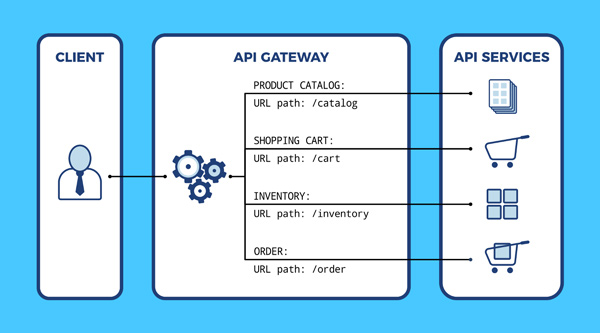
An API Gateway is a centralized entry point that handles all incoming API requests from clients and routes them to the appropriate backend services.
Instead of clients calling individual services directly, they interact with a single endpoint—the API Gateway—which manages cross-cutting concerns on their behalf.
High-level flow:
Client → API Gateway → Backend Services
Core Responsibilities of an API Gateway
1. Request Routing
- Routes requests based on URL paths, HTTP methods, headers, or versions.
- Abstracts internal service topology from external clients.
Example:
- /api/users → User Service
- /api/orders → Order Service
- /api/payments → Payment Service
2. Authentication and Authorization
- Validates JWTs, OAuth2 tokens, or API keys.
- Enforces role-based or scope-based access control.
- Prevents unauthorized access before requests hit backend services.
This avoids duplicating authentication logic across every service.
3. Rate Limiting and Throttling
- Protects systems from abuse or traffic spikes.
- Applies limits per user, per IP, or per API.
- Improves system reliability and cost control.
Example:
- 100 requests/minute per user
- 1,000 requests/hour per API key
4. Request and Response Transformation
- Modifies headers or payloads.
- Translates protocols (REST ↔ gRPC).
- Aggregates multiple service calls into a single response.
This is especially useful for mobile or frontend applications that require optimized payloads.
5. Observability and Monitoring
- Centralized logging
- Metrics (latency, error rate, throughput)
- Distributed tracing integration
An API Gateway provides a single point of visibility into how APIs are consumed.
6. Security and Protection
- SSL/TLS termination
- IP whitelisting and blacklisting
- Web Application Firewall (WAF) integration
- Hides internal services from direct internet exposure
Why API Gateways Matter
Without an API Gateway:
- Clients must know about every backend service.
- Authentication, logging, and rate limiting are duplicated.
- Security policies are inconsistent.
- Changes in backend architecture break clients.
With an API Gateway:
- Clients remain stable while backend services evolve.
- Cross-cutting concerns are centralized.
- Teams can move faster with clearer boundaries.
API Gateway vs Load Balancer
Aspect Load Balancer API Gateway Primary Role Traffic distribution API management Layer L4 / L7 L7 (Application) Auth & Security Minimal Built-in Request Transformation No Yes Rate Limiting Limited Advanced A load balancer distributes traffic.
An API Gateway controls and governs APIs.
Common API Gateway Patterns
1. Microservices Entry Point
All external traffic goes through the gateway, keeping services internal and protected.
2. Backend for Frontend (BFF)
Different gateways per client type:
- Web BFF
- Mobile BFF
- Partner BFF
Each gateway tailors responses to client needs.
Popular API Gateway Solutions
Cloud-Managed
- AWS API Gateway
- Azure API Management
- Google Cloud API Gateway
Open-Source / Self-Hosted
- Kong
- NGINX / NGINX Plus
- Traefik
- KrakenD
The right choice depends on scale, budget, operational maturity, and cloud strategy.
When You Should NOT Use an API Gateway
- Very small systems or early-stage MVPs
- Simple monoliths with limited external exposure
- Teams without operational capacity to manage another critical component
An API Gateway introduces operational complexity—use it intentionally.