


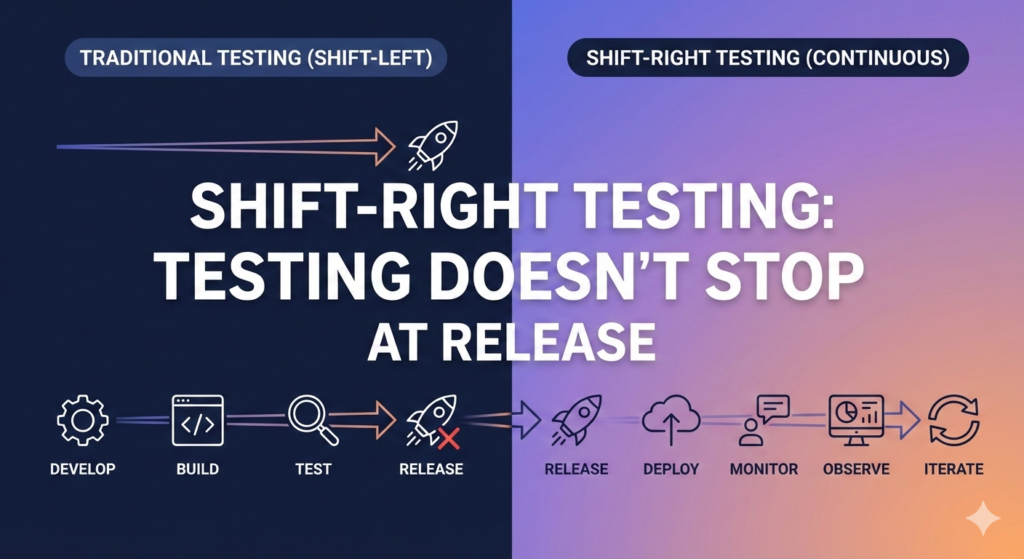
In the previous blog, we talked about Shift-Left testing, focusing on preventing problem early by testing closer to planning and coding.
But let’s be honest, shift-left can’t predict everything. Real users, real traffics, and real production environments always behave differently.
That’s why this blog looks to the other side of the timeline. If shift-left is about preventing issues early, shift-right testing is about learning from the reality and modern teams need both.
Why Shift-Right Testing Matters
Shift-right testing matters because real users and real environments rarely behave the way we expect. Once software goes live, teams start noticing real user habits, sudden traffic spike, and environment issues that no pre-production test can fully capture. These real-world signals create a natural feedback loop, helping teams learn and improve continuously. When combined with shift-left testing, shift-right fills in the gaps catching issues early and learning from what actually happen after release.
Core Activities in Shift-Right Testing
Shift-right testing is all about observing, learning, and improving after your code is live. Unlike shift-left, which focuses on preventing bugs early, shift-right ensures your systems stay resilient and user-friendly in the real world.
Monitoring and Observability
Monitoring and observability help teams understand what’s actually happening in production, not just what they expect to happen. Popular industry tools, for example: Datadog, New Relic, Prometheus with Grafana, or Splunk, make it easier to spot performance issues early and fix them before the users start complaining.
Understanding User Behaviour and Customer Experience(CX)
Even automated tests can’t predict how real users behave. Popular industry tools, for example: Google Analytics, Hotjar, or FullStory, help teams see the real usage patterns and quickly spot UX issues that only show up after release.
Resilience and Stress Testing
Real systems need to survive failures and traffic spikes, not just normal days. Technique like chaos engineering (with Gremlin or Chaos Monkey) and stress/load testing (JMeter, Locust) put systems under controlled pressure so they can strengthen resilience before real incidents happen.
Synthetic Monitoring
Synthetic monitoring keep checking critical user journeys, even when no one is actively using the system. Popular industry tools, for example: Pingdom, Uptrends, or Dynatrace Synthetic, act like an early warning system when something starts to break.
Production-Safe Experimentation
Shift-right testing isn’t about risky release, it’s about learning safely. Techniques like canary releases and A/B testing allows teams to release changes gradually and learn safely. Popular industry tools, for example: Optimizely or LaunchDarkly, support controlled experimentation.
Example: The new feature is released to a small group of users first. Early results look positive, so the rollout is expanded with confidence.
Conclusion
Shift-right testing is essentially about seeing the system through the eyes of real users and production conditions. By combining observability, behavioral insights, stress validation, synthetic monitoring, and safe experimentation, teams can deliver more stable, resilient, and user-friendly applications.
Reference
https://blog.nashtechglobal.com/unleashing-the-power-of-shift-right-testing-in-software-development
https://blog.nashtechglobal.com/shift-right-testing-elevating-quality-assurance-in-live-environments
https://blog.nashtechglobal.com/real-time-production-testing-with-checkly-from-setup-to-execution
https://blog.nashtechglobal.com/chaos-engineering-in-shift-right-testing
Other Internet resources