


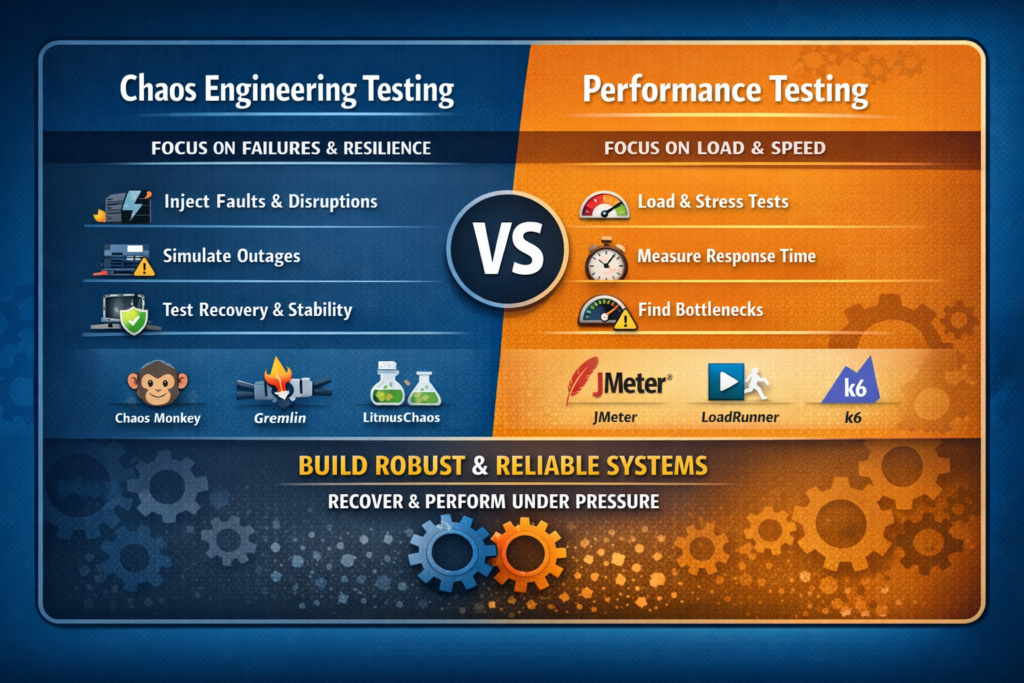
In modern software systems, ensuring both reliability and performance is critical. Applications today run in distributed, cloud-based, and microservices architectures where failures are inevitable and user expectations are high. Two important testing practices that help address these challenges are Chaos Engineering Testing and Performance Testing.
Although both aim to strengthen system robustness, they focus on different risks, answer different questions, and are applied at different stages of the delivery lifecycle. This blog explores their differences and explains when each type of testing should be performed.
1. What is Chaos Engineering Testing?
Chaos Engineering Testing is the practice of intentionally injecting failures into a system to validate its resilience and recovery capabilities. Instead of waiting for incidents to happen in production, teams proactively simulate failures to understand how the system behaves under real-world disruptions.
The core goal is to build confidence that the system can withstand unexpected conditions without causing major outages or data loss.
2. Key characteristics of Chaos Engineering Testing
- Focus on resilience, fault tolerance, and recovery
- Introduces controlled failures such as:
- Shutting down services or nodes
- Simulating network latency or packet loss
- Breaking dependencies (e.g., database or third-party APIs)
- Helps uncover hidden weaknesses that are difficult to detect through traditional testing
- Improves incident response, monitoring, and alerting
3. When to Perform Chaos Engineering Testing?
Chaos Engineering is most effective when applied to production-like or even live environments, with proper safeguards in place. Typical scenarios include:
- Ensuring high availability for business-critical systems
- Validating resilience in microservices and cloud-native architecture
- Testing disaster recovery and failover mechanisms
- Verifying system behavior before major releases or infrastructure changes
- Improving confidence in auto-scaling, self-healing, and redundancy mechanisms
Chaos Engineering is not about causing outages—it’s about learning how to prevent them.
4. What is Performance Testing?
Performance Testing evaluates how a system behaves under expected and extreme workloads. It ensures that an application meets defined performance benchmarks for speed, responsiveness, stability, and scalability.
The objective is to confirm that the system can handle user demand without slowdowns, failures, or unacceptable response times.
5. Key Characteristics of Performance Testing
- Measures key metrics such as: Response time, Throughput, Resource utilization (CPU, memory, network)
- Identifies performance bottlenecks and capacity limits. Includes several testing types:
- Load Testing – expected user traffic
- Stress Testing – beyond normal capacity
- Scalability Testing – growth handling
- Endurance (Soak) Testing – long-running stability
6. When to Perform Performance Testing?
Performance Testing is typically conducted before production deployment, but it should also be repeated whenever system behavior might change. Common use cases include:
- Before releasing applications to production
- Ahead of high-traffic events (e.g., Black Friday, marketing campaigns)
- During capacity planning and scalability assessments
- After infrastructure changes such as:
- Database upgrades
- Cloud migrations
- Architecture refactoring
Performance Testing answers the question: “Can the system handle the load?”
7. Key Differences Between Chaos Engineering Testing and Performance Testing
Performance Testing focuses on load. Chaos Engineering focuses on failure.
| Items | Chaos Engineering Testing | Performance Testing |
| Goal | Identify failure points and improve system resilience | Measure application speed, scalability, and stability |
| Focus | Unexpected failures and outages | System response under different loads |
| Testing Method | Introduces deliberate disruptions (e.g., killing services, breaking networks) | Simulates high traffic, stress, and endurance |
| When to Apply | In production-like environments for failure recovery testing | During development and pre-production to ensure optimal performance |
| Tools | Chaos Monkey, Gremlin, LitmusChaos, Azure Chaos Studio | JMeter, LoadRunner, K6 |
8. Required for / Not recommended for
| Items | Chaos Engineering Testing | Performance Testing |
| Required for | – Business-critical and revenue-impacting systems – Microservices and distributed architectures – Cloud-native, containerized, or auto-scaling platforms – High-availability (24/7) applications – Systems with multiple third-party integrations – Disaster recovery and failover validation – Organizations with mature DevOps/SRE and strong monitoring | – High user load (e.g. large-scale enterprise systems serving several thousands of internal users; applications serving a thousand or more external users) – High traffic events, data volume/transactions (e.g. sales events, admission season, online examination, media publishing & streaming, etc.) – Have critical performance criteria (e.g. real-time data OR business-critical system) – Have specific performance required by client (e.g. response time, CCU, throughput, etc.) |
| Not recommended for | – Early-stage or unstable applications – Systems without proper logging, monitoring, or alertsSimple or low-risk standalone applications – Teams without incident response readiness – Projects with very limited time or budget | – Small scale application (e.g. limited user load, simple functionality) – Early development stage (e.g. Prototype or MVP) – Informational websites for news, magazines without complex functionality – Scope of works that do not have direct impact on system performance (e.g. data migration, application only showing information from other systems) |
9. Can we combine Performance Testing and Chaos Engineering Testing?
Yes. Combining Performance Testing and Chaos Engineering helps teams validate not only how fast a system is, but also how well it survives and recovers under stress and failure.
Performance Testing measures an application’s speed, stability, and scalability under load, while Chaos Engineering intentionally injects failures (e.g., resource or network issues) to evaluate system resilience. Combined, they provide a deeper view of system robustness. After establishing a performance baseline, chaos experiments are run under load to verify whether the system can maintain performance, recover automatically, and meet SLAs during disruptions—ensuring real production readiness.
How to Choose the Right Test?
- If our concern is user experience under peak traffic → Performance Testing
- If our concern is outages and recovery → Chaos Engineering
- If our system is cloud-native, high-traffic, business-critical → Both
10. Conclusion
To build reliable, scalable, and user-friendly systems, organizations need both Performance Testing and Chaos Engineering Testing.
- Performance Testing ensures applications deliver a smooth and responsive experience under expected and peak loads.
- Chaos Engineering Testing ensures systems can survive failures, recover quickly, and minimize business impact.
By understanding the purpose of each approach and applying them at the right time, teams can significantly reduce outages, improve user satisfaction, and maintain long-term system stability.