


Definition
Multivariate testing (MVT) is essentially a more complex form of A/B testing, in which the changes are made on combinations of multiple page elements. Every combination is a new version which is assigned evenly split traffic and tested against the original version. The purpose of this testing is to determine which combination is more effective.
This type of testing is the best choice for evaluating the impact of UI revamp on a webpage rather than focusing on only one element at a time.
Websites and mobile applications are composed of various changeable components. An MVT test changes multiple elements at the same time, for example, a picture and a headline. Testing is conducted concurrently on multiple variants of the content, such as three variations of the headline and two variations of the image. By this, MVT testing not only identifies the best-performing combination but also helps analyze interaction effects between elements, which cannot be observed in traditional A/B testing.
An example of multivariate testing
Observation:
On a desktop application home page, there is a call-to-action (CTA) which is underperforming. The marketing team wants to improve clicking rate, but they are not sure what is causing the issue: the button color, the button label text or the combination of any elements? So, they decide to make changes to the combinations to see which will increase user clicks.
Experiment Design:
Colors: The team decides to change button colors from blue to red and green
Button label text: The wording will be changed to Proceed, instead of Start.
When it builds to test, there will be:
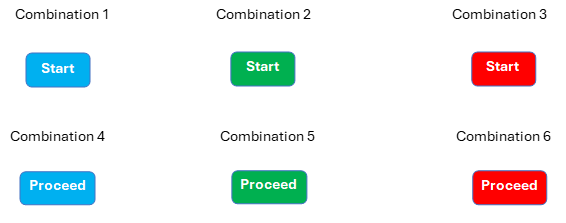
- The original version of the combination is: Start + Blue button
New combinations for multivariate test:
- Start + Green button
- Start + Red button
- Proceed + Green button
- Proceed + Red button
- Proceed + Blue button
The total number of versions for MVT testing is 6.
How it looks on UI:
Calculation of total number of variations in multivariate testing
Total number of variations = [# of Variations on Element A] x [# of Variations on Element B] x … x [# of Variations on Element n]
In multivariate testing, the number of variations grows exponentially as more elements and options are added. As a result, the traffic requirement increases rapidly to achieve statistically significant results.
Key characteristics of multivariate testing
- Allows multiple page elements to be tested simultaneously.
- Larger sample sizes are required compared to A/B testing.
- It offers insights into interactions between elements.
- Ideally use for optimizing critical pages without full redesign.
- Useful for interpreting complex user behavior patterns.
Differences between multivariate testing and A/B testing
| Aspect | A/B testing | MVT |
| Number of variants tested | One at a time | Multiple |
| Traffic requirements | Lower traffic | High |
| Setup complexity | Simple and straightforward | Highly complex |
| Website/Application size | Suite for smaller websites/applications | Suite for larger size of websites/applications |
| Goal of testing | To determine the winning version when making a major change | To refine and optimize specific elements on a page |
| Conversion baseline | Less dependent on a highly stable baseline; can work even with moderate baseline data | Requires a stable and reliable baseline to accurately measure impact across many combinations |
| Experiment maturity | Reaches maturity faster due to fewer variants and simpler setup | Takes longer to mature due to high number of combinations and larger sample size requirements |
Multivariate practical execution checklist
Multivariate Testing (MVT) is powerful but it’s only if we do it right. Below is a simple checklist to keep on track:
Define a Clear Goal
- Set one main metric, for example: conversion rate.
- Add a few supporting metrics if needed
Create a Hypothesis
- Example: Changing CTA color will increase clicks because it stands out more
Check Your Baseline
- Make sure your current conversion rate is stable
- Avoid testing during unusual traffic spikes
Limit Combinations
- Too many variations = not enough data
- Keep it simple and manageable
Split Traffic Evenly
- Each combination should get similar traffic
- Ensure enough sample size per variant
Track & QA Carefully
- Double-check tracking (events, conversions)
- Test all combinations before launch
Monitor the Test
- Watch for bugs or uneven traffic
- Don’t change anything mid-test
Wait for Maturity
- Run long enough
- Reach statistical significance
- Ensure results are stable
Learn, Not Just Win
- Identify why something works
- Look at impact of each element
Apply & Iterate
- Launch the winner
- Document insights
- Plan the next test
In short: Stable baseline + enough data + patience = reliable MVT results
Risks & Limitations of multivariate testing
1. High traffic requirement
- Traffic is split across many combinations
Risk: insufficient data per variant
2. Longer time to reach experiment maturity
- Needs more time for reliable results
3. Complex setup & analysis
- Harder to design, QA, and interpret
4. Sensitive to unstable baseline
- Fluctuating data can distort results
5. Risk of over-testing
- Too many variables → noisy, unusable insights
When not to use multivariate testing
Given the above risks and limitations of MVT, we should avoid using this testing method in the following situations:
1. Low Traffic
- MVT splits traffic across many combinations
- If traffic is low → each variant gets too little data
Result: Inconclusive or misleading results
2. Unstable Conversion Baseline
- If your conversion rate is fluctuating (seasonality, campaigns, bugs)
Result: You can’t trust comparisons between variations
3. Early-Stage Testing
- When you don’t yet know what works at all
Use simpler tests (like A/B) first to find big wins before refining
4. Major Redesigns
- If you’re testing completely different layouts or concepts
MVT is for fine-tuning, not big changes
5. Limited Time
- MVT needs more time to reach experiment maturity
If you need quick results → MVT is not ideal
6. Limited Resources
- Requires:
- Strong tracking setup
- Careful QA
- Deeper analysis
Without this → high risk of errors
7. Too Many Variables
- Testing too many elements at once without enough traffic
Leads to noise instead of insights
Basic terminologies in multivariate testing
While MVT is an integral part of A/B testing, the method has its own set of terminology that anyone working with it should be familiar with.
- Combination: It refers to the total number of different combinations that can be formed when testing multiple variable options across various placements. In this context, the sequence or permutation of choices is irrelevant. For example, if your homepage experiment includes three elements and each element has three variations, you will end up with 27 distinct combinations (3 × 3 × 3). Each visitor who enters the experiment is exposed to a single combination—often called an experience—during their visit to the website.
- Content: Any text, visual, or component included in an experiment. In multivariate testing, multiple variations distributed across a webpage are evaluated simultaneously to determine which mix performs most effectively. In MVT, content is sometimes described as a level rather than content.
- Location: A location indicates a page or a specific area on the website, where you run optimizations.
- Control: A Control refers to the original version of the page, component, element or content which you’re planning for MVT testing. In A/B testing, it represents the A. For example, if you want to test how it performs on your homepage’s banner image, the original or existing banner image will be the “control.” Some experienced optimizers are also referred to the control as the “Champion”.
- Goal: One or more events used to evaluate the success of a multivariate test, such as improving content engagement or generating leads.
- Confidence Level: The degree of certainty regarding the reliability of an experiment’s results.
- Conversion Rate: The percentage of unique visitors who enter a conversion funnel and complete a desired action, such as becoming paying customers.
- Element: An individual component on a page, such as a form, text section, image, or call-to-action button.
- Experiment: A method used to measure and compare the performance of one or more page’s elements.
- Hypothesis: A testable assumption that predicts an outcome based on a specific problem and supporting data. For example, insights from past experiments and heatmaps or scrollmaps analysis may suggest that adding banner and text CTAs at regular intervals on a guide page could increase content leads and MQLs.
- Non-Conclusive Results: Outcomes that do not lead to a clear conclusion from an experiment. Such results do not indicate test failure, but rather a lack of actionable learning.
- Qualitative Research: The process of collecting and analyzing non-numerical customer data to understand perceptions, opinions, and user experiences.
- Quantitative Research: The analysis of numerical data from analytics to uncover visitor behavior patterns and generate statistical insights.
- Visitors: Unique individuals or entities who access a website or landing page, counted once regardless of how many visits they make.