


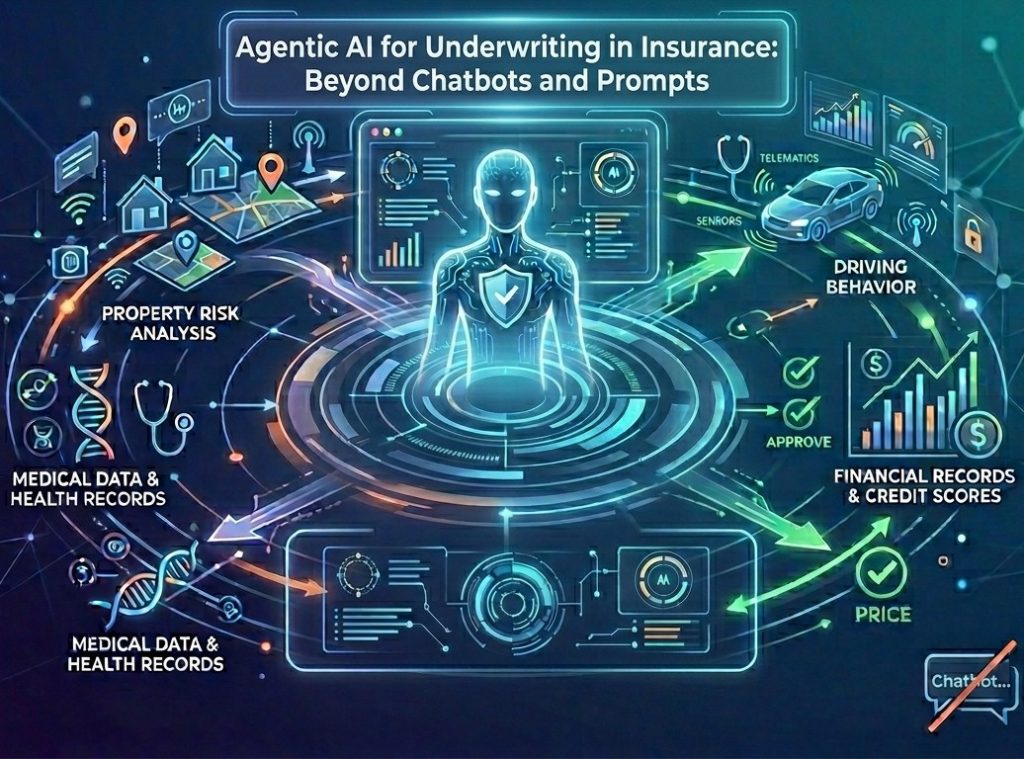
Since the inception of GenAI, insurance companies have been experimenting with Large Language Models (LLMs) – mostly in the form of chatbots for answering policy questions or assisting customer support. While these experiments have resulted in an impressive jump in customer engagement, they lack when applied to the underwriting process, as a whole.
That’s because, underwriting is not a single task, it’s a structured decision process involving:
- Risk evaluation
- Pricing judgement
- Regulatory compliance
- And, fairness considerations
Hence, treating it as a “conversation problem” can lead to legal, financial, and reputational consequences.
This blog touches three key areas of underwriting in insurance domain:
- Why underwriting is fundamentally complex?
- Why Single‑LLM approaches (chatbots) fail?
- And, why Agentic (Multi‑Agent) AI is a more realistic path forward?
Why Underwriting is Fundamentally Complex?
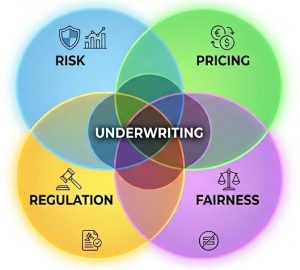
As we can see, insurance underwriting sits at the intersection of risk, pricing, regulation, and fairness.
This means, every time an underwriting decision is made, it must balance all four, i.e.,
- Risk assessment – Evaluating the probability and impact of loss based on historical data and disclosed information.
- Pricing – Translating risk into premiums that remain competitive while maintaining profitability.
- Compliance – Adhering to jurisdiction‑specific regulations that often change over time.
- Fairness – Ensuring decisions do not introduce bias or discrimination, intentionally or non-intentionally.
The process get exponentially more complex when the data is fragmented, i.e,:
- Policy documents are unstructured.
- Risk data comes from multiple internal and third‑party sources.
- Regulatory rules vary across regions and products.
Human underwriters manage this complexity through years of experience and specialization. Moreover, no single person can evaluate everything in isolation. Hence, expecting a single AI model (agent) to do so, reliably, is unrealistic.
Why Single‑LLM approaches (Chatbots) fail?
Single‑model (LLM) GenAI solutions typically rely on increasingly complex prompts. In underwriting, this approach fails fast. Because of:
1. Overloaded Prompts
A single underwriting prompt(s) often try to integrate:
- Risk rules
- Product guidelines
- Pricing constraints
- And, regulatory considerations
all under one instruction (prompt). With time, as prompt(s) grow, behavior becomes less reliable.
2. Hallucinations
When an LLM (single AI Agent) is unsure, it doesn’t say “I don’t know“. Surprisingly, it confidently generates plausible‑sounding outputs, which represents an unacceptable failure mode for a highly regulated decision‑making process like underwriting.
3. Poor Explainability
Regulators and internal auditors never accept anything as-is, let alone a model’s output. Since, a single‑LLM output(s) lack traceable (chain-of-thought) reasoning, making it difficult to justify its decisions (output).
4. Compliance Risk
A single-LLM is like a monolithic application, i.e., crossing multiple decision domains. This increases the blast radius of any failure. One hallucination can violate everything – pricing rules, fairness constraints, regulatory mandates, and product guidelines, simultaneously.
In short, single‑LLM systems are monolithic, opaque, and fragile – a total opposite of what is required for a solid underwriting process.
What “Multi‑Agent AI” Really Means?
Multi‑agent AI is often mistaken as “multi-models interacting with each other“. Whereas, in reality, that’s not the real case.
True agentic AI is about specialization and responsibility separation, not just conversation, where each agent:
- Has a clearly defined role
- Operates with limited, relevant context
- Produces focused outputs
- And, can be validated independently
This mirrors how underwriting teams work today, i.e.,
- Risk analysts assess exposure
- Pricing teams define premiums
- Compliance teams review constraints
- And senior underwriters review final decisions.
Multi‑agent AI brings the same structure into an AI‑driven system(s).
Mapping Underwriting Roles to AI Agents
Instead of a single “super‑model”, Agentic AI decomposes underwriting into different cooperating roles:
- Risk Assessor Agent – Evaluates applicant risk factors using historical data and disclosed information.
- Policy Evaluator Agent – Interprets eligibility rules, exclusions, and coverage constraints from product guidelines.
- Pricing Analyst Agent – Translates assessed risk into premium recommendations within defined bounds.
- Compliance Reviewer Agent – Ensures decisions comply with regulatory and fairness requirements applicable to the jurisdiction.
Each agent produces a bounded and explainable insights. Finally, a reviewer (human or AI) evaluates the combined output.
This approach helps in reducing hallucinations, improving traceability, and aligning with existing underwriting governance models.
When not to Use Multi‑Agent AI?
Multi‑agent systems are powerful – but they are not always required.
We can avoid them when:
- Underwriting decisions are purely rule‑based
- Products are low‑risk and high‑volume
- Turnaround time requirements don’t justify the orchestration overhead
In these cases, a simple rule-engine(s) or simpler ML models (like single AI Agent) can work just right.
In Summary
Underwriting has always been a collaborative decision process. Agentic AI doesn’t replace that fact – it simply respects it.
However, there are still some key concerns remaining, like:
- How do agents share context without overexposure?
- How is orchestration handled safely?
- Where do human reviews fit?
- How is auditability enforced?
Since, these are architectural concerns and not prompt‑engineering tricks. Hence, in our next blog, we will focus on designing a production‑ready multi‑agent underwriting architecture using Amazon Bedrock, with governance, reasoning, and cost in mind. So, stay tuned 🙂