


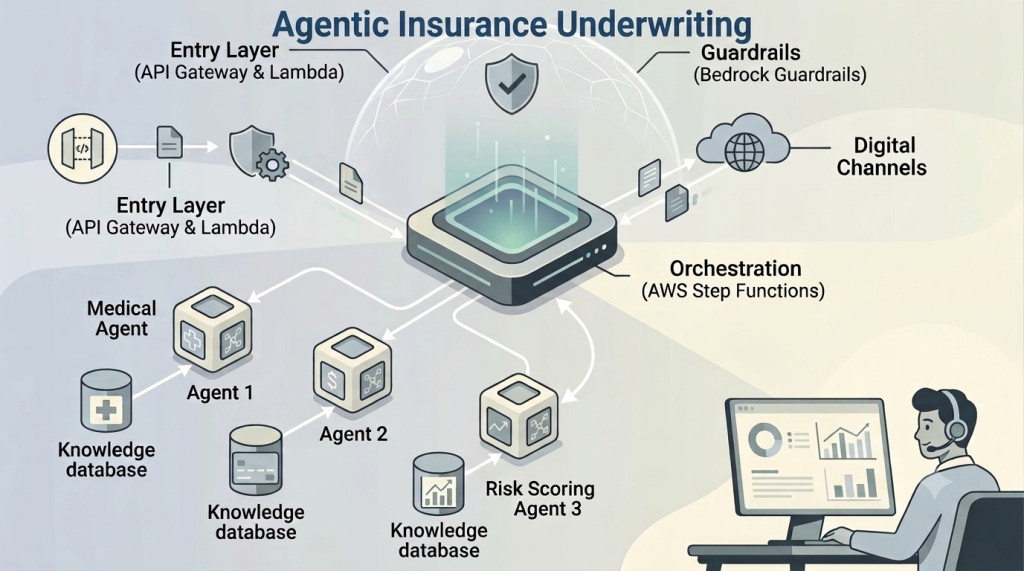
In the previous blog, Agentic AI For Insurance Underwriting: Beyond Chatbots and Prompts, we established why underwriting (in insurance) requires Agentic (multi‑agent) AI rather than a single (monolithic) LLM. We went through the inherent complexity of underwriting decisions and why chatbot‑style implementations fail in regulated environments.
In this blog we will focus on the next stage of Agentic-AI for Insurance Underwriting, i.e.,:
How do we design an Agentic-AI (multi‑agent) underwriting system that is scalable, explainable, and production‑ready?
The goal here is not to deep dive into any code, but to establish a clear mental model of the system:
- How agents are structured?
- How they collaborate?
- And why Amazon Bedrock is a strong fit for regulated underwriting workloads?
Underwriting Workflow (Recap)
An underwriting decision is not a single step – it is a sequence of coordinated evaluations. At a high level, a modern underwriting workflow looks like this:
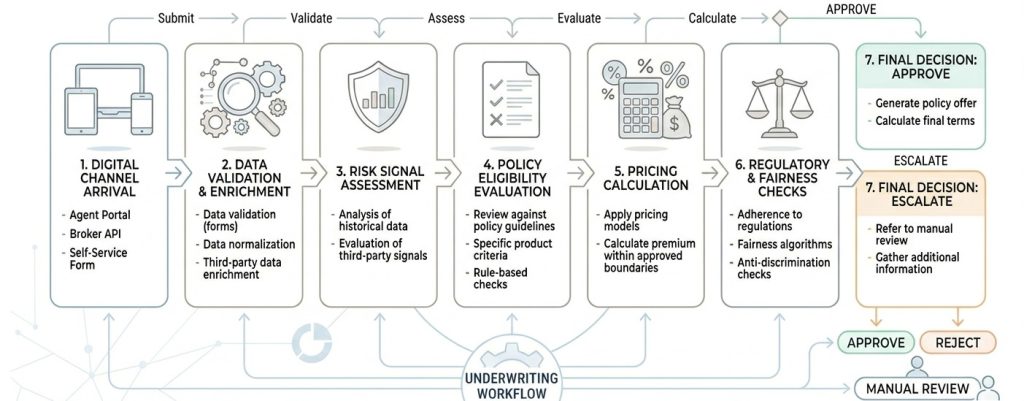
Usually, different teams own each step. A multi‑agent AI architecture reflects that reality by decomposing underwriting logic into focused, cooperating agents instead of a single decision‑making brain.
Agent Roles & Responsibilities
A well‑designed underwriting system defines clear agent boundaries, with each agent having a single responsibility, limited context, and testable output(s).
I. Application Understanding Agent
Context:
- Parses raw application input (structured/unstructured).
- Normalizes applicant information.
- Flags missing or inconsistent data.
Purpose: Create a clean and consistent underwriting context.
II. Risk Assessment Agent
Context:
- Evaluates loss probability and exposure.
- Leverages historical underwriting outcomes and risk signals.
- Produces a risk score and rationale.
Purpose: Quantify risk without pricing or policy bias.
III. Policy (Eligibility) Agent
Context:
- Interprets product rules, exclusions, and endorsements.
- Determines whether the applicant qualifies for coverage.
- Identifies constraints and required conditions.
Purpose: Ensure coverage decisions align with product guidelines.
IV. Pricing Agent
Context:
- Translates assessed risk into premium recommendations.
- Operates within approved pricing corridors.
- Flags pricing anomalies or edge cases.
Purpose: Balances risk‑based pricing with profitability.
V. Fairness/Compliance Agent
Context:
- Evaluates jurisdiction‑specific regulatory rules.
- Detects potential bias or discriminatory patterns.
- Ensures explainability requirements are met.
Purpose: Reduce regulatory and reputational risk.
VI. Reviewer / Senior Underwriter Agent
Context:
- Consumes outputs from all other agents.
- Challenges inconsistencies and unsupported assumptions.
- Determines approval, rejection, or escalation.
Purpose: Act as the final quality and accountability gate.
Amazon Bedrock Reference Architecture
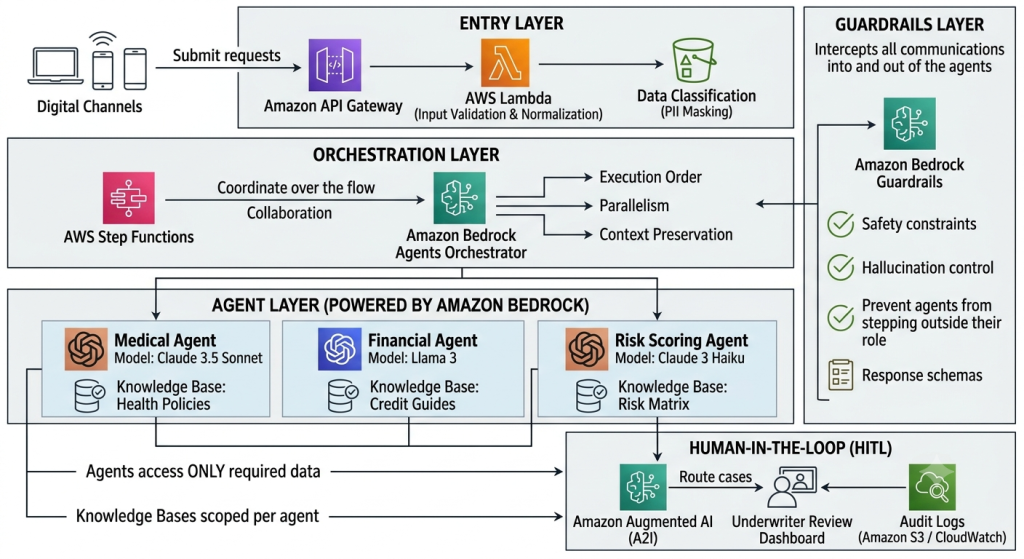
Let’s understand the architecture in detail:
- Entry Layer: Digital channels submit underwriting requests and validates input. Also, classify (or mask) sensitive data like PII.
- Orchestration Layer: This layer controls collaboration across Amazon Bedrock agents, without embedding any intelligence.
- Agent Layer: This layer is solely powered by Amazon Bedrock, where each agent has its own foundation model and knowledge base.
- Guardrails Layer: By enforcing response format and safety guidelines, this layer prevents agents stepping outside their scope.
- Human-in-the-Loop: High risk decisions and continuous improvement of Agentic AI underwriting process require a human underwriter’s feedback.
Note: Above-mentioned architecture is for reference only. Since, each use case is different, hence, before adapting any architecture it should be reviewed thoroughly.
Why Amazon Bedrock fits Underwriting?
Amazon Bedrock is not just an LLM hosting service, it provides a lot of other useful features too, which makes it fit for developing an intelligent underwriting process:
- Foundation Model Choice per Agent: Amazon Bedrock offers flexibility of choosing reasoning‑optimized model for policy agent versus cost‑efficient model for a data extraction agent.
- Isolation by Design: All agents are isolated by design. This limits the impact of any failure by any agent during the underwriting process.
- Governance/Auditability: Easy integration with IAM, logging, and Chain-of-Thought (CoT) agents, allows regulatory audits without retrofitting.
In-Summary
Agentic AI succeeds in automating underwriting not because it is smarter, but because it is structured like the systems underwriting already trusts.
This blog showcased:
- How underwriting agents collaborate
- How Amazon Bedrock enables safe orchestration
- And, how governance is built in the architecture, via Amazon Bedrock, and not bolted on
The upcoming blogs in this series will focus on operationalizing the architecture. Basically covering governance, cost control, bias management, and real‑world lessons learned when moving from design to production. So, stay tuned 🙂