


Insurance underwriting has always been a data-driven discipline. Underwriters rely on information from different sources, like:
- Policy administration systems
- Claims platforms
- Credit bureaus
- Inspection reports
- And, third-party risk providers.
They do this to assess risk and make informed decisions. However, while the volume and variety of available data have increased dramatically, many insurers continue to depend on fragmented legacy systems that make it difficult to transform data into actionable insights.
As the industry moves toward real-time risk assessment, which involves:
- AI-assisted underwriting
- And, data-driven decision-making
Insurers need a modern architecture that can unify multi-dimensional data sources while supporting advanced analytics at scale. This is where the Lakehouse architecture (powered by Delta Lake) becomes a game changer.
Traditional Underwriting Data Challenge
Insurance organizations have become one of the top investors in technology, over the last decade. While these systems serve critical business functions, they often operate in silos, creating challenges for underwriting teams.
I. Policy Administration Systems
Policy systems remain a primary source of customer and policy information. They contain details such as:
- Policyholder demographics
- Coverage information
- Premium history
- Policy endorsements
- Renewal records
Even though these systems are rich in business context, these systems are optimized for transactional processing rather than analytical workloads. Hence, extracting historical trends from policy administration systems data can be slow and cumbersome.
II. Claims Management Systems
Claims experience is one of the strongest indicators of risk. Hence, underwriters frequently require access to:
- Claim frequency
- Claim severity
- Loss ratios
- Fraud indicators
- Litigation history
Unfortunately, claims data often resides in its own silo, managed by different business teams. This makes reconciling policy and claims information a highly time-consuming exercise.
III. Third-Party Risk Vendors
Modern underwriting heavily depends on external data sources, like:
- Credit scores
- Property valuation services
- Catastrophe risk models
- Geospatial risk data
- Vehicle telematics providers
Since, each vendor supplies data in their own format and have their own delivery mechanisms. Hence, integrating these datasets into a single underwriting workflow can be expensive and time-consuming.
Why Data Silos Slow Underwriting Decisions?
For instance, an underwriter is evaluating a commercial property application. To assess the application, the underwriter may need to:
- Review policy history in the policy administration system.
- Analyze past claims from a separate claims platform.
- Retrieve catastrophe scores from an external vendor.
- Examine engineering inspection reports stored in document repositories.
- Validate address information using a geospatial service.
Each step involves switching systems, waiting for data retrieval, and manually correlating information. This fragmented process introduces several challenges, like:
- Increased Decision Time: When critical data is scattered across systems, underwriters spend more time gathering information than analyzing risk.
- Inconsistent Risk Assessment: Different teams may rely on different datasets, leading to inconsistent underwriting outcomes.
- Limited Visibility: Without a 360o view of customer and portfolio data, insurance organizations struggle to identify future risks.
Data Warehouse vs. Data Lake vs. Delta Lake
Before discussing Lakehouse architecture, it is important to understand the difference between different data platforms.
| Feature | Traditional Data Warehouse | Data Lake | Delta Lake |
|---|---|---|---|
| Primary Purpose | Structured reporting and business intelligence | Low-cost storage for large volumes of raw data | Unified analytics platform combining reliability and scalability |
| Schema Approach | Schema-on-write (data must conform before loading) | Schema-on-read (schema applied during query time) | Schema enforcement with flexibility and governance |
| Data Quality Controls | Strong | Limited | Strong, with built-in validation and schema enforcement |
| Transaction Support | ACID compliant | Lacks ACID guarantees | Full ACID transaction support |
| Historical Data Tracking | Limited | Limited | Built-in time travel and versioning |
| Scalability | Moderate to high | Very high | Very high |
| Storage Cost | High | Low | Low to moderate |
Lakehouse Architecture (Recap)
Lakehouse architecture combines the strengths of data warehouses and data lakes into a unified platform. Instead of maintaining separate systems for:
- Reporting
- Data science
- Machine learning
Organizations can leverage a single architecture that supports all these workloads.
Key Characteristics
- Scalability – The platform can handle everything from daily underwriting reports to petabyte-scale catastrophe modeling exercises.
- Governance & Reliability – Delta Lake ensures data consistency through transaction management and schema controls.
- AI/ML Readiness – The same datasets used for underwriting analytics can also support predictive risk models, fraud detection systems, and generative AI applications.
Lakehouse for Insurance Underwriting
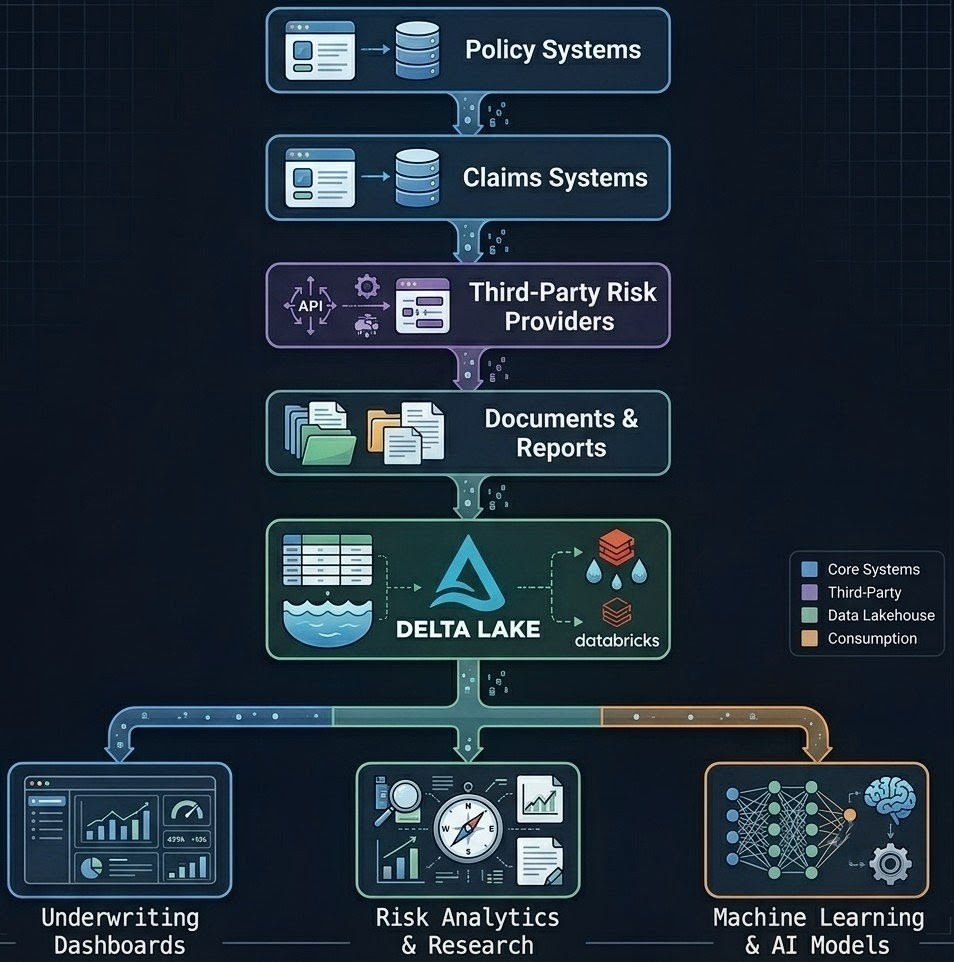
A typical underwriting Lakehouse architecture may look like the following:
Value to Market
The value of a Delta Lake extends beyond technology modernization.
- Faster Underwriting Decisions – Centralized data reduces investigation time and accelerates policy issuance.
- Improved Risk Selection – Underwriters gain access to richer datasets and more comprehensive risk insights.
- Better Regulatory Readiness – Versioned and governed datasets improve traceability and auditability.
In Summary
Insurance underwriting is becoming extensively data-centric, everyday. However, many insurance providers still remain constrained by fragmented legacy systems that makes it extremely difficult to derive meaningful insights from their datasets.
Delta Lake offers a modern approach to overcoming these challenges. By consolidating structured, semi-structured, and unstructured data into a governed and scalable platform, insurance underwriters can achieve faster underwriting decisions, improved risk assessment, and advanced analytics capabilities.
In the upcoming article(s) of this series, we’ll explore how insurance providers can build a 360o risk profile using Delta Lake, bringing together policy, claims, customer, and third-party data into a single source of truth for underwriting decisions. So stay tuned 🙂