


PART 1: The Orchestration Architecture of Modern AI Systems
Introduction: Peeking Inside the AI “Black Box”
To most users, interacting with Artificial Intelligence seems straightforward: you type a prompt, wait a few seconds, and receive a coherent response. This seamless experience often creates the illusion that Large Language Models (LLMs) are monolithic, all-knowing entities operating in isolation.
In reality, modern production-grade AI has evolved far beyond a single model answering prompts. Today’s systems are highly modular orchestrations of specialized components, including Autonomous Agents, Sub-agents, and standardized communication layers like the Model Context Protocol (MCP).
Understanding this internal machinery is crucial for developers, prompt engineers, and tech enthusiasts. This article breaks down the technical lifecycle of an AI request—tracing its journey from initial prompt reception to tool execution and final response generation.
The Multi-Agent Orchestration Workflow
When a complex request enters a modern AI system, it undergoes a structured pipeline divided into discrete operational phases. Instead of sending raw user text directly to the core LLM, the system deploys a network of specialized components.
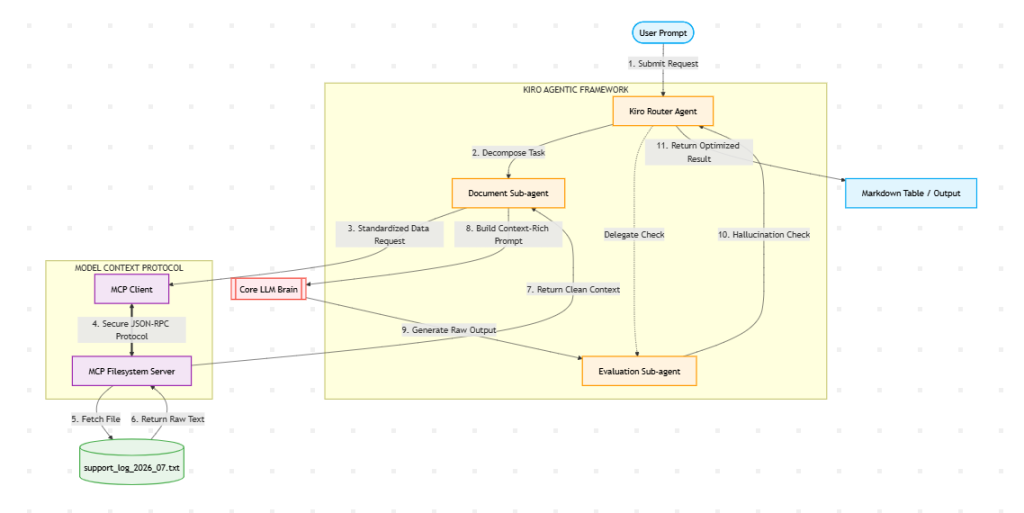
Phase 1: Parsing and Intent Analysis (The Router Agent)
The entry point of the system is the Router Agent (or Orchestrator). Its primary objective is not to solve the problem, but to understand it.
- It analyzes the user’s intent.
- It evaluates the complexity of the request.
- It determines whether the request can be answered using static knowledge or if it requires external data and tools.
Phase 2: Task Decomposition (Sub-agents)
If a prompt is multi-layered (e.g., “Analyze our Q2 sales spreadsheet, cross-reference it with market competitor data, and draft an executive summary”), a single LLM call will often fail or hallucinate.
The Router Agent breaks down the massive task into smaller, manageable sub-tasks. It then delegates these to specialized Sub-agents. One sub-agent may be optimized solely for mathematical parsing, while another excels at semantic synthesis or web-scraping.
Phase 3: Context Enforcement via MCP
Before the core LLM can reason over the request, it needs raw data. This is where the system encounters a traditional bottleneck: how can an isolated AI model securely read local files, query production databases, or call third-party APIs without custom, messy code for every single tool?
The Model Context Protocol (MCP) solves this by acting as an open, universal standard connection. It provides an architecture where:
- MCP Clients (the AI Agents) can make uniform requests.
- MCP Servers (the data connectors) safely expose local files, databases, or API tools.
Through MCP, the sub-agents gather the precise, real-time context needed to fulfill their specific sub-tasks.
Phase 4: Core Processing and Reasoning (The LLM)
Once the data is retrieved via MCP, the system constructs a Context-Rich Prompt. This payload contains the original user request alongside the exact, verified data retrieved by the sub-agents.
The Core LLM (the central “brain”) finally receives this structured bundle. Because it does not have to guess or search its own outdated training weights for the facts, its full computational capacity is utilized purely for what it does best: reasoning, synthesizing, and formatting.
Phase 5: Synthesis and Guardrails
The output from the Core LLM is routed back to the supervising Orchestrator Agent. The system verifies the output against predefined guardrails (checking for data formatting, hallucination indicators, or safety protocols) before compiling the pieces into a single, polished response returned to the user.
Conclusion to Part 1: Moving Beyond Static Prompts
By decoupling reasoning from data access, this modern orchestration architecture fundamentally changes how we deploy AI. The core LLM is no longer expected to know everything or execute every task blindly. Instead, it operates as a centralized processor, guided by a network of specialized sub-agents and fed with secure, real-time data via the Model Context Protocol (MCP).
Understanding this blueprint is the first step toward moving away from basic, hit-or-miss prompting and moving toward reliable, deterministic AI systems that can actually get work done.
But how does this theoretical architecture translate into a live development environment? How do autonomous agents adapt when a file is too large, or when tools return unexpected errors?
In Part 2 of this series, we will move from blueprint to execution. We will look under the hood of Kiro, an advanced agentic framework, and walk through a practical, step-by-step case study: automating the breakdown and summarization of a massive enterprise chat log using live MCP connections. Stay tuned.
Reference: https://modelcontextprotocol.io/docs/getting-started/intro