


Building an impressive AI model is no longer the hardest part of software engineering. However, the real challenge lies in deploying that model in production without blowing through your budget. Consequently, many teams struggle to maintain a seamless user experience due to high network latency.
Every AI architect eventually faces the same dilemma: Speed vs. Cost.
For instance, if you route every single AI inference request to massive cloud instances, your latency will skyrocket. Moreover, your monthly cloud bill will inevitably terrify finance. On the other hand, if you push every workload directly to the device, you will quickly hit severe hardware constraints. As a result, the solution isn’t simply picking one environment. Instead, it requires mastering the delicate balance between Cloud, Fog, and Edge architectures.
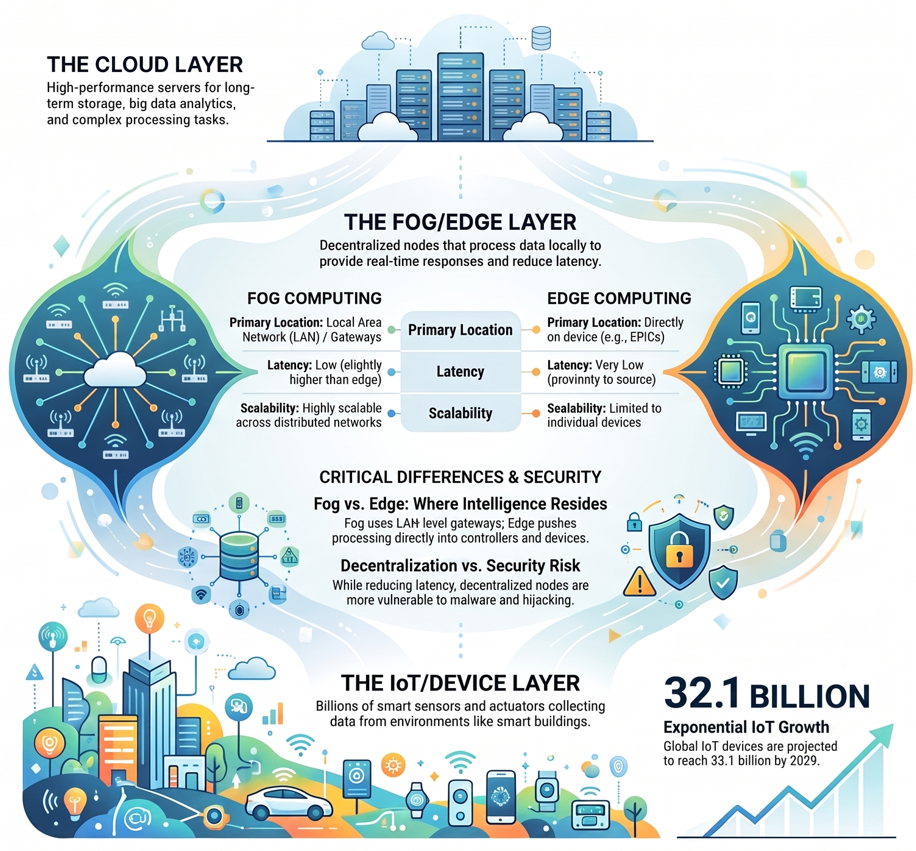
Here is the strategic playbook on how to balance the triad for cost-effective, high-speed AI.
The Architectural Breakdown: Cost vs. Speed
To successfully implement AI cost and speed optimization, you must first understand the economic trade-offs of each architectural layer. Specifically, each tier offers distinct advantages and constraints.
| Layer | Latency (Speed) | Operational Cost (OpEx) | Capital Cost (CapEx) | Primary AI Role |
| Cloud AI | High (100ms – Seconds) | High (Per-token/GPU hourly fees) | Low (Pay-as-you-go) | Heavy Training, Global RAG, Complex LLMs |
| Fog AI | Medium (10ms – 50ms) | Medium (Local maintenance) | Medium (Gateway hardware) | Data Filtering, Multi-Agent Orchestration |
| Edge AI | Ultra-Low (<10ms) | Near Zero (Local execution) | High (Upfront device cost) | Instant Inference, Computer Vision, Anomalies |
Cloud AI: The High-Cost Powerhouse
The cloud gives you unmatched compute power, but it comes with a heavy “bandwidth tax” and high recurring operational expenses (OpEx).
- The Cost Trap: Every gigabyte of raw data sent to the cloud incurs network egress fees. Every API call to a closed-source model or an idle cloud GPU instance drains cash.
- The Latency Bottleneck: No matter how fast your model is, network round-trips are bound by physics. If your AI needs to make a decision in milliseconds, the cloud is inherently too slow.
Fog AI: The Financial & Network Shock Absorber
Fog nodes (localized servers, regional gateways) act as a smart buffer. By processing data from a cluster of local devices, Fog AI stops unnecessary traffic from reaching the cloud.
- The Speed Advantage: It coordinates local assets within a Local Area Network (LAN), dropping latency significantly compared to the cloud.
- The Cost Optimization: Instead of paying to stream 100 raw video feeds to a cloud vision API, a local fog node aggregates, compresses, and filters the data—only sending critical anomalies upstream. This can slash cloud ingest costs by up to 80%.
Edge AI: The Zero-Marginal-Cost Reflex
Edge AI flips the script: high upfront capital expenditure (CapEx) for hardware (NPUs, specialized microcontrollers), but incredibly low operational costs (OpEx) over time.
- The Speed Advantage: Pure, sub-millisecond local inference. No internet connection required.
- The Cost Optimization: Once the hardware is deployed, running inference on an Edge chip costs nothing in network data transfer or cloud compute tokens. It is the ultimate way to scale user-facing AI inference sustainably.
The Optimization Playbook: Striking the Perfect Balance
How do you orchestrate these layers to achieve maximum speed at the lowest cost? Consider these architectural strategies:
1. The “Shift Left” Inference Strategy
Move your first-line AI inference as close to the data source (the Edge) as possible.
- How it works: Take your heavy cloud-trained models, compress them using techniques like quantization (e.g., converting FP16 to INT8), and deploy them directly onto Edge devices.
- The Result: You eliminate cloud token costs for standard requests and deliver instantaneous responses to the user.
2. Implementation of Smart Fog Gateways
Don’t let your Edge devices talk directly to the cloud if they can talk to a local coordinator first.
- How it works: Use a Fog layer to manage local multi-agent orchestration. Let local nodes handle immediate cross-device logic.
- The Result: Your cloud architecture transforms from a highly stressed transaction engine into an asynchronous analytics platform, massively reducing concurrent cloud connection costs.
3. Reserve the Cloud Only for Value-Add Tasks
Treat cloud compute as a premium resource.
- How it works: The Cloud should only handle tasks that genuinely require massive context windows or deep compute—such as asynchronous model fine-tuning, global vector database synchronization (RAG), and heavy historical batch processing.
Real-World Architecture in Action
Imagine an AI-powered Predictive Maintenance System across multiple smart factories:
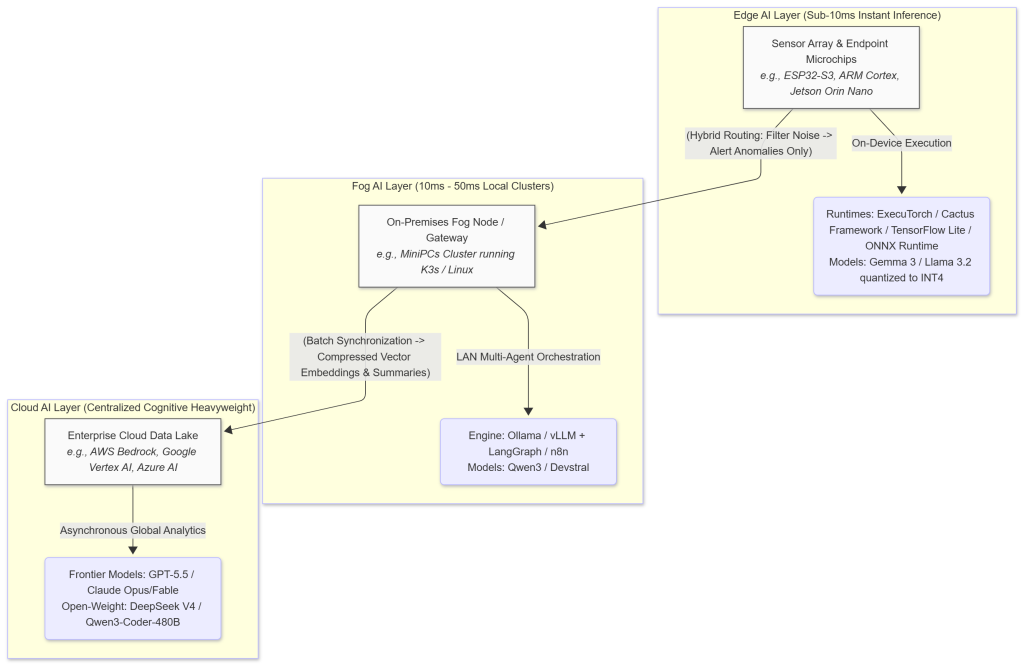
By keeping the high-frequency data loops local (Edge/Fog) and only sending high-value summaries upstream, the business achieves real-time safety guarantees while keeping cloud operational costs completely flat.