


Five years ago, RISC-V was mostly discussed in universities, research labs, and a handful of open hardware communities. Today, it is steadily finding its way into AI cameras, industrial gateways, developer boards, robotics platforms, and low-power edge servers. That shift reflects something much bigger than the rise of another processor architecture—it signals a change in how we think about deploying AI outside the data center.
While large language models continue to dominate headlines, the next wave of AI is increasingly happening closer to where data is generated: factory floors, surveillance cameras, autonomous robots, home labs, smart appliances, and industrial IoT devices. Running AI in these environments requires a very different set of design priorities than running workloads inside hyperscale cloud infrastructure.
This is where RISC-V is becoming increasingly relevant. Rather than competing solely on raw CPU performance, it offers architectural flexibility that aligns remarkably well with the unique demands of Edge AI.
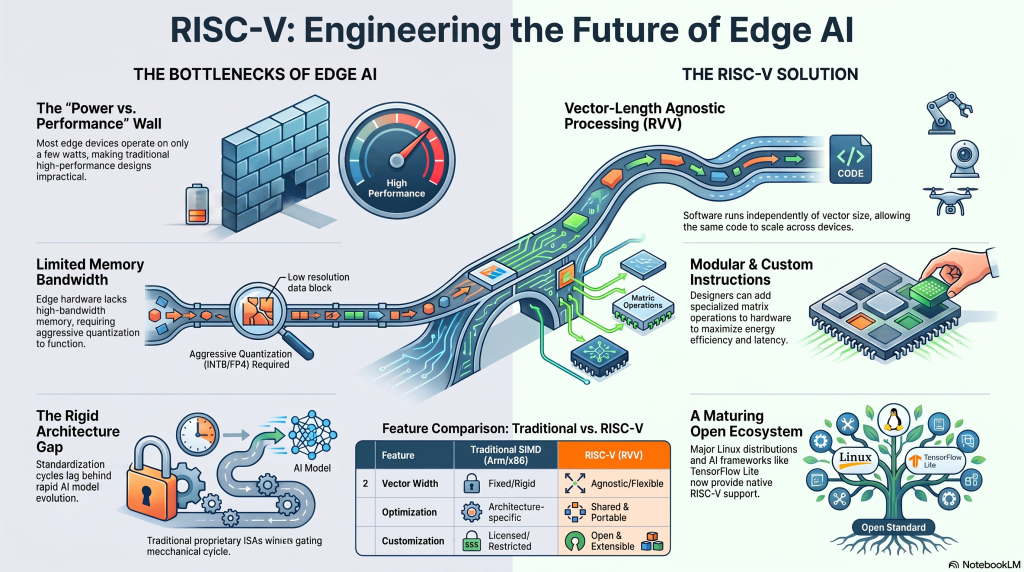
The Real Bottlenecks of Edge AI
Deploying machine learning models at the edge is fundamentally different from deploying them in the cloud. Hardware designers must balance strict constraints around power, cost, memory, and thermal limits while still delivering acceptable inference performance.
Some of the biggest challenges include:
- Limited memory bandwidth. Edge devices rarely have access to high-bandwidth memory (HBM). Efficient quantization techniques such as INT8, INT4, and FP4 become essential for reducing model size and improving throughput.
- Tight power budgets. Many edge systems operate within only a few watts—or even rely on battery or harvested energy. Designs that maximize peak performance at the expense of power efficiency are often impractical.
- Hardware-software integration. Deploying models compiled from frameworks such as PyTorch or TensorFlow Lite frequently depends on proprietary SDKs, vendor-specific compilers, or closed optimization pipelines.
Traditional processor architectures were designed primarily as general-purpose computing platforms. While they continue to evolve, extending them with workload-specific instructions often requires long standardization cycles or commercial licensing agreements. That can make hardware innovation significantly slower than the pace at which AI models evolve.
RVV: A Different Way to Think About Vector Processing
One of the most important developments for RISC-V in AI is the maturation of the RISC-V Vector Extension (RVV).
Unlike traditional SIMD instruction sets such as Intel AVX or Arm NEON, RVV is vector-length agnostic. Instead of assuming a fixed register width, software expresses operations independently of the underlying vector size.
Traditional SIMD follows this model:
128-bit registers
↓
Software is written for a fixed vector width.
Supporting wider vectors often requires recompilation or architecture-specific optimizations.
RVV takes a different approach:
Vectorized application
↓
Hardware determines the available vector length at runtime.
This separation between software and hardware offers an important advantage. A single RVV-enabled implementation can execute across processors with different vector lengths, provided they implement compatible ISA profiles. Developers spend less time maintaining architecture-specific optimization paths while hardware vendors remain free to innovate internally.
Imagine deploying the same object detection pipeline across three different products:
- a battery-powered smart camera
- an industrial gateway
- a compact edge AI server
With traditional SIMD architectures, each platform often requires its own optimization strategy. With RVV, much of that optimization effort can be shared while still allowing each processor to utilize its available vector resources.
Custom Instructions for Domain-Specific AI
Perhaps the most distinctive aspect of RISC-V is its modular instruction set architecture.
The base ISA remains stable, while standardized and custom extensions can be added when necessary. This gives chip designers considerably more flexibility than traditional proprietary ISAs.
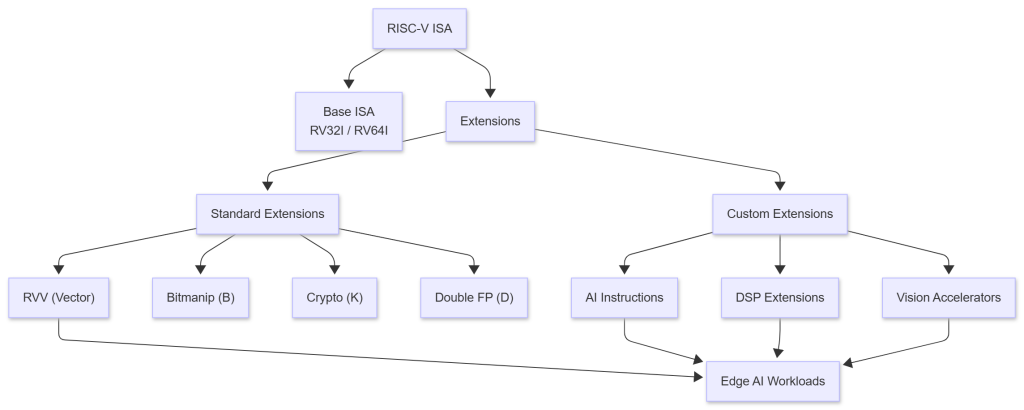
Suppose an inference workload spends a significant amount of time performing specialized matrix operations or activation functions. Rather than implementing those operations entirely in software, hardware designers can introduce custom instructions or tightly coupled accelerators that execute these workloads more efficiently.
Instead of adapting software to fixed-function hardware, RISC-V makes it practical to adapt hardware to the workload itself. For edge devices where every milliwatt matters, that flexibility can translate into meaningful improvements in both energy efficiency and latency.
The Software Ecosystem Has Grown Up
For years, one of the biggest criticisms of RISC-V was its immature software ecosystem. That criticism is becoming less convincing as the ecosystem continues to mature.
Several developments have accelerated adoption:
Linux Distributions
Major Linux distributions now provide increasingly mature RISC-V support, making it much easier to deploy production workloads on modern RISC-V platforms without extensive customization.
Compiler Infrastructure
LLVM and GCC continue to improve support for RVV and other standardized extensions, enabling developers to write portable, high-performance code using familiar toolchains.
AI Frameworks
Projects such as Apache TVM, MLIR, IREE, ONNX Runtime, TensorFlow Lite, and llama.cpp are steadily expanding their RISC-V support. Automated scheduling and compiler optimizations allow tensor operations to take better advantage of vector hardware without requiring developers to write architecture-specific assembly.
Rather than relying exclusively on vendor SDKs, developers increasingly have access to open-source inference stacks that can target multiple hardware platforms.
Why Open Hardware Matters
The growing interest in RISC-V is not only about performance.
It is also about control.
Hardware vendors can differentiate their products without waiting for ISA revisions. Researchers can experiment with new architectural ideas without negotiating licensing agreements. Startups can build specialized AI accelerators without the barriers traditionally associated with proprietary processor architectures.
This has helped foster a diverse ecosystem that includes companies such as SiFive, Andes Technology, Alibaba Xuantie, StarFive, SpacemiT, and Sophgo, each targeting different segments of the embedded and edge computing market.
As Edge AI becomes more specialized, architectural openness becomes increasingly valuable.
Final Thoughts
The future of Edge AI is unlikely to be defined by a single processor architecture. x86 will continue to dominate servers, and Arm will remain a major force across embedded and mobile computing.
However, RISC-V is establishing itself as an increasingly compelling alternative where customization, efficiency, and long-term flexibility matter most.
Its modular ISA, vector-length-agnostic processing model, and rapidly maturing software ecosystem make it well suited for the next generation of edge workloads—from industrial vision systems and autonomous robots to local LLM inference on compact home servers.
The real story is not that RISC-V will replace Arm or x86 overnight. Rather, it is changing the design trade-offs available to hardware and software engineers. In an era where AI models evolve faster than processor generations, an open and extensible architecture may prove to be one of the most important advantages of all.