


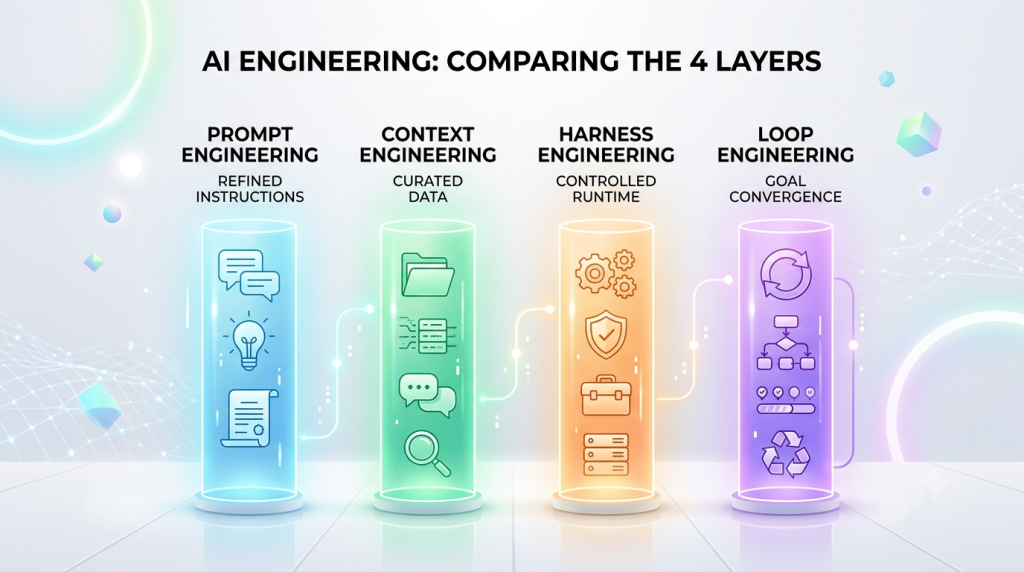
This article doesn’t discuss Graph Engineering; it’s quite new and there aren’t many clear illustrations yet.
In the early days of Generative AI, most of us focused on Prompt Engineering: how to write prompts that would get the model to produce the desired output. But as AI systems have become more sophisticated, especially AI agents capable of using tools, accessing data, and taking actions, prompts have become only a small part of a much bigger picture.
Today, the evolution of AI agents can be viewed as a progression:
Prompt Engineering → Context Engineering → Harness Engineering → Loop Engineering
The Four Layers of AI Agent Engineering
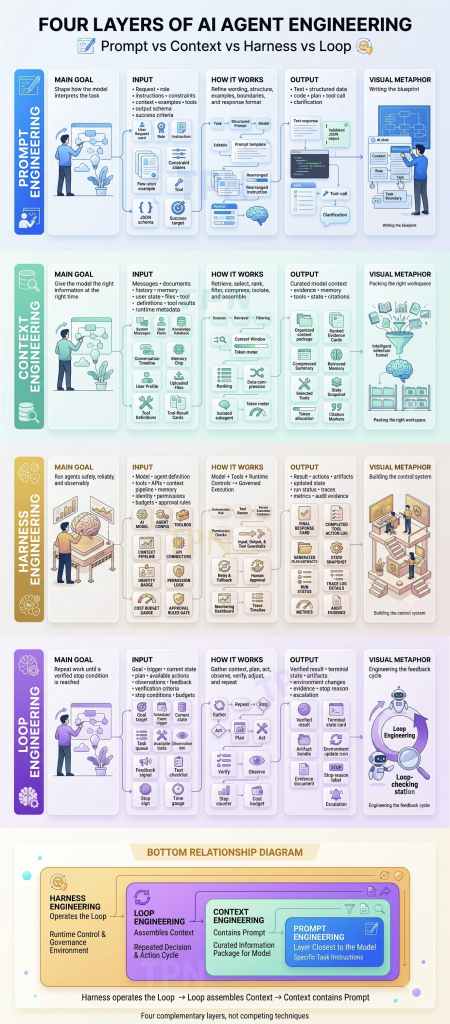
1. Prompt Engineering: Optimizing Communication with the Model
Prompt Engineering revolves around a simple question:
“How should we express a task so the model interprets it correctly?”
The focus is on designing:
- Roles and responsibilities
- Objectives
- Constraints
- Examples
- Output formats and schemas
This is the layer closest to the model itself. When the output quality is not satisfactory, the typical solution is to refine the prompt, improve instructions, or provide better examples.
Prompt Engineering is particularly effective for:
- Q&A tasks
- Summarization
- Translation
- Classification
- Content generation
- Structured data extraction
However, even the best prompt cannot help if the model simply doesn’t have access to the information it needs.
2. Context Engineering: Providing the Right Information at the Right Time
Once AI systems need to work with enterprise knowledge, conversation history, long-term memory, or external documents, the focus shifts beyond prompts and toward context.
The key question becomes:
“What information should the model see at this specific moment?”
Context Engineering is responsible for:
- Retrieving relevant information
- Selecting trustworthy sources
- Ranking and filtering content
- Compressing large amounts of information
- Combining memory, documents, and runtime state
If Prompt Engineering is about writing the assignment, Context Engineering is about preparing the entire reference package before handing the task to the model.
This discipline forms the foundation of:
- Enterprise search systems
- RAG-based assistants
- Customer support bots
- Personalized AI assistants
- Multi-turn conversational agents
3. Harness Engineering: Building the Operating System for AI Agents
When AI starts calling APIs, using tools, modifying files, or interacting with external systems, a new challenge emerges:
“Who manages all of these execution processes?”
This is where Harness Engineering comes in.
Harness Engineering focuses on building and operating the runtime environment around the model, including:
- Tool registries
- API integrations
- Runtime orchestration
- Permission controls
- Memory systems
- Logging and monitoring
- Retry and fallback mechanisms
- Human approval workflows
If Context Engineering prepares information for the model, Harness Engineering manages the entire ecosystem surrounding the model.
It is the layer responsible for:
- Safety
- Observability
- Recoverability
- Governance and auditing
In other words, Harness Engineering transforms a chatbot into a production-ready AI system.
4. Loop Engineering: Designing Autonomous Work Cycles
A truly capable AI agent does not think just once.
It needs to:
- Plan
- Act
- Observe results
- Verify outcomes
- Adapt
- Continue working
This cycle repeats until the goal is achieved.
That is the core idea behind Loop Engineering.
Rather than focusing on a single model call, Loop Engineering focuses on the entire execution cycle:
Plan → Act → Observe → Verify → Update → Repeat
This approach powers:
- Coding agents
- Research agents
- Automated troubleshooting systems
- CI/CD monitoring workflows
- Evaluator-optimizer architectures
The goal is no longer simply to generate a good answer, but to successfully complete a task.
How These Concepts Relate to Each Other
A common misconception is to treat these four disciplines as separate and independent.
In reality, they are layered on top of one another:
Harness
 └── Loop
      └── Context
└── Prompt- Prompt determines how the model thinks.
- Context determines what the model knows.
- Loop determines how work progresses.
- Harness determines how the entire system is operated and controlled.
Each outer layer expands and orchestrates the layers beneath it.
A Simple Way to Think About It
| Concept | Primary Focus |
|---|---|
| Prompt Engineering | Writing better instructions for the model |
| Context Engineering | Providing the right information to the model |
| Loop Engineering | Designing the work cycle that drives execution |
| Harness Engineering | Operating and governing the overall agent system |
If 2023 was largely the era of Prompt Engineering, today’s AI landscape is increasingly moving toward Context Engineering, Harness Engineering, and Loop Engineering. As AI agents become more autonomous and capable of acting in the real world, success depends less on crafting the perfect prompt and more on how we provide context, design execution loops, and build robust systems around the model. These disciplines together define what it takes to create reliable, production-grade AI agents.