


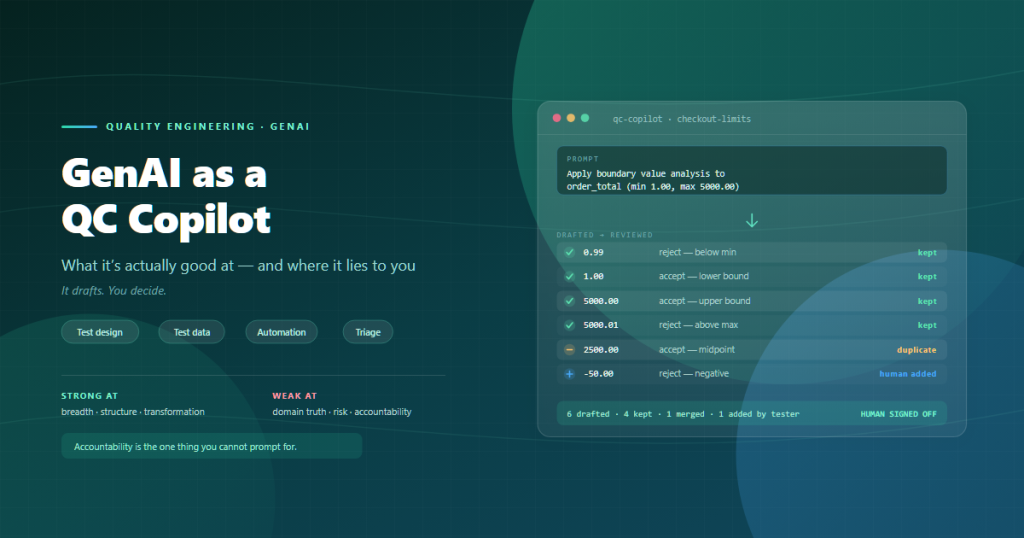
Every QC team I talk to is somewhere on the same curve. First the excitement (“it wrote 40 test cases in nine seconds”), then the hangover (“half of them tested the same thing and one referenced a field that doesn’t exist”), and finally – if the team sticks with it – something genuinely useful.
The teams that get value are not the ones with the best prompts. They are the ones who worked out which parts of their job GenAI is actually suited to, and put a review step everywhere else.
Here is my map of that territory.
What does “GenAI as a QC copilot” mean?
It means using a large language model as an accelerator inside your existing process, not as a replacement for it. The model drafts; you decide.
In practice it lands on four clusters of work:
- Test design – turning a user story or acceptance criteria into candidate scenarios, boundary values, equivalence partitions, decision tables, and the negative cases people forget.
- Test data generation – synthetic customers, edge-case strings, unicode and locale variants, realistic-but-fake PII, and payloads that satisfy a schema.
- Test implementation – scaffolding automation code from a scenario, converting a manual test into a script, writing the boilerplate around a page object or API client.
- Defect triage and communication – clustering duplicate failures, summarising a stack trace into a plain-language symptom, drafting a reproducible bug report, and writing the release-note version of a technical fix.
There is a fifth, quieter use that is arguably the highest value: as a critic. Paste your finished test plan and ask “what have I not covered, and what assumptions am I making?” It is a very good adversarial reviewer and a mediocre author.
Note the distinction: this is testing with AI. Testing of AI systems is a different discipline entirely.
Why does it matter?
The bottleneck was never typing. It was thinking of the scenario nobody thought of, and finding time to write the fortieth variation. GenAI is genuinely fast at breadth – enumerating combinations, permutations, and formats.
It attacks the boring 60%. Boilerplate, restructuring, format conversion, and summarisation are where testers lose hours that could go to exploratory testing and risk analysis.
It lowers the cost of a first draft. A mediocre draft you can critique in five minutes is more useful than a blank page you avoid for a day.
It breaks tester blind spots. We all have habitual patterns. A model trained on an enormous corpus will suggest the locale, timezone, and encoding cases you stopped thinking about years ago.
The skill gap is becoming visible. ISTQB now has a dedicated Testing with Generative AI certification. This is moving from “someone’s experiment” to an expected professional competence.
Refusing to engage is not neutral. Developers are already generating code with AI, at volume. If QC does not scale its thinking to match, the bottleneck simply moves to us.
Comparison: where it helps, where it hurts
| QC task | GenAI fit | Why | Human role |
| Brainstorming scenarios | Strong | Breadth and recall of patterns | Prune, prioritise by risk |
| Boundary / equivalence analysis | Strong | Mechanical, well-defined technique | Verify against real spec |
| Synthetic test data | Strong | Format-following is a core strength | Check realism and privacy |
| Boilerplate automation code | Strong | Common patterns, well represented | Review logic and locators |
| Converting formats (manual to Gherkin) | Strong | Pure transformation | Spot-check for drift |
| Summarising logs / stack traces | Strong | Compression is what it does best | Confirm the root cause |
| Drafting bug reports | Good | Structure and clarity | Supply the actual evidence |
| Duplicate defect clustering | Good | Semantic similarity | Final merge decision |
| Risk assessment / prioritisation | Weak | Needs business context it lacks | Own it entirely |
| Domain-specific business rules | Weak | Will confidently invent them | Own it entirely |
| Deciding release readiness | Not suitable | Accountability cannot be delegated | Own it entirely |
Compared to the alternatives:
- Manual authoring is still more accurate for anything domain-heavy – but far slower for breadth. GenAI wins on volume, loses on truth.
- Record-and-playback / low-code tools produce runnable artifacts immediately but only for paths you actually walked, and they generate brittle locators. GenAI reasons about what should be tested; recorders only capture what was done.
- Model-based testing gives mathematically complete coverage of a model you built by hand – high rigour, high effort. GenAI is the opposite trade-off: instant, broad, unverified.
- Traditional data generators (Faker, Bogus) are deterministic, free, and offline. Prefer them for bulk volume; use GenAI when you need semantically meaningful data – plausible support tickets, realistic addresses for a specific locale, believable product descriptions.
The honest summary: GenAI is the fastest way to a draft and the slowest way to certainty.
Best practices
Treat every output as a suggestion from a confident junior. Fast, well-formatted, occasionally wrong, and never accountable. Review accordingly – that review is the job now.
Give it context, not just an instruction. The single biggest quality jump comes from pasting the actual acceptance criteria, API schema, or error message rather than describing them. Vague prompt in, generic tests out.
Use a repeatable prompt structure. Role, context, task, constraints, output format, and an example. Store the good ones in a shared team library – prompts are test assets and deserve version control.
Ask for the technique by name. “Apply boundary value analysis and equivalence partitioning to this field, and list the partitions explicitly” outperforms “write tests for this field” every time. Your ISTQB vocabulary is a prompting superpower.
Constrain the output format. Request a table, Gherkin, or JSON matching your test-management import schema. It converts a wall of prose into something you can actually load and run.
Iterate rather than accept. The second prompt – “now add the negative and security cases,” “which of these are duplicates?”, “what did you miss?” – is where the real value appears.
Never paste what you cannot afford to leak. No production data, customer PII, credentials, or proprietary source unless you are on an approved enterprise tenant with training opt-out. Know your company’s policy before you open the tab.
Keep a human as the author of record. Someone’s name goes on the test plan. AI assistance is a tool disclosure, not a shift in accountability.
Measure whether it is actually helping. Track defect detection rate, escaped defects, and review effort – not “number of test cases generated.” Volume is the vanity metric of this era.
Start narrow and prove it. Pick one team, one use case, one sprint. A demonstrated win on test data generation will do more for adoption than any all-hands presentation.
Addressing common challenges
“It generates plausible nonsense.” That is hallucination, and it is a property of the technology, not a bug you can prompt away. Mitigate it: ground the model in real artifacts (spec, schema, code), ask it to cite which requirement each test traces to, and verify anything factual. If a generated test references a field, confirm the field exists before you trust the case.
“The tests are shallow and repetitive.” Usually a context problem. Provide the risk areas, the past defects, and the actual data model, then ask explicitly for negative, boundary, security, and concurrency cases. Generic input produces generic output.
“Reviewing the output takes longer than writing it myself.” Then do not use it for that task. This is a legitimate finding, not a failure – it usually means the task is domain-heavy. Move GenAI to the mechanical work (data, boilerplate, format conversion) where review is cheap.
“Our data cannot leave the building.” Use an enterprise deployment with contractual no-training terms, a private or self-hosted model, or anonymise before prompting. Alternatively, work from the schema rather than the data – a model can generate excellent synthetic records from a structure definition alone.
“Different testers get wildly different results.” Standardise. A shared prompt library, agreed output templates, and a short internal guideline removes most of the variance and turns individual skill into team capability.
“People are worried it will replace them.” Address it directly rather than letting it fester. What it automates is drafting and formatting; what it cannot do is own risk, negotiate with a product manager, judge whether a bug is worth fixing, or explore an unfamiliar system with intuition. The role shifts toward critical evaluation and risk ownership – which is, frankly, the more interesting half of the job.“Leadership expects it to cut the QC budget.” Push back with evidence. Faster drafting does not reduce the need for judgement, and AI-assisted development is increasing the volume of code needing verification. Reframe the gain as coverage and speed, not headcount.
Conclusion
GenAI is a genuinely useful copilot for QC – as long as you are clear about which seat it is in. It is excellent at breadth, structure, transformation, and summarisation. It is unreliable on domain truth, and it is incapable of accountability.
The practical formula is unglamorous: use it to draft, use your expertise to verify, and never let it near the decisions that carry risk. Give it real context, ask for known test techniques by name, constrain the output, and measure escaped defects rather than generated volume.
The testers who thrive over the next few years will not be the ones who resisted this, nor the ones who accepted every suggestion. They will be the ones who became excellent critics – fast at spotting what a confident draft got wrong.