


Introduction
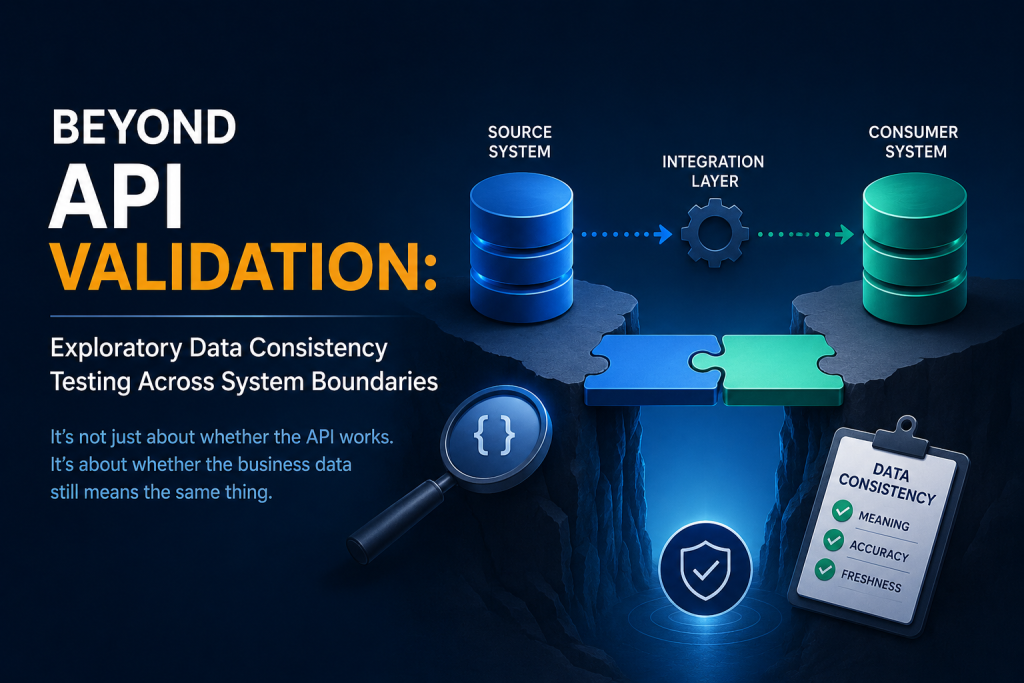
Exploratory data consistency testing becomes important when API validation alone cannot tell us whether business data remains correct across connected systems.
Testing an API often starts with familiar checks: status codes, response schemas, required fields, validation, and authorization. These checks are important, but they do not always tell us whether the business data is actually correct.
Consider a simple integration:
Source System
     │
     ▼
Integration Layer
     │
     ▼
Consumer System
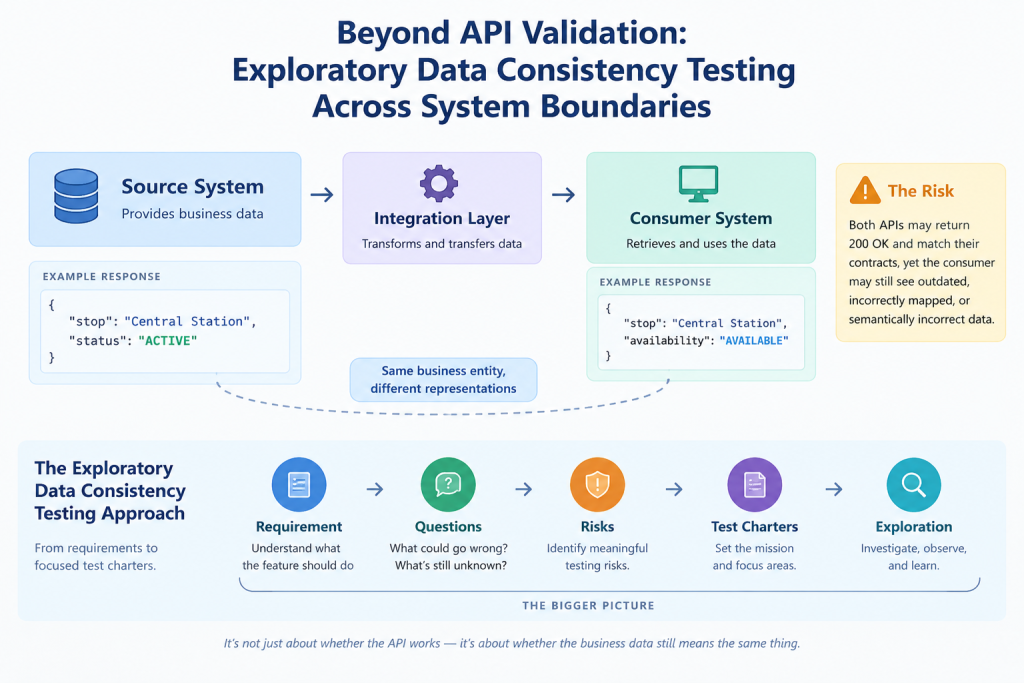
The Source System provides business data, while the Consumer System retrieves and uses that data through an integration path.
Both APIs may return 200 OK. Both responses may match their contracts. Yet the Consumer System may still expose outdated, incorrectly mapped, or semantically incorrect data.
Two systems can be individually correct and collectively inconsistent.
This is the risk we want to explore.
API Success Does Not Guarantee Data Consistency
Consider a fictional transport system where Stop information is provided by a Source System.
The source returns:
Stop: Central Station
Status: ACTIVE
The Consumer System retrieves the same business entity and represents it as:
Stop: Central Station
Availability: AVAILABLE
The responses are different, but that does not necessarily mean the data is inconsistent.
If the expected business mapping is:
ACTIVE → AVAILABLEthen both systems are expressing the same business state.
Instead of asking:
“Are these two responses identical?”
a more useful testing question is:
“Do these two representations preserve the same business meaning?”
This is an important principle in exploratory data consistency testing. We are not simply comparing raw JSON. We are checking whether business meaning remains correct when data crosses a system boundary.
Start With a Data Consistency Test Charter
Exploratory testing works well for this type of problem because the next useful test often depends on what we discover during the previous one.
A Test Charter gives us a clear mission and areas of focus without prescribing every test in advance.
In this case, the mission is simple:
Explore whether business data remains consistent when it crosses a system boundary.
Sample Test Charter: Data Consistency
Purpose
Explore whether business data remains consistent when consumed across a system boundary.
Focus
- Important business fields
- Lifecycle states
- Field mapping
- Relationships
- Data freshness
Test Ideas
- Establish the source data as a baseline.
- Retrieve the same entity through the consumer path.
- Compare business meaning rather than raw responses.
- Change important values and observe both sides.
- Explore related data after meaningful changes.
- Investigate unexpected differences.
The charter gives us enough direction to start exploring while still leaving room to follow what we discover.
If you are new to Test Charters, you may want to start with my previous article on turning requirements and risks into focused exploratory API testing charters.
Exploratory API Testing: From Requirements to Test Charters
Follow One Business Entity
A practical way to begin is to choose one business entity and follow it across the system boundary.
For example:
Stop: Central Station
Status: ACTIVE
Type: STANDARD
First, establish what the Source System says:
SOURCE

Central Station
Status = ACTIVE
Then retrieve the same Stop through the Consumer System:
CONSUMER

Central Station
Availability = AVAILABLE
Assuming the expected mapping is:
ACTIVE → AVAILABLEthe business meaning is consistent.
We now have a baseline.
The more interesting exploration begins when that data changes.
Change the Data and Observe
Suppose the Stop becomes temporarily unavailable.
The source is updated:
ACTIVE
   ↓
TEMPORARILY_CLOSED
The Source System now returns:
TEMPORARILY_CLOSEDBut the Consumer System still returns:
AVAILABLEIt may be tempting to report a defect immediately.
Instead, treat the difference first as an observation:
The source and consumer currently represent different business states.
Then ask:
Why?
This small change in mindset is important.
Exploratory testing is not only about finding differences. It is about investigating those differences and understanding whether they represent expected behaviour or an actual defect.
Investigate the Difference
When the source and consumer disagree, four areas provide useful starting points.
Mapping
Is the source value mapped to the correct consumer value?
For example:
TEMPORARILY_CLOSED
        ↓
UNAVAILABLE
An incorrect or missing mapping can produce a technically valid API response with the wrong business meaning.
Transformation
Does the Consumer System intentionally represent the data differently?
For example:
Source:
status = TEMPORARILY_CLOSED

Consumer:
availability = UNAVAILABLE
The field names and values are different, but their business meaning may still be consistent.
The same idea applies to timestamps, formats, derived fields, or enriched data.
Timing
Does the change need time to become visible?
For example:
T0

Source   → TEMPORARILY_CLOSED
Consumer → AVAILABLE
A short time later:
T+10s

Source   → TEMPORARILY_CLOSED
Consumer → UNAVAILABLE
The initial difference may be caused by caching, processing, or expected propagation behaviour.
This creates another useful exploratory question:
“Is the data inconsistent, or is it simply not consistent yet?”
Business Rules
Do the systems intentionally represent the same data differently?
Different systems may use the same business entity for different purposes. Finding different values is therefore not enough evidence by itself.
A difference is an observation, not automatically a defect.
Look Beyond Individual Fields
Data consistency is not limited to fields such as name, status, or type.
Relationships between business entities can reveal more interesting risks.
Consider a fictional timetable:
Service 101

Central Station
      ↓
Riverside
      ↓
Airport
Now imagine that Central Station becomes TEMPORARILY_CLOSED.
The Consumer System correctly represents the Stop as unavailable, but Central Station still appears in the timetable.
Is that a defect?
Not necessarily.
The timetable may represent a planned service, while the Stop status represents the current operational state.
That observation gives us new questions:
- Should a temporarily closed Stop remain in a planned timetable?
- Should its current operational state also be visible?
- Are the Stop and Timetable representations following the expected business rules?
This is where exploratory testing becomes valuable. One observation creates a question, the question creates another test, and the result gives us new information about the system.
A Simple Exploratory Data Consistency Testing Flow
The approach does not need to be complicated.
A simple five-step flow is:
ESTABLISH
What does the source say?
      ↓
OBSERVE
What does the consumer show?
      ↓
COMPARE
Is the business meaning consistent?
      ↓
INVESTIGATE
Why is there a difference?
      ↓
LEARN
Expected behaviour or defect?
Or simply:
Establish → Observe → Compare → Investigate → Learn
The same thinking can be applied through meaningful lifecycle changes:
CREATE → UPDATE → DEACTIVATE → REACTIVATE → DELETEThere is no need to compare every available field after every action.
Focus on what matters to the business risk: important attributes, lifecycle states, relationships, timestamps, collections, and derived values.
Final Thoughts
Exploratory data consistency testing goes beyond asking:
“Does the API work?”
It asks:
“Does the business data preserve its intended meaning when it crosses a system boundary?”
A successful API response does not prove that the consumer sees the correct business data. At the same time, different values across systems do not automatically indicate a defect.
A Test Charter gives us a focused mission, while observations made during testing help determine where the exploration should go next.
The approach can be summarized simply:
Follow the source. Observe the consumer. Compare the meaning. Investigate the difference.
Because ultimately:
Data consistency is not always about identical values. It is about preserving the correct business meaning across systems.
References & Further Reading
Cem Kaner – Defining Exploratory Testing
A useful foundation for the exploratory mindset, particularly the relationship between learning, test design, execution, and interpretation during testing.
Defining Exploratory Testing – Cem Kaner
Martin Fowler – Integration Test
Additional reading on testing interactions between components and systems and the risks that can emerge across integration boundaries.