


Modern organizations invest millions in data platforms, cloud infrastructure, BI tools, governance frameworks, and AI capabilities. Yet analytics teams still face familiar challenges. Projects run late, data quality issues appear unexpectedly, governance controls arrive too late, and stakeholders lose confidence in reporting.
The issue is not a lack of technology. Instead, the root cause is fragmentation.
Today, most analytics programs rely on multiple disconnected platforms, spreadsheets, ticketing systems, modeling tools, governance solutions, monitoring applications, and reporting environments. As a result, teams spend more time coordinating work than delivering value.
Consequently, technical debt grows faster than business outcomes.
This challenge inspired the Datus Data Engineering Agent. In this article, we’ll examine why traditional analytics programs struggle, uncover the hidden costs of fragmented workflows, and explain how Datus creates a unified approach across the entire analytics lifecycle.
Traditional Analytics Lifecycle
Most enterprises follow a lifecycle that looks something like the following:
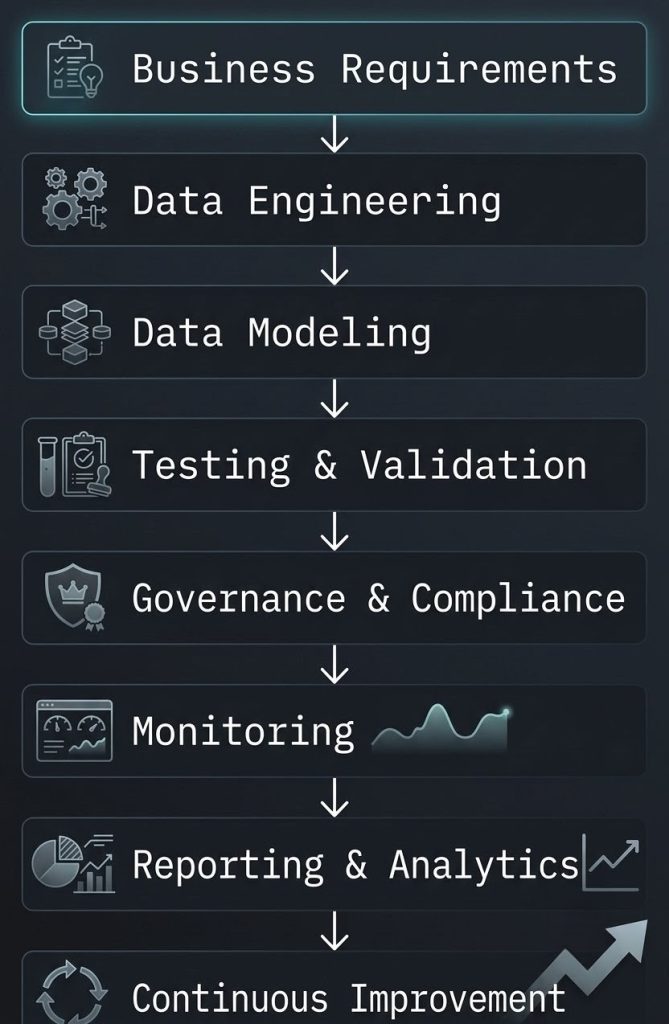
At first glance, this process seems logical. However, organizations usually execute each phase using different tools and platforms.
| Function | Common Tools |
| Planning | Excel, Jira, Confluence |
| Engineering | Spark, Databricks, Fabric, AirFlow |
| Modeling | dbt, ER Studio, custom frameworks |
| Validation | Great Expectations, custom SQL |
| Governance | Purview, Collibra, Alation |
| Monitoring | Grafana, Datadog, Splunk |
| Reporting | Power BI, Tableau, Looker |
Although each tool solves a specific problem, the overall process becomes fragmented. Common consequences include:
- Handoffs increase risk.
- Tool sprawl creates silos.
- Manual processes introduce inconsistencies.
- Teams lose valuable business context.
Why Fragmented Analytics Environments Fail?
1. Planning and Engineering Are Disconnected
Business stakeholders typically define requirements through meetings, presentations, and documentation. By the time engineers begin implementation, several weeks may have passed.
During that period:
- Requirements evolve.
- Assumptions get lost.
- Data contracts remain undefined.
- Compliance considerations are overlooked.
As a result, engineering teams spend significant time rediscovering information that already existed.
For example, a treasury team may request a new liquidity dashboard with regulatory calculations, daily refresh requirements, and exception handling. Unfortunately, developers often receive only partial documentation. Therefore, they spend weeks attending clarification meetings before building the first pipeline.
A connected framework would eliminate much of this delay because requirements, architecture, and implementation plans would stay aligned throughout the project.
2. Engineering Activities Operate in Silos
In many organizations, different teams focus on different parts of the lifecycle:
- Data engineers build pipelines.
- Architects create designs.
- Governance teams manage compliance.
- Data quality teams define validations.
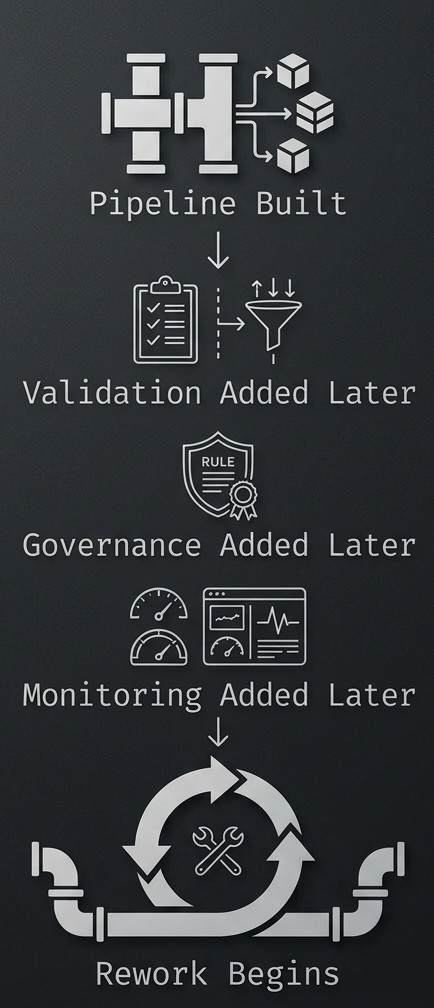
While each group performs important work, they often operate independently. Consequently, organizations discover quality issues, design gaps, or compliance concerns late in the delivery process. At that stage, fixes become more expensive and disruptive.
Instead of preventing problems early, teams spend valuable time correcting them later.
3. Data Models Lose Business Context
Another common issue occurs when data modeling becomes disconnected from planning and governance activities. Consider the following table:
CREATE TABLE transactions (
    transaction_id STRING,
    customer_id STRING,
    amount DECIMAL(18,2),
    trade_date DATE
);
From a technical perspective, the design looks valid. However, important business questions often remain unanswered:
- Which regulatory report uses this data?
- What quality rules apply to these fields?
- Who owns the dataset?
- What lineage information exists?
- Which KPIs depend on it?
Without connected processes, teams struggle to find these answers quickly. Therefore, business context gradually disappears as solutions evolve.
4. Governance Arrives too late
Many organizations treat governance as a separate activity that begins after deployment. Unfortunately, this approach creates avoidable risks. For example:
- Ownership becomes unclear.
- Compliance controls become reactive.
- Accountability weakens.
- Regulatory exposure increases.
Furthermore, teams often spend more effort fixing governance gaps than they would have spent preventing them.
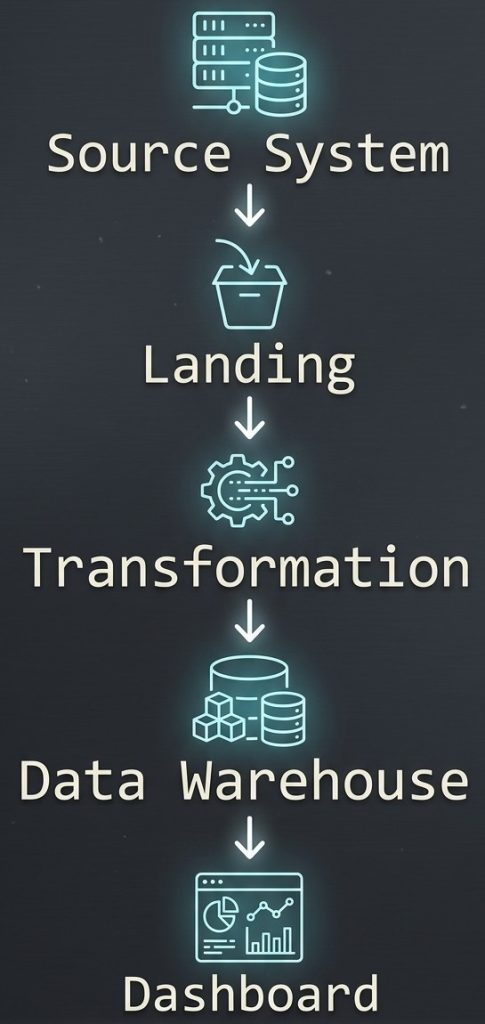
5. Monitoring Focuses on Symptoms
Most monitoring platforms answer a simple question:
Is something broken?
While that information matters, it often arrives after business users experience the impact. Typical issues include:
- Delayed data refreshes
- Missing records
- Failed jobs
- Incorrect calculations
Ideally, organizations should identify risks before they affect production systems. Therefore, monitoring should become an integrated part of the lifecycle rather than a final checkpoint.
Cost of Disconnected Platforms
When teams rely on disconnected systems, delivery timelines increase because knowledge must be recreated repeatedly. Furthermore, inconsistent validation practices often reduce data quality. In addition, manual coordination drives up operational costs.
Meanwhile, governance teams struggle to maintain ownership, lineage, and compliance information across multiple platforms. Ultimately, stakeholders begin questioning the accuracy of reports and dashboards.
Why Analytics Need for a Unified Orchestration Approach?
The analytics lifecycle should not operate as a series of isolated steps.
Instead, each phase should automatically inform and strengthen the next. Requirements should influence architecture. Architecture should guide engineering. Engineering should drive validation. Governance should exist throughout the process.
When these activities remain connected, organizations deliver analytics faster and with greater confidence.
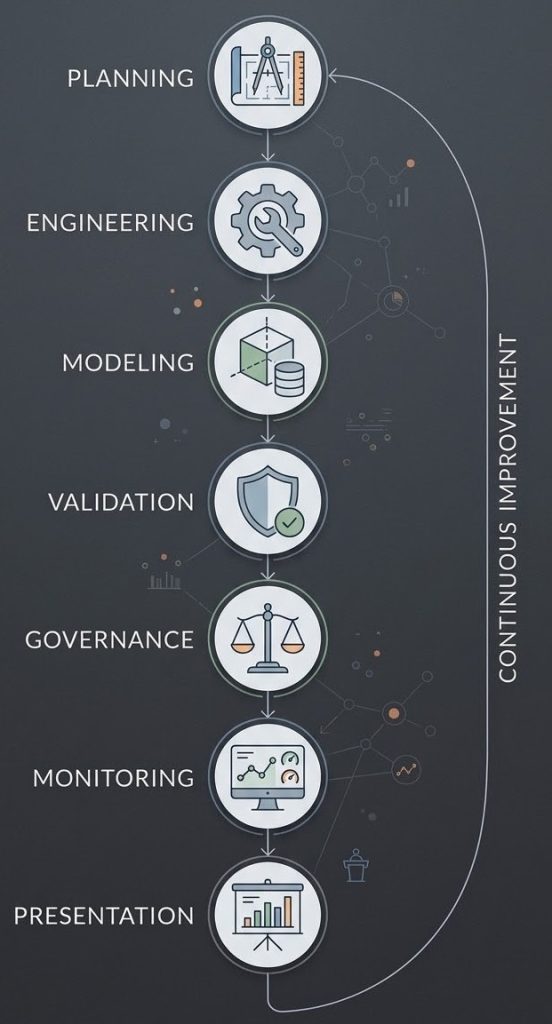
Introducing Datus: The Analytics Lifecycle Agent
To address these challenges, Datus provides an AI-driven orchestration platform that connects every stage of the analytics lifecycle.
Rather than forcing teams to coordinate work across dozens of disconnected tools, Datus acts as an intelligent engineering companion. As a result, teams can move from planning to production with greater consistency and less manual effort.
With Datus, organizations can:
✅Plan data initiatives
✅Generate architectures
✅Design engineering workflows
✅Build data models
✅Define quality validations
✅Enforce governance controls
✅Monitor health metrics
✅Generate reporting assets
✅Document the entire platform
Datus Architecture Overview

Example: Automated Validation Generation
During the modeling phase, teams can automatically generate validation frameworks from business requirements and data models.
For example, it can recommend quality checks such as:
SELECT
    COUNT(*) AS invalid_transactions
FROM transactions
WHERE amount < 0;
Completeness validation:
SELECT
    COUNT(*)
FROM transactions
WHERE customer_id IS NULL;
Freshness validation:
SELECT
    MAX(load_timestamp)
FROM transactions;
Instead of creating these checks manually, teams receive recommendations during engineering and modeling activities. Therefore, quality becomes proactive rather than reactive.
Example: Governance By Design
Datus also embeds governance requirements during planning instead of adding them later.
Example metadata definition:
asset: transactions
owner: Treasury Analytics Team
classification: Confidential
retention_period: 7 Years
criticality: High
regulatory_dependency:
    - Basel
    - Liquidity Reporting
As a result, teams implement governance as code rather than maintain governance as separate documentation.
Key Benefits of Datus
- Faster Project Delivery – Because requirements, architecture, and engineering activities remain connected, teams spend less time resolving gaps between project phases.
- Reduced Technical Debt – Furthermore, organizations capture knowledge once and reuse it across the lifecycle.
- Improved Data Quality – In addition, automatically generated validation rules help identify issues earlier.
- Built-In Governance – Meanwhile, ownership, lineage, and compliance controls remain embedded throughout delivery.
- Lower Operational Costs – As a result, teams spend less effort coordinating activities manually.
- Better Business Trust – Ultimately, business stakeholders gain greater confidence in analytics outputs.
Who Benefits Most from Datus?
Datus provides value across multiple groups:
- Data Engineering Teams – Accelerate design, development, testing, and deployment.
- Analytics Leaders – Improve delivery predictability and reduce project failures.
- Enterprise Architects – Ensure consistent architecture patterns.
- Governance Teams – Embed compliance controls from the beginning.
- Business Stakeholders – Receive trusted analytics faster.
Future of Analytics Is Orchestrated
The next generation of analytics platforms will not be defined by individual tools alone. Instead, successful organizations will differentiate themselves through orchestration.
Companies that continue managing analytics through disconnected platforms will face growing technical debt, slower delivery cycles, governance gaps, and declining trust. In contrast, organizations that adopt lifecycle orchestration will improve quality, accelerate delivery, and unlock greater business value.
Datus was built to solve this exact challenge.
By connecting planning, engineering, modeling, validation, governance, monitoring, and reporting into a single workflow, Datus transforms analytics delivery from a fragmented process into an intelligent operating model.