


Software testing is an important part of the software development process. A good test case can help QC engineers find bugs before users find them. However, writing test cases can take a lot of time, especially when a system has many features and complex business rules.
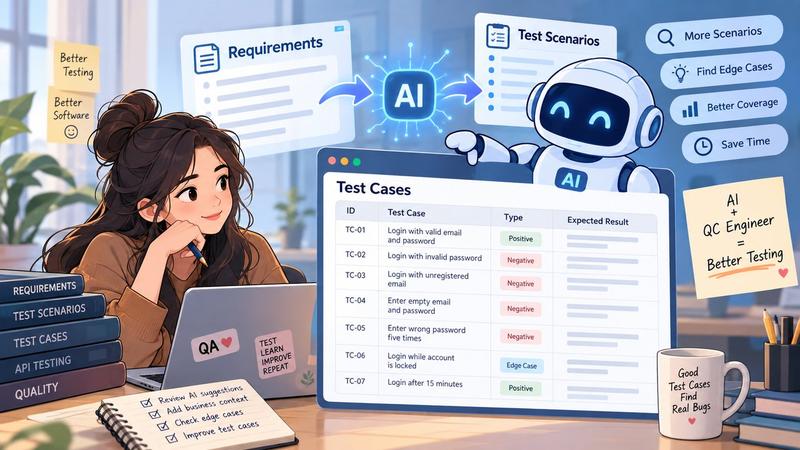
Today, Artificial Intelligence (AI) is becoming more popular in software testing. One interesting use case is AI-powered test case generation. Instead of creating every test case manually, QC engineers can use AI to analyze requirements and suggest test scenarios.
But an important question is: Can AI really help QC engineers test better, or does it only help them test faster?
What Is AI-Powered Test Case Generation?
AI-powered test case generation means using AI tools to create test scenarios or test cases based on information such as requirements, user stories, acceptance criteria, API documentation, or existing test cases.
For example, imagine we have this requirement:
Users can log in using a registered email and password. After five failed login attempts, the account will be locked for 15 minutes.
A QC engineer can ask AI to generate test cases for this feature.
AI may suggest:
- Login with a valid email and valid password.
- Login with an invalid password.
- Login with an unregistered email.
- Login with empty email and password.
- Login with an invalid email format.
- Enter the wrong password five times.
- Try to log in while the account is locked.
- Try to log in after 15 minutes.
- Verify that the account is unlocked after the lock period.
This can give the QC engineer a starting point instead of creating everything from zero.
How Can AI Help QC Engineers?
1. Generate Test Scenarios Faster
The biggest advantage of AI is speed.
Normally, a QC engineer needs to read the requirement, understand the business logic, identify possible scenarios, and then write test cases. This process can take a lot of time.
AI can quickly generate a list of possible scenarios from a requirement.
For example, if a registration form has 10 fields, AI can suggest tests for:
- Required fields
- Invalid formats
- Minimum and maximum length
- Special characters
- Duplicate data
- Boundary values
- Different combinations of valid and invalid data
The QC engineer can then review these suggestions instead of starting from an empty test case document.
2. Find Negative and Edge Cases
One common challenge in testing is thinking about unusual situations.
Developers often focus on the happy path, where everything works correctly. QC engineers need to think about what happens when users do something unexpected.
AI can help generate these negative scenarios.
For example, for an age field that accepts values from 18 to 60, AI may suggest:
- Age = 17
- Age = 18
- Age = 19
- Age = 59
- Age = 60
- Age = 61
- Empty value
- Negative number
- Decimal number
- Very large number
- Text instead of a number
This is useful because AI can generate many possible combinations quickly.
3. Improve Test Coverage
AI can also help QC engineers identify areas that may not be covered by existing test cases.
For example, suppose we have test cases for:
- Successful login
- Invalid password
- Empty password
AI may suggest additional scenarios such as:
- Account locked
- Expired password
- Disabled account
- Session timeout
- Multiple login attempts
- Login from a different device
This does not guarantee complete coverage, but it can help QC engineers discover scenarios they may have missed.
4. Support API Testing
AI-powered test generation can also be useful for API testing.
For example, an API has the following request:
POST /api/users
{
  "name": "John",
  "email": "john@example.com",
  "age": 25
}
AI can suggest tests such as:
- Valid request
- Missing name
- Missing email
- Invalid email format
- Negative age
- Age = 0
- Very large age
- Duplicate email
- Empty request body
- Missing authentication token
- Invalid authentication token
The generated scenarios can then be implemented using tools such as Postman, RestSharp, Playwright, or other API testing frameworks.
AI Does Not Understand the Product Like a Human
Although AI can generate many test cases, it has an important limitation: AI does not automatically understand the real business context.
Imagine a requirement says:
Customers can cancel an order before shipment.
AI may generate normal cancellation scenarios. However, a QC engineer may know additional business rules that are not clearly written in the requirement.
For example:
- VIP customers may have different cancellation rules.
- Some products cannot be cancelled.
- Orders with a specific payment method may require additional validation.
- Cancellation may require approval from another department.
If these rules are not provided to AI, AI may not generate the correct test cases.
Therefore, AI-generated test cases should be treated as suggestions, not final test cases.
The Risk of Over-Relying on AI
Another problem is that AI can generate incorrect or repetitive test cases.
For example, AI may generate ten test cases that are slightly different but actually test the same functionality. It can also misunderstand a requirement and create tests based on an incorrect assumption.
There is also a risk of missing important scenarios.
AI can generate many test cases, but quantity does not mean quality.
A list with 100 test cases is not necessarily better than a list with 30 well-designed test cases.
QC engineers still need to review the test cases and decide which scenarios are important.
The Best Approach: AI + QC Engineer
The best way to use AI is not to replace QC engineers but to work together with them.
A simple workflow can be:
Requirement → AI-generated scenarios → QC review → Improve test cases → Execute tests → Analyze results
For example, AI can generate the first version of the test cases. The QC engineer then checks:
- Does the test case match the requirement?
- Are the business rules covered?
- Are negative cases included?
- Are boundary values tested?
- Are security and performance risks considered?
- Is the expected result correct?
- Are there duplicate or unnecessary test cases?
This approach allows AI to handle repetitive work while the QC engineer focuses on analysis and decision-making.
So, Can AI Help QC Engineers Test Better?
The answer is yes, but only when it is used correctly.
AI can help QC engineers generate test cases faster, discover additional scenarios, improve test coverage, and reduce repetitive work. It can be especially useful when working with large requirements or complex systems.
However, AI is not a replacement for testing knowledge. A good QC engineer needs to understand the product, business logic, user behavior, risks, and potential impact of bugs.
The future of software testing may not be AI versus QC engineers. Instead, it will be AI with QC engineers.
AI can generate ideas, but QC engineers provide the critical thinking.
AI can create test cases, but QC engineers decide whether those test cases are valuable.
And most importantly, AI can help us test faster, but human thinking is still necessary to test better.