


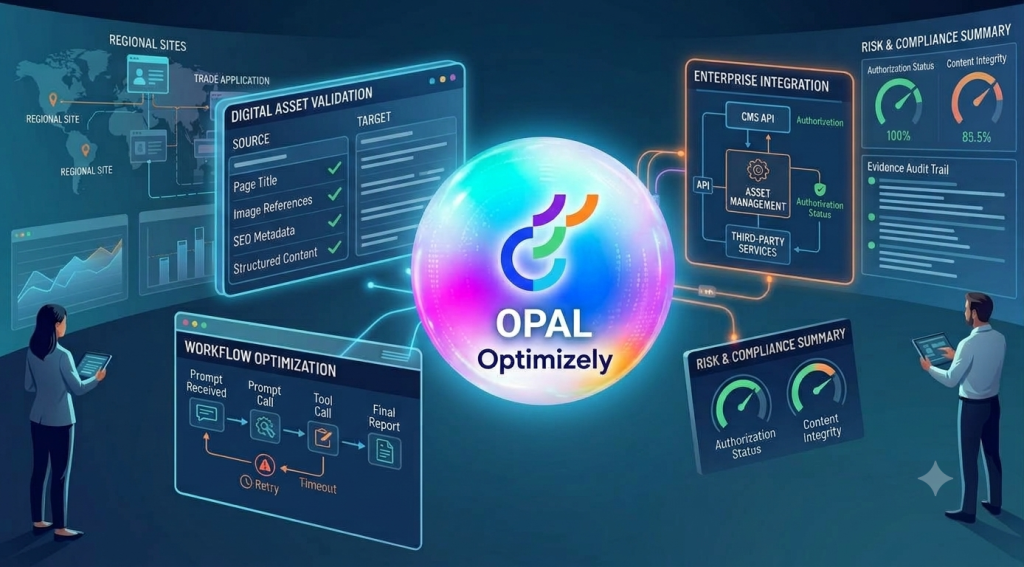
Artificial intelligence is increasingly transforming how enterprise teams create, manage, validate, and publish digital content. With Optimizely Opal, organizations can leverage AI-powered capabilities to support content workflows, marketing operations, and business process automation. However, integrating AI agents into an enterprise digital experience platform (DXP) introduces new quality assurance challenges. Unlike traditional applications, AI agents may produce variable outputs, interpret instructions differently, select tools dynamically, and execute multi-step workflows across connected systems.
For the testing team, the challenge is not simply to verify whether an AI agent generates a correct response. It is to establish whether the agent consistently meets business requirements, respects security boundaries, preserves content integrity, and produces the expected outcome across the entire workflow. These challenges become particularly relevant in large-scale CMS migration projects, where content, metadata, links, regional variations, and integrations must be validated across multiple websites and environments.
This blog explores how the testing team can apply AI agent testing principles and Optimizely Opal’s available evaluation capabilities to real-world enterprise content workflows. Using practical scenarios inspired by CMS migration and post-deployment validation activities, it presents a structured approach to testing AI behavior, content quality, workflow reliability, and business outcomes.
1. Foundational Concepts: Understanding Optimizely and Opal
Before diving into AI-assisted testing workflows, it is essential to understand the core platform and its underlying AI agent ecosystem.
What is Optimizely?
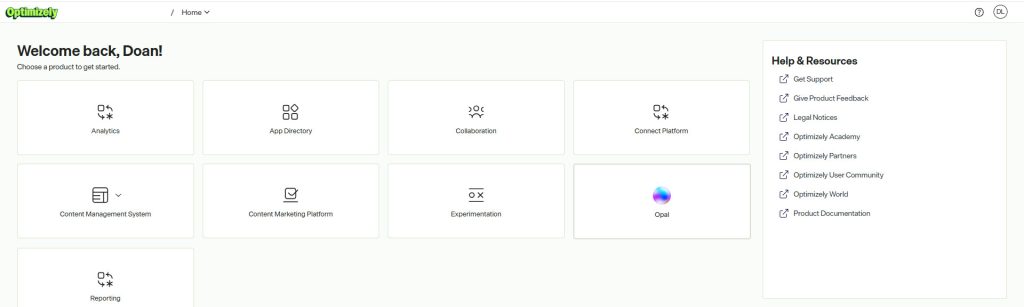
Optimizely is a Digital Experience Platform (DXP) designed to help enterprise teams plan, create, test, optimize, and deliver personalized digital experiences across multi-channel web applications. It unifies essential digital capabilities into a single cohesive ecosystem, including:
– Content Management System (CMS): Enterprise-grade content authoring, structured content modeling, and multi-site publishing.
– Digital Asset Management (DAM): Centralized storage, organization, and distribution of digital media assets.
– Web Experimentation & Personalization: Advanced A/B testing, multivariate testing, and dynamic audience targeting.
– eCommerce Solutions: Scalable commerce integration for digital storefronts and transactional workflows.
Why Use Optimizely?
Enterprise organizations choose Optimizely for three key reasons:
– Composable Architecture: Seamlessly connects with existing modern tech stacks, microservices, third-party tools, and external APIs.
– Scalability & Security: Purpose-built to support complex multi-site and multi-region operations with granular permissions, robust governance, and enterprise-grade reliability.
– Data-Driven Optimization: Combines powerful content management with native experimentation, enabling product and marketing teams to continuously optimize digital experiences based on real user data.
What is Optimizely Opal?
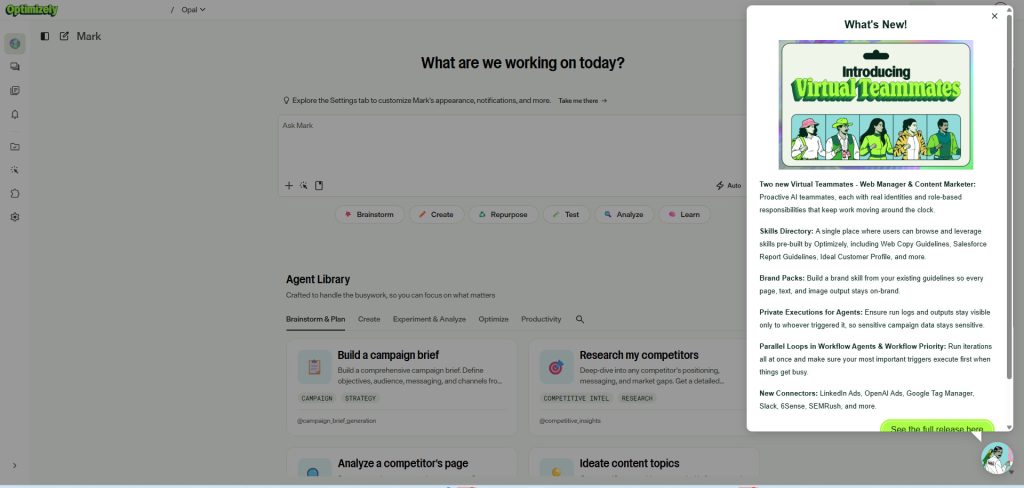
Optimizely Opal is Optimizely’s native AI ecosystem and agentic suite designed to act as an intelligent co-pilot and autonomous agent across the entire DXP platform. Rather than acting as a standalone chat tool, Opal embeds AI capabilities directly into core marketing workflows, CMS operations, experiment design, and business process automation—enabling autonomous execution of tasks such as content generation, field-level metadata extraction, link validation, and defect triage.
Why Use Opal?
Organizations leverage Optimizely Opal to achieve:
– Workflow Acceleration: Automates repetitive digital operations, significantly reducing manual effort during content audits, CMS migrations, and post-deployment validation.
– Native DXP Context: Unlike generic AI tools, Opal operates with direct awareness of the Optimizely context—understanding site hierarchies, content models, field constraints, and brand guidelines.
– Built-in Guardrails & Safety: Provides built-in execution monitoring, output evaluation mechanisms, and safety guardrails to ensure AI operations remain secure, compliant, and aligned with business rules.
2. The Testing Challenge: Why Traditional Testing Is Not Enough
In an enterprise CMS migration project, content is transferred from a legacy platform to a new CMS, with the testing team responsible for verifying data accuracy, content structure, functionality, and business requirements. Consider a project involving multiple digital channels, such as a consumer website, a trade website, and a trade application. Each channel may have different content structures, regional configurations, navigation rules, and integration dependencies. AI agents could support selected testing activities, including content comparison, metadata validation, link analysis, test scenario generation, and defect triage. However, introducing AI into these activities creates additional risks that traditional regression testing alone may not adequately address
2.1. Incorrect Intent Interpretation and Tool Selection
An AI agent may misunderstand a request or select an inappropriate tool for the task.
Real-world application:
During CMS migration validation, a tester asks an AI agent to investigate a broken link reported on a trade website. The agent should identify the affected URL, inspect the relevant content configuration, compare the expected and actual destination, and produce a structured finding.
Potential failures include:
• Selecting the wrong website or environment for verification.
• Treating an expected relative URL as an incorrect absolute URL without considering the application configuration.
• Suggesting a content update without sufficient evidence.
• Attempting to modify or publish content when the task only requires investigation.
Testing approach:
• Maintain representative prompts covering common migration and production-verification scenarios.
• Verify the selected tool, parameters, and execution context.
• Test ambiguous requests and confirm that the agent asks for clarification when necessary.
• Ensure that read-only investigations cannot unexpectedly trigger content changes.
2.2. Inconsistent Output and Content Quality
AI-generated analysis may be incomplete, factually incorrect, or inconsistent with business rules.
Real-world application:
During migration testing, the testing team identifies an article that appears to be missing its image. An AI agent is asked to investigate the finding.
The agent must distinguish among several possible causes: missing source content, an incorrect image reference, an unavailable image asset, a rendering issue, or an environment-specific configuration problem.
A weak implementation might immediately classify the issue as a migration defect without comparing the source content, target CMS data, and actual rendered page.
Testing approach:
• Compare source and target content using defined field-level rules.
• Validate image references, links, metadata, and required fields.
• Require evidence before assigning a defect category or root cause.
• Distinguish confirmed findings from hypotheses requiring manual investigation.
• Use deterministic checks for mandatory data requirements and AI-based evaluation for contextual analysis.
2.3. Multi-Step Workflow Failures
AI-assisted testing workflows may involve several steps, such as retrieving a test case, inspecting content, comparing URLs, evaluating results, and creating a defect report. A failure in one step can lead to incorrect conclusions or incomplete test evidence.
Real-world application:
An AI agent investigates a production issue involving a link that directs users to the wrong regional website. The intended workflow is to identify the affected page, inspect the link configuration, compare the expected destination with the actual destination, and prepare a structured defect report.
Potential failures include:
• Comparing data from different environments.
• Reporting an issue without verifying the actual page behavior.
• Creating duplicate defect reports when a tool call is retried.
• Marking a finding as resolved without confirming the fix after deployment.
Testing approach:
• Validate each workflow step and its input/output data.
• Verify environment, website, and regional context.
• Test retries, timeouts, partial failures, and duplicate-action prevention.
• Require explicit verification evidence before changing a defect’s status.
• Confirm the final outcome independently of the agent’s response.
These scenarios demonstrate why AI agent testing must extend beyond output quality to cover tool execution, data integrity, security, and the complete business process.
3. Applying a Risk-Based Testing Framework to a Real Project
An effective approach combines Optimizely Opal’s available native capabilities with independent testing automation, integration testing, and human verification. The framework should be applied to actual project workflows rather than remaining a collection of generic AI testing principles
3.1 Define Quality Criteria and Validate Outputs
The first step is to identify what constitutes a correct result for each business scenario.
Where available, Optimizely Opal’s Output Evaluation capability can support the assessment of agent executions against defined evaluation criteria. Deterministic assertions should supplement AI-based evaluations for requirements that can be checked precisely.
Real-world application: CMS migration content validation
Suppose testing needs to validate migrated product and article pages across consumer and trade websites. An AI agent may be used to analyze source and target content and prepare a validation summary covering:
• Page title and content fields.
• Image references and required media.
• Internal and external links.
• SEO metadata.
• Regional content differences.
• Required disclaimers and structured content.
The test framework should define explicit expectations for each field.
For example, a mandatory page identifier must match the approved migration mapping. A required image reference must exist and resolve correctly. A regional link must point to the intended website.
AI can help identify suspicious differences and summarize evidence, but it should not automatically classify every difference as a defect. Some differences may be intentional because of environment configuration, regional requirements, or approved content changes.
Testing team considerations:
• Define mandatory versus optional fields.
• Establish approved source-of-truth datasets.
• Separate deterministic validation from semantic evaluation.
• Require evidence for every reported discrepancy.
• Measure false positives and missed defects.
3.2 Validate Intent, Tool Selection, and Execution
The next phase validates whether the agent interprets a request correctly and performs only the permitted actions.
Real-world application: Production defect investigation
Consider a finding where a tile on a trade website opens a consumer website instead of the expected trade destination. A testing investigation agent could be asked to:
- Identify the affected page and tile.
- Retrieve the configured destination.
- Compare it with the expected destination.
- Inspect the actual link behavior.
- Prepare a structured finding with supporting evidence.
The test should verify that the agent uses the correct website and environment, extracts the correct URL, and does not confuse a legitimate external link with an incorrect internal link.
The same principle applies to post-deployment verification. If a defect requires validation in Production, the agent must not use Staging results as proof that the Production fix is successful.
Test scenarios should include:
• Correctly specified URLs and expected destinations.
• Relative versus absolute URL handling.
• Incorrect regional destinations.
• Missing or malformed links.
• Ambiguous environment references.
• Requests to publish or modify content when only verification is authorized.
Where the agent can call tools that modify external systems, validate permissions independently and require appropriate human approval for high-impact actions.
3.3 Test Guardrails and Recovery
AI agent workflows need safeguards against repeated failures, invalid operations, and unintended side effects. Optimizely Opal’s available Execution Guardrails and Execution Advisor capabilities can support execution monitoring and intervention. Their exact behavior should be verified in the target environment rather than assumed.
Real-world application: Automated defect investigation
Suppose an agent attempts to retrieve a page’s metadata, but the CMS API returns a timeout.
The agent should follow the agreed recovery policy instead of repeatedly calling the same endpoint without limits or reporting an unverified result.
Expected behavior may include:
• Retrying within an approved limit.
• Recording the failure and relevant diagnostic information.
• Stopping when the dependency remains unavailable.
• Reporting the investigation as blocked or incomplete.
• Avoiding duplicate defect creation or content updates.
Testing validation should cover:
• Maximum retry limits and timeout handling.
• Malformed API responses.
• Unavailable services and authorization failures.
• Failed recovery attempts.
• Repeated tool calls and unintended side effects.
• Correct handling of incomplete test evidence.
A critical principle is that an unsuccessful investigation must not be reported as a passed test or a confirmed root cause.
3.4 Validate Cross-System Workflows and Content Integrity
Enterprise CMS projects depend on multiple connected systems, content models, and environments. AI-assisted testing must verify the complete workflow and the resulting application behavior.
Real-world application: CMS migration and release validation
For a migration involving consumer and trade websites, the testing team may need to validate:
• Migrated page content and metadata.
• Navigation and footer links.
• Product and article images.
• Content rendering and component behavior.
• Regional URLs and redirects.
• Forms and third-party integrations.
• Production behavior after deployment.
An AI agent can assist with test preparation, data comparison, anomaly identification, and defect-report drafting. Independent automated tests and human verification should confirm critical results.
For example, if a migrated page contains the expected image URL but the image is not displayed, the investigation should distinguish between missing data, an inaccessible asset, a rendering problem, and an environment-specific issue.
Similarly, a correct URL in the CMS does not necessarily prove that the rendered page navigates correctly.
The expected outcome should therefore be validated at multiple levels:
- Content and configuration are correct in the CMS.
- The application renders the expected content.
- User interactions behave correctly.
- Integrations and downstream systems behave as expected.
- Production verification confirms the fix where required.
This approach ensures that AI supports testing execution without replacing independent verification of the actual business outcome.
4. A Practical AI Agent Testing Framework for Enterprise CMS Project
The following framework translates common CMS testing activities into testable scenarios and measurable outcomes.
| Testing dimension | Real-world scenario | Testing method |
| Intent and tool selection | Agent investigates a broken link on the correct website and environment | Prompt suites, tool-call assertions, environment validation |
| Output quality | Agent compares migrated content and reports meaningful discrepancies | Field-level assertions, approved reference data, output evaluation |
| Content integrity | Missing images, incorrect metadata, broken links, or malformed HTML | Schema validation, URL checks, content comparison, rendering tests |
| Guardrails and recovery | CMS API timeout during an investigation | Retry-limit tests, failure-path testing, execution trace review |
| Security and authorization | Agent attempts to publish content when only read access is authorized | Permission checks, adversarial prompts, sensitive-action tests |
| Workflow reliability | Agent prepares a defect report based on several system checks | End-to-end testing, duplicate-action checks, evidence verification |
| Production readiness | A defect is marked fixed after deployment | Environment-specific verification, regression testing, audit trail review |
| Performance and cost | Large batches of pages are analyzed | Load testing, execution telemetry, latency and cost measurement |
Example: Test Case for an AI-Assisted Broken-Link Investigation
Objective: Verify that an AI agent identifies and reports an incorrect destination on a trade website without making unauthorized content changes.
Preconditions:
• The affected page and tile are known.
• The expected destination is documented.
• The test environment and user permissions are configured.
• Read-only investigation tools are available.
Test steps:
- Submit a request to investigate the reported link.
- Verify that the agent identifies the correct website, page, and environment.
- Verify that it retrieves the configured destination.
- Compare the configured destination with the approved expected destination.
- Inspect the actual rendered link behavior.
- Review the agent’s findings and supporting evidence.
- Confirm that the agent has not modified or published content.
Expected results:
• The correct page and link are identified.
• The destination comparison is accurate.
• The finding is supported by observable evidence.
• Unverified root causes are clearly identified as hypotheses.
• No unauthorized content changes occur.
• The final report accurately reflects the investigation outcome.
This scenario can be automated partially or fully depending on available integrations and access permissions. Human review remains appropriate where the result requires business interpretation or Production changes.
5. Establishing Measurable Acceptance Criteria and Continuous Regression
A practical framework needs measurable criteria so the testing team can determine whether AI-assisted workflows are reliable enough for their intended use. The following are proposed acceptance criteria that should be agreed upon with stakeholders; they are not default Optimizely thresholds or claimed project results.
| Quality area | Proposed acceptance criterion |
| Content validation | All mandatory fields and schema constraints pass validation in the approved test dataset. |
| Link validation | All known critical broken-link and incorrect-destination scenarios are detected. |
| Finding accuracy | Every confirmed defect report contains the required evidence and correct environment details. |
| Tool authorization | All defined unauthorized-action scenarios are blocked. |
| Workflow reliability | Critical investigation scenarios complete successfully or report a clear blocked/failed status. |
| Recovery behavior | Retry limits are respected and repeated execution causes no unintended side effects. |
| Production verification | Fixes are marked verified only after the required Production checks pass. |
| Regression stability | Results remain within approved thresholds following changes to prompts, tools, or integrations. |
Apply Continuous Regression to Real Project Changes. In an ongoing CMS project, content models, migration mappings, redirects, integrations, and application configurations may change throughout development and release cycles. When AI agents support testing activities, these changes should trigger the relevant regression suites. A practical process is:
- Maintain a baseline. Store approved prompts, test datasets, expected outcomes, evaluation criteria, and tool permissions in version-controlled repositories where feasible.
- Execute targeted regression. Run relevant scenarios when agent instructions, content models, URLs, API contracts, or integration configurations change.
- Compare results. Identify changes in content validation, tool selection, defect classification, and workflow completion.
- Review deviations. Investigate false positives, missed defects, incorrect conclusions, and unexpected tool behavior.
- Make an evidence-based release decision. Use test results, defect severity, security findings, and documented residual risks to determine readiness.
For example, changes to URL handling should trigger regression tests covering relative links, absolute links, regional destinations, and cross-site navigation. Changes to CMS content models should trigger field-level validation and rendering tests.
This approach helps the testing teams use AI to improve investigation efficiency while retaining control over testing accuracy, traceability, and release decisions.
6. Conclusion
Applying AI agent testing to real-world enterprise CMS projects requires more than validating generated responses. It requires verifying how agents interpret requests, select tools, evaluate content, recover from failures, and interact with connected systems. By combining Optimizely Opal’s available evaluation and execution-control capabilities with independent automation, security checks, and end-to-end verification, testing teams can establish a structured approach to AI-assisted testing.
In CMS migration and post-deployment scenarios, AI agents can support content comparison, link investigation, metadata validation, test preparation, and defect reporting. However, critical findings must remain evidence-based, authorization must be enforced independently, and release decisions must rely on verified business outcomes. For the testing team, the objective is to use AI to improve testing efficiency without compromising quality, security, or accountability. A risk-based framework with measurable acceptance criteria, continuous regression, and appropriate human oversight provides a practical foundation for adopting AI agents in enterprise testing workflows.