Introduction
React is a JavaScript library for building user interfaces. While React itself doesn’t inherently create security vulnerabilities, when developers enable certain options during implementation, it can leave the application open to attacks. It’s important for developers to be mindful of potential vulnerabilities and take steps to address them.
Following are some of the best practices we should follow to secure our React applications:
1. Use default React XSS protection with data binding
In React, data binding using curly braces {} automatically escapes values for textContent but not HTML attributes.
Use JSX data binding syntax ({}) to place data in your elements.

Do:
{data}
Avoid dynamic attribute values without custom validation.
Avoid:
2. Sanitize and render HTML
Do:
Avoid:
3. Avoid JSON injection attacks
It is common to send JSON data along with server-side rendered React pages. Always try to replace < character with a gentle value (Unicode value) to prevent injection attacks.
Always try to replace HTML specific codes from JSON with its equivalent characters.
Do:
4. Secure React server-side rendering
Do:
5. Never serialize sensitive data
There is a good chance that your React app uses JSON to set the initial state of your application.
This can be potentially dangerous because JSON.stringify() is a function that converts any data into a string without detecting malicious values. An attacker can manipulate data like username and password by injecting a JS object that can modify valid data.
6. Check for known vulnerabilities in dependencies
Snyk VS Code extension
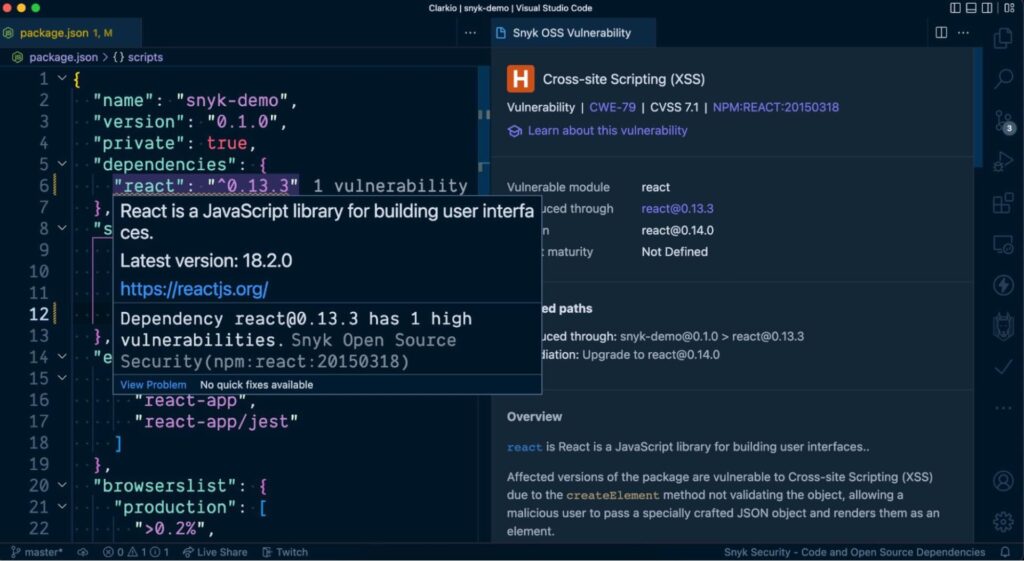
While developing a React application in VS Code you can use the Snyk extension to alert you of any known vulnerabilities in your project. You’ll find visibility to these alerts via squiggly line warnings directly in your package.json file, the Snyk extensions panel and the VS Code problems panel. This is helpful so that you don’t have to switch context out of your development environment to learn of these vulnerabilities — it’s all within your scope.
Conclusion
React security is intangible at first glance. However, all the unique features, attractive UIs, and seamless performance won’t matter unless your app is secure. With new threats coming up every day and attackers exploiting more and more loopholes, making your React app secure is the top priority during the development.
References:
- https://snyk.io/blog/10-react-security-best-practices/
- https://medium.com/whatfix-techblog/reactjs-security-best-practices-6542b71a5577
- https://www.freecodecamp.org/news/best-practices-for-security-of-your-react-js-application/