


Artificial Intelligent (AI) is the intelligence of machines or software that aims to perform tasks thought to require human intelligence, such as reasoning, learning, making decisions, solving problems, and even creativity. Today, the term ‘AI’ is popular in various fields of our life, including healthcare, finance, transportation, manufacturing, education, and entertainment.
Chatbots, computer programs designed to simulate human conversation and deliver relevant and helpful responses, leverage AI to enhance their capabilities. These systems can now understand and interpret human language, even generate different creative content. ChatGPT, developed by OpenAI, stands as a prime example, this chatbot is transforming the way we interact with machines to do surprising tasks of humans.
What is ChatGPT?
ChatGPT, or Chat Generative Pre-training Transformer, also known as “large language model” (LLM) that can generate human-like text based on the input it’s given. Unlike traditional chatbots that rely on predefined responses, ChatGPT is a generative model, capable of creating unique, contextually relevant responses word by word. It is a generative model, meaning that can create new, creative content—in this case, text.
With the right prompting and context, ChatGPT is very useful in writing articles, editing documents, translating languages, brainstorming ideas in planning, guidelines, or presentations, and even writing code in multi programming languages, etc.
How does ChatGPT work?
The ChatGPT model uses Reinforcement Learning from Human Feedback (RLHF). It was trained by using supervised fine-tuning: human AI trainers provided conversations in which they played both sides-the user and an AI assistant. This model was trained from various sources from internet, websites, books, news articles, and more to help ChatGPT capture grammar, facts, and basic reasoning from a broad range of information.
When you interact with ChatGPT, the model uses the knowledge it gained during pre-training and fine-tuning to generate responses based on the input it receives. It predicts the next words in the sequence given the context of the conversation history.
It’s important to note that while ChatGPT can generate coherent and contextually relevant responses, it doesn’t have a deep understanding of the world, and its responses are generated based on patterns it learned during training. It might not always provide accurate or up-to-date information, and its responses are limited to the scope of its training data.
What are the limitations of ChatGPT?
It’s important to use ChatGPT with an awareness of these limitations and to exercise caution in relying on its responses, especially in critical or sensitive situations. It’s just a tool that can provide information and assistance, but human judgment and verification are essential.
1. Accuracy
ChatGPT is still facing the problem whenever the training data is not enough or up to date so this can lead to misleading, incorrect, or enough information when interacting with users.
2. Tendency to generate incorrect or unreliable information
In some cases, with ambiguous questions, the model doesn’t know how to clarify the questions and tries to guess for answering the questions, this thing leads to incorrect answers. It doesn’t have the ability to verify information and may accidentally respond to misinformation so the users should verify the critical information from reliable sources.
3. Verbosity and Overuse
The responses of ChatGPT can be verbose and overuse certain phrases. It might not always provide concise answers and may include unnecessary details in its responses, it’s easy to recognize this in chatting.
4. Inability to Perform Actions
ChatGPT is a text-based model and cannot perform actions in the real world. It can provide information and answer questions but cannot execute commands, make physical changes, or access external systems. As an example, we can’t ask ChatGPT to generate and execute the programming codes, it just helps us to generate the programming codes as expectation.
5. Potential for Biases or Inappropriate Responses
The model may exhibit biased behavior or respond to sensitive topics inappropriately. It can accidentally reflect and perpetuate biases present in the data on which it was trained, it may not be free from them.
6. Ethical Use
The model might generate responses that are inappropriate or violate ethical standards. It’s important for users to exercise discretion and not use the model to generate harmful content. This thing must be managed and controlled by chatbot model closely.
7. Security Concerns
In general, the AI models are trained with training data so the model may be vulnerable to adversarial inputs, and there could be concerns related to malicious uses of the technology, such as generating harmful content. It needs to control the model from training data and more with fine-tuning models.
How to use ChatGPT effectively (Prompting Hints)
A prompt is a phrase or set of words that you give to a language model like ChatGPT to help it generate a response (output). With ChatGPT, we need to use some techniques in prompting to get concise, correct, or relevant information because this model can’t read your mind to give the better outputs from beginning. If the outputs are not clear, we can ask for clear or give more constraints to have better outputs. If the outputs are simple, we can ask for writing at an expert level, etc. The more understanding from ChatGPT, the more exactly what you want of outputs by prompting.
1. Type of prompts
Open-Ended prompt: it is great for creative and diverse responses, it means that the information of outputs will be opened, no specific constraints in responses. This kind of prompt encourages the model to generate a creative and imaginative response (Prompt 1).
Prompt 1: “Tell me a story about an adventure in a magical forest.”
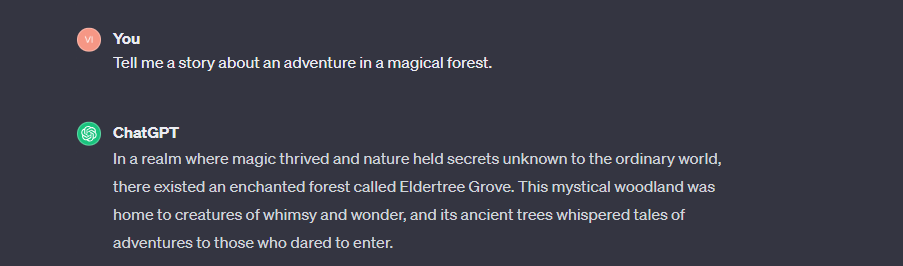
Close-Ended prompt: it understands that the information in outputs will be precise, fact-based information (unchanged information). The question has a clear, singular correct response, the user is looking for precise information rather than a creative or varied output (Prompt 2).
Prompt 2: “What is the capital of France?”

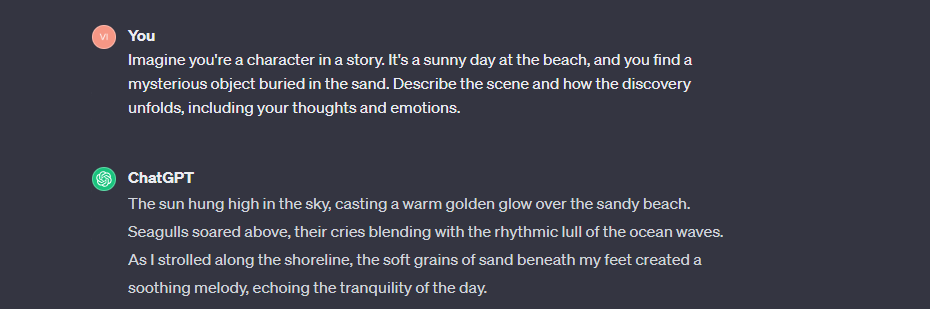
There is one more definition of prompting as Complex prompt which introduces additional conditions and scenarios, transforming it into a more intricate request. It not only asks for a description but also instructs the model to incorporate elements of a story, emotions, and a specific event (Prompt 3).
Prompt 3: “Imagine you’re a character in a story. It’s a sunny day at the beach, and you find a mysterious object buried in the sand. Describe the scene and how the discovery unfolds, including your thoughts and emotions.”
2. Language and tone
The language and tone of your prompts have a significant impact on ChatGPT’s responses and the tone of ChatGPT is neutral by default. The model is designed to adapt its language and tone based on user input. If users use polite and friendly language, the model is more likely to respond in a similar tone. Conversely, if the user adopts a more formal or assertive tone, the model adjusts its responses accordingly. For example, we use the words in friendly way and the ChatGPT will change its language and tone as friendly as your way in conversation.
Prompt 1: “Kindly explain the fundamental principles governing the phenomenon of climate change.”
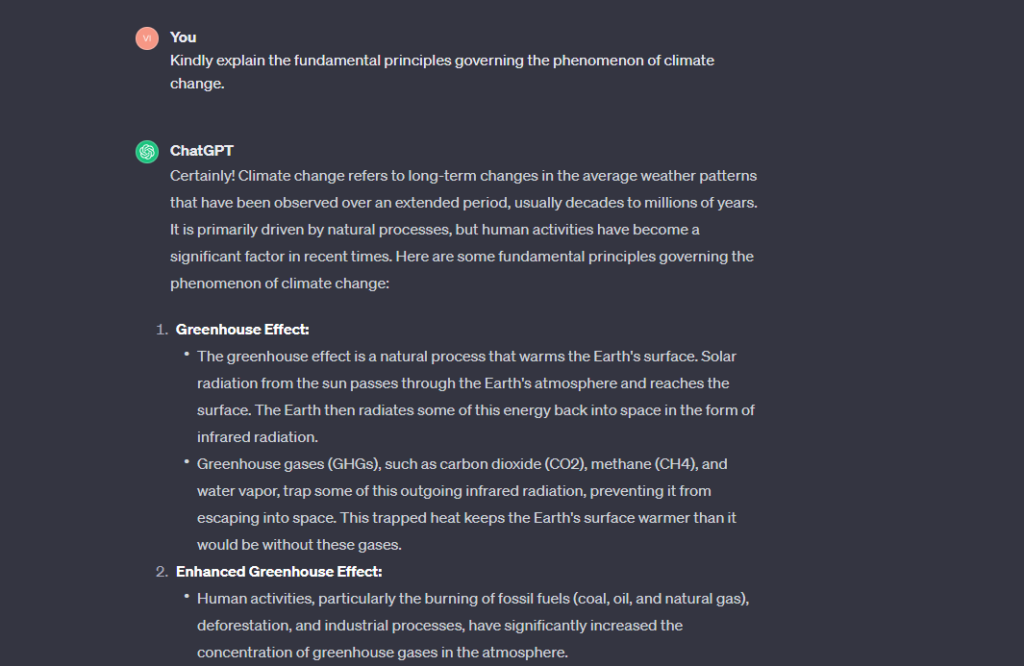
In this example, the use of formal language and a polite tone sets an expectation for a detailed and sophisticated response.
Prompt 2: “Hey, tell me what’s up with climate change these days.”
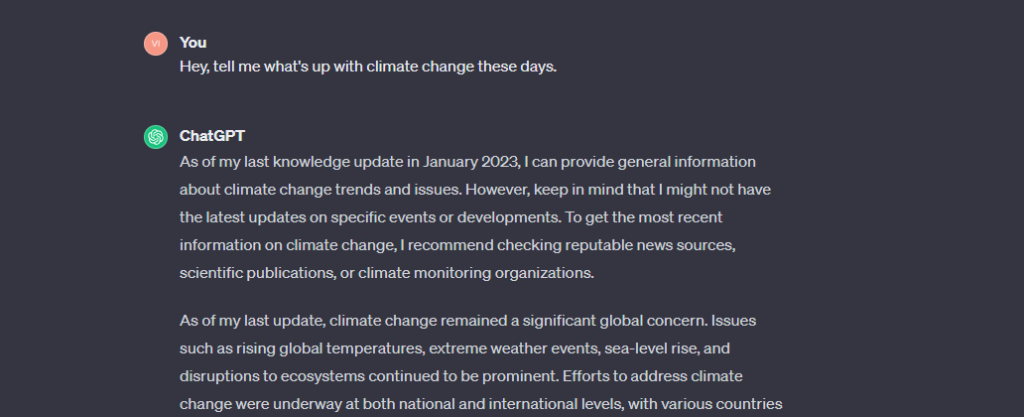
Using casual language and a relaxed tone suggests a more conversational and informal response, possibly with simplified explanations.
Prompt 3: “Convince me why renewable energy is crucial for the future of our planet.”
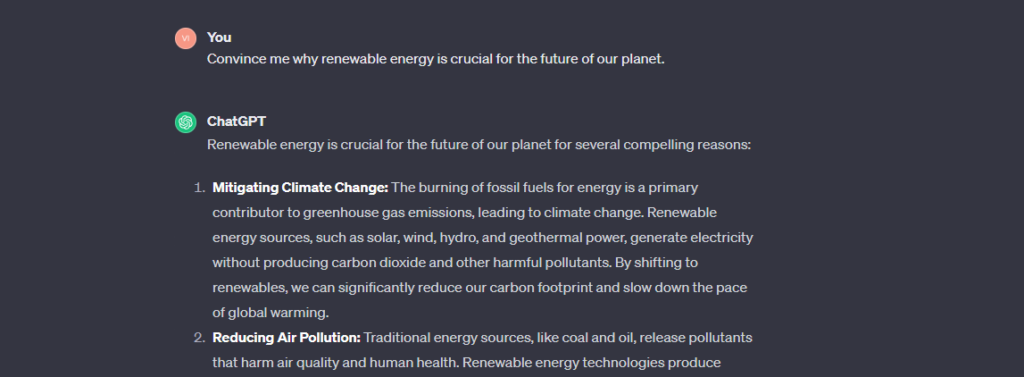
The use of persuasive language and a challenging tone directs the model to generate a response that emphasizes the importance of renewable energy in a compelling way.
3. Storytelling, context and clarity
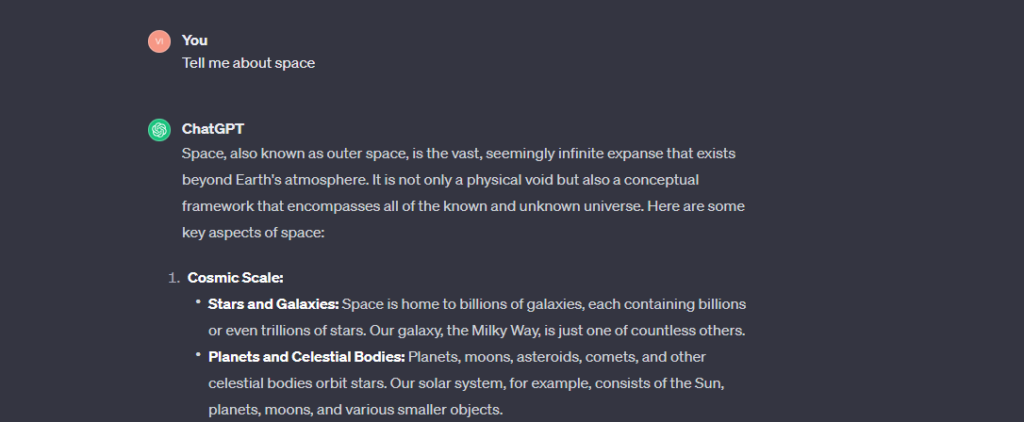
It provides a stronger way to influence the model’s output by establishing context, encouraging creativity for more engaging responses instead of starting with incorporating prologues into your prompts so prompts with good context and clarity will give more exact or relevant what to meet your expectations. The more details are given, the closer to what we want.
Prompt 1: “Tell me about space”
Prompt 2: “I’m writing a school paper on the wonders of space exploration. Can you provide information about recent advancements, exciting discoveries, and the potential for future space missions?”
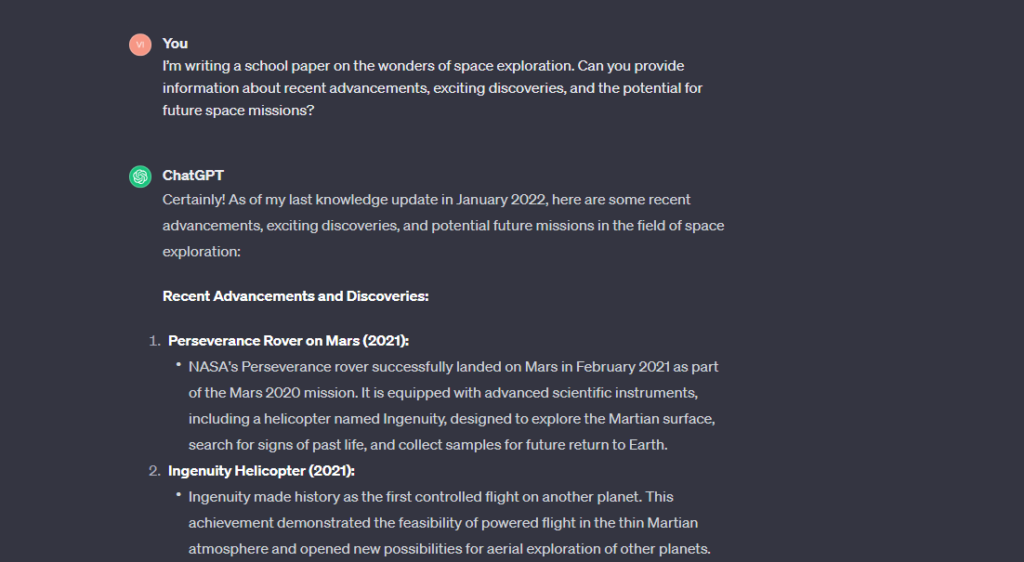
With Prompt 2, the information is clearer and focuses on what user wants the model to respond to instead of Prompt 1.
4. Driving action
It is a way for users to take a more proactive role in shaping the nature of the model’s responses, ensuring that the generated content aligns with their specific requirements or preferences. It involves being intentional and explicit in the instructions to achieve the desired outcome in the interaction with ChatGPT.
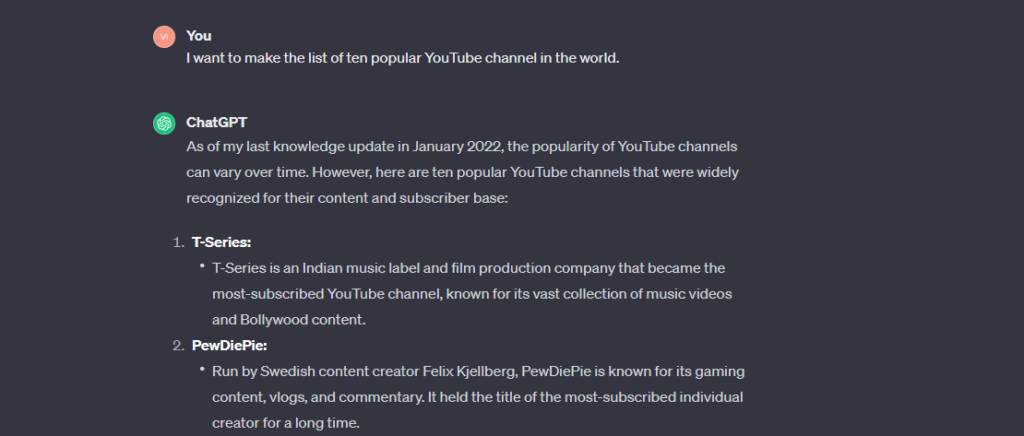
Prompt 1: “I want to make the list of ten popular YouTube channel in the world.”
Prompt 2: “I want to make the list of ten popular YouTube channel in the world, and show them in two columns (one is name of channel, and one is topic of channel)”
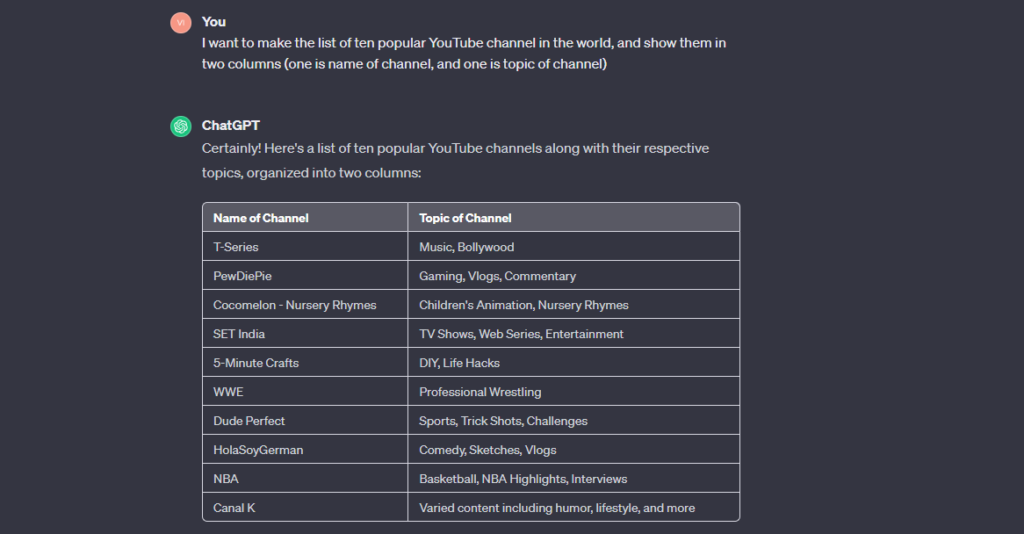
With Prompt 2, I clearly ask the model to draw the table (2 columns) to list out the top ten YouTube channels. I specify the meaning of each column as my expectation from ChatGPT’s response which is easier to catch up.
5. Different age, knowledge and background
ChatGPT can recognize and propose the outputs which are appropriate to the age, knowledge level and background from prompts of users. It will be easier for us to control the outputs as we expect in diversity information.
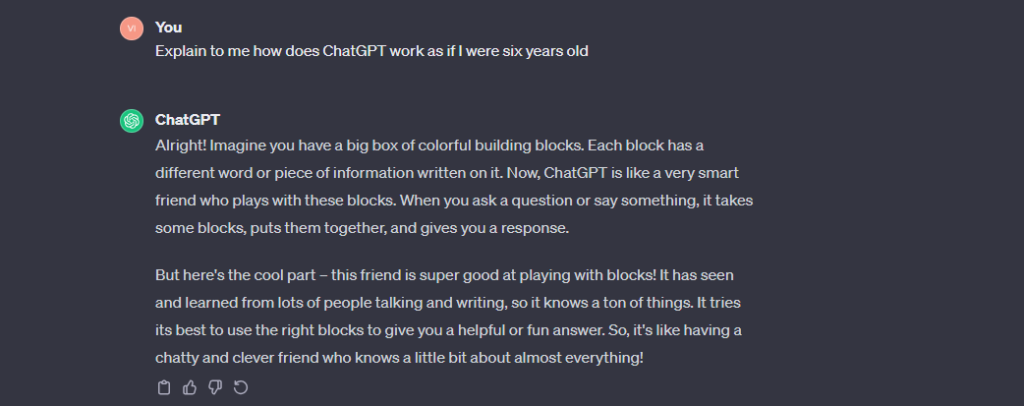
Prompt 1: “Explain to me how does ChatGPT work as if I were six years old”
Prompt 2: “Explain to me how does ChatGPT work as if I were 24 years old”
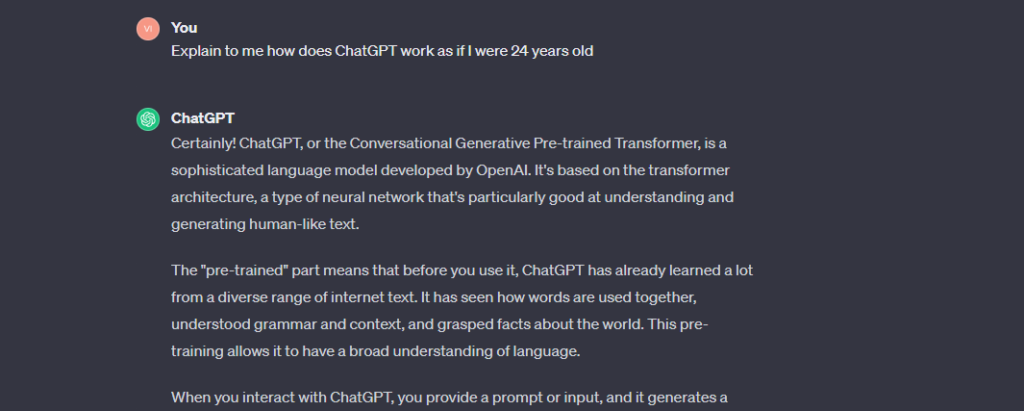
In the example of prompt 1 and 2, the model will provide the simple words for ‘six years old’ and more complex for ’24 years old’ in explaining.
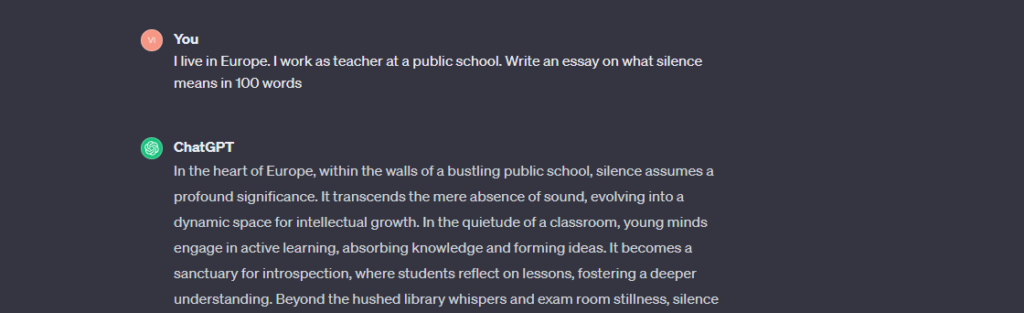
Prompt 3: “I live in Europe. I work as teacher at a public school. Write an essay on what silence means in 100 words”
Prompt 4: “I live in Vietnam. I work as shopkeeper. Write an essay on what silence means in 100 words”
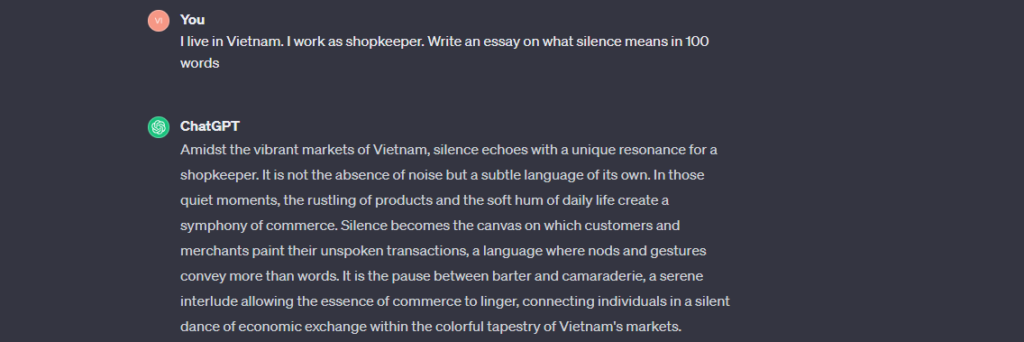
In the example of prompt 3 and 4, the model will describe the silence in different words which belong to background knowledge accordingly.
6. Temperature setting
The configuration temperature setting is control randomness, a lower temperature setting will result in more formal and polite language, while a higher temperature setting will result in more informal, creative, and playful language.
There are two ways of controlling the temperature setting values:
a. By configuration of ChatGPT (Playground Screen)
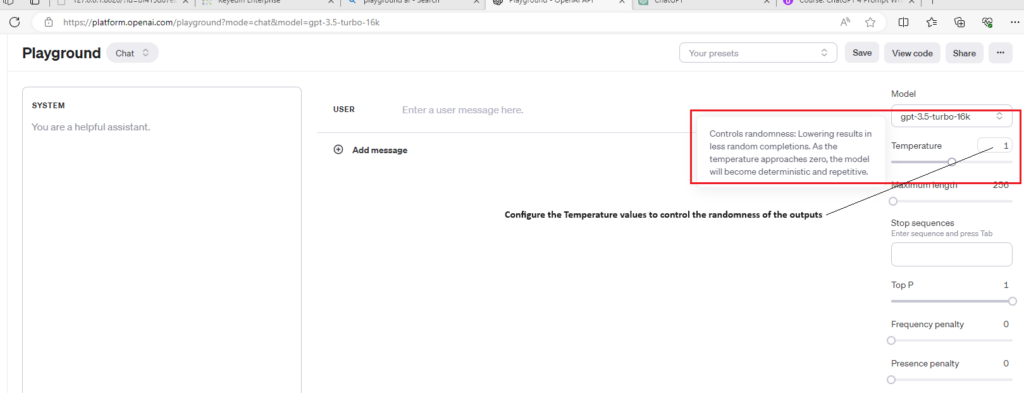
b. By input the message chat-box of ChatGPT directly
Prompt 1: “Write a story about a bird.
The temperature parameter is set to 0.1”
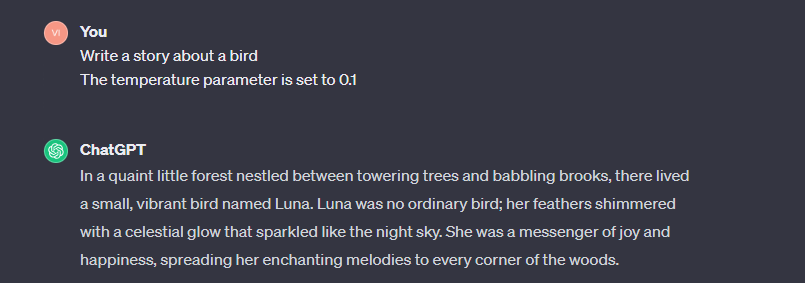
The output of Prompt 1 will be more deterministic and focused responses.
Prompt 2: “Write a story about a man in space.
The temperature parameter is set to 1 (temperature as in terms of prompt engineering, where temperature describes the randomness of the output)”
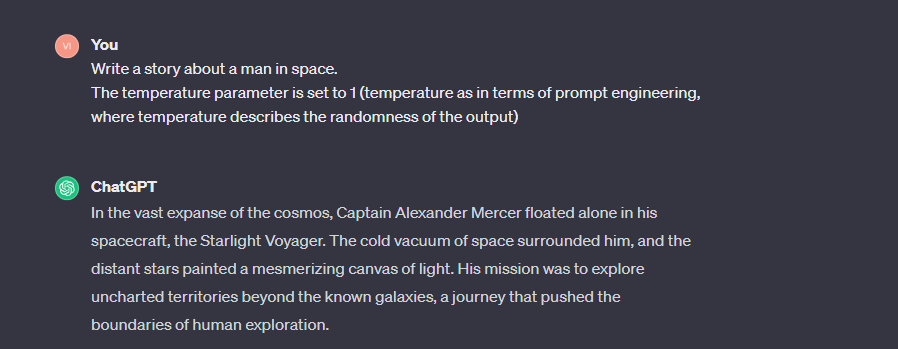
The output of Prompt 2 will be more diverse and creative.
The default temperature setting for ChatGPT is 0.7. This is a good starting point for most users, but you may want to experiment with different values to find what works best for you.
Here are some tips choosing a temperature setting:
– If you want to generate text that is factual and accurate, use a lower temperature setting.
– If you want to generate text that is creative and unpredictable, use a higher temperature setting.
– If you are not sure what temperature setting to use, start with the default setting of 0.7 and adjust from there.is creative and unpredictable, use a higher temperature setting.
Ultimately, the best way to find the right temperature setting for you is to experiment with different values and see what works best for your needs.
Sum up
By understanding the model’s workings, experimenting with prompts, and embracing the nuances of language, we can unlock the capabilities of ChatGPT as a power chatbot in the evolving field of artificial intelligence.
How about your views? Please share more of your knowledge or experience to let us have deeper understanding about ChatGPT, an innovative AI chatbot.
1 thought on “ChatGPT – The Innovative AI Chatbot”
I find this blog is very helpful for me, especially the ‘Temperature’ part.
Comments are closed.