


Introduction
Hi Everyone! I am thrilled to dive into the world of Server less Automation Testing with all of you. Whether you are a seasoned tester or just getting started in the fascinating realm of Server less architectures, this blog is your go-to guide for crafting rock-solid test cases for Server less Automation Testing. Let’s dive into the essentials of “Serverless Testing: Test Cases.”
Writing strong test cases is essential when it comes to Server less architecture, and automated testing is an essential part of the software development life cycle. We will go into the nuances of creating test cases especially for Server less applications. Using real world examples to highlight best practices, you will have a thorough understanding of how to improve your Server less automated testing strategy by the time you finish reading this blog.
Understanding the Server Less Landscape
We need to have a firm understanding of Server less architecture before we can write test cases. I have addressed all the major ideas, including statelessness, event triggers, and function as a service (FaaS), in detail below. This explains why testing Server less apps necessitates a distinct methodology than testing traditional architectures. Join me in unravelling the intricacies of “Serverless Testing: Test Cases.”

Function as a Service (FaaS): Function as a Service (FaaS) is a basic idea of Server less computing. Applications in FaaS are divided into discrete, standalone tasks that can be carried out in reaction to circumstances.
As an illustration:
Think of a photo-sharing website where users can submit pictures. Whenever an image is uploaded, anyone can invoke a serverless function, eliminating the need for a server that is always up and running to handle uploads. This function smoothly scales with demand as it processes and store the image.
- Event Triggers: Because Server less Apps are event-driven, they react to trigger or events. These triggers can be anything from file uploads and HTTP requests to modification in databases.
As an illustration:
An event indicating a new order could set off a Server less function in an e-commerce platform. When a customer makes a purchase, the function receives the order, adjusts the inventory, and sends confirmation emails. - Statelessness: Because Server less function are meant to be stateless, they don’t save data in between users. Every function is executed independently and does not depend on earlier states.
As an illustration:
Consider a Server less function that retrieves real-time weather data for a weather forecasting application. Because of its statelessness, every function call is guaranteed to return current, correct data that is unaffected by previous queries.
Identifying Test Scenarios
Crafting test scenarios for Server less applications requires paying close attention to the challenges presented by the Server less architecture. Effective test cases begin with a thorough identification of test scenarios. Real-world examples are used to illustrate potential issues and showcase how comprehensive test scenarios can catch these issues early in the development process. Explore the nuances of crafting effective test scenarios with a focus on “Serverless Testing: Test Cases.”
Here are some important test scenarios to address:
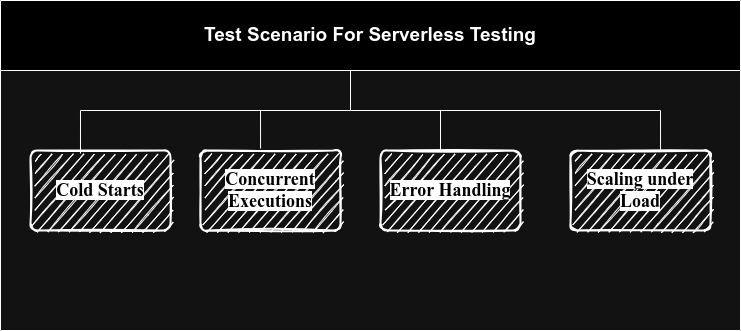
- Cold Starts:
- Scenario: Simulate a scenario where a function is not called for a period and a cold start occurs when event is triggered.
- Example: An eCommerce application may cold start if the product recommendation function is not called for a while. Test your system’s response time during this first run to ensure it meets your performance requirements.
- Concurrent Executions:
- Scenario: Tests the system’s ability to execute multiple functions simultaneously.
- Example: Simulate a situation where multiple users are sending messages at the same time in a chat application. This test scenario confirms that the Server less function that manages incoming messages scales without errors and can handle concurrency.
- Error Handling:
- Scenario: Create mistakes in the system to see how Server less functions respond to and recover from them.
- Example: For instance, purposefully designate failure scenarios for transactions in a payment processing function. Verify that error-handling procedures are followed, and that the system delivers pertinent feedback while maintaining data integrity.
- Scaling Under Load:
- Scenario: Examine the Server less application’s scalability under changing load conditions.
- Example: Consider simulating a spike in user requests during peak hours in a media streaming service. Make sure the Server less functions in charge of delivering content can grow horizontally to accommodate demand while preserving a seamless user experience.
Test Cases for Server less Architecture
After determining the most important test scenarios for Server less applications, let’s move on to creating efficient test cases. In a Server less environment, thorough coverage and early problem detection are guaranteed by a well-organised set of test cases.
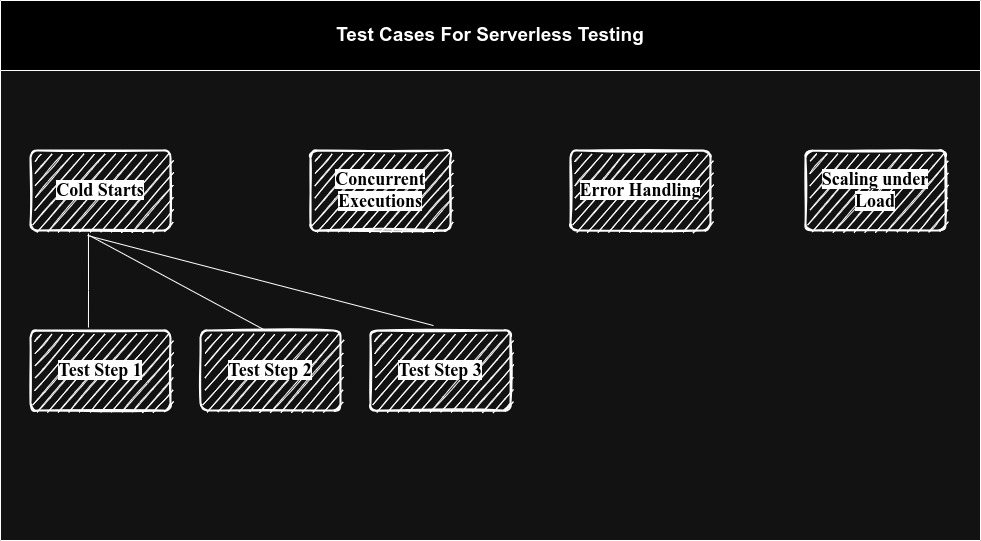
Test Case: Cold Start Performance
Objective: Evaluate the performance of Server less functions during cold starts.
- Steps:
- Activate a Server less function that has not been used in a set amount of time.
- During cold start, gauge the function’s response time.
- Check to see if the function operates within the specified bounds.
- Expected Results:
- The function ought to effectively manage the cold start, fulfilling the performance benchmarks.
- During cold starts, response time should fall within reasonable bounds.
Test Case: Concurrent Executions Handling
Objective: Assess the ability of Server less functions to handle concurrent executions.
- Steps:
- Play out a situation in which more than one instance of a function is called at the same time.
- Observe how the system performs when the load is higher.
- Check that functions have horizontal scaling to support multiple executions at once.
- Expected Results:
- Error-free concurrent execution of Server less functions should be possible.
- For the system to handle an increase in load, it should scale dynamically.
Test Case: Error Handling and Recovery
Objective: Verify the effectiveness of error handling mechanisms in Server less functions.
- Steps:
- Introduce mistakes into the system, like erroneous inputs or malfunctioning external services.
- Observe how errors are detected and handled by Server less functions.
- Verify that system gracefully bounces back from mistakes without jeopardising the integrity of the data.
- Expected Results:
- Errors should be recognised and handled correctly by Server less functions.
- Errors should be recovered from by the system, preserving overall functionality.
Test Case: Scaling Under Load
Objective: Evaluate the scalability of Server less functions under increased load.
- Steps:
- To initiate scaling mechanisms, simulate an increase in user requests.
- Keep an eye on Server less system’s horizontal scaling.
- Check that responsiveness and performance are maintained by the application even under heavy load.
- Expected Results:
- To manage growing loads, Server less functions ought to scale horizontally.
- Even at times of high demand, response times ought to stay within reasonable bounds.
Best Practices for Writing Test Cases for Server Less Automation Testing
Due to the unique characteristics of Server less architectures, crafting effective test cases for Server less automation testing, such as “Serverless Testing: Test Cases,” demands thoughtful consideration. Explore the following best practices:
Identify Key Test Scenarios:
Why: Pay attention to Server less application-specific scenarios like concurrent executions, cold starts and event driven workflows.
How: Work together with stakeholders, developers and architects to pinpoint crucial situations that affect the scalability and dependability of Server less functions.
Prioritise Edge Cases:
Why: Test boundary conditions and extreme scenarios to identify possible weakness and vulnerabilities in the system.
How: To guarantee robustness under a variety of circumstances, identify edge cases pertaining to input values, system load, and concurrent executions.
Design Independent Test Cases:
Why: Create test cases that can execute on their own to take advantage of Server less function’s statelessness.
How: Make sure every test case is independent of the status or outcomes of earlier test cases and is self-contained.
Include Negative Testing Scenarios:
Why: Check how well Server less functions respond to unusual circumstances, errors, and unexpected inputs.
How: To validate error and recovery mechanisms, create test cases that purposefully introduce errors, invalid inputs, or simulate failures of external services.
Simulate Event-Driven Workflows:
Why: Simulate real-world situations in which Server less functions are triggered by events to guarantee that event-driven architecture operates seamlessly.
How: Create test cases that imitate event triggers and verify that data consistency and function executions are carried out in the right order.
Focus on Performance and Scalability:
Why: Examine Server less function’s scalability and performance to make sure they can handle growing loads and respond to requests in a timely manner.
How: Use performance testing tools to stimulate different load scenarios and evaluate system behaviour, such as Artillery, K6, Jmeter or Gatling.
Monitor and Analyse Results:
Why: Test results should be continuously observed to spot trends, patterns and potential improvement areas.
How: Use monitoring tools to keep tabs on the Server less functions scalability, performance, and dependability over time.
Document Test Cases Clearly:
Why: Encourage team members to share knowledge and work together.
How: Clearly and succinctly describe test cases, included steps, expected outcomes, and any Server less testing considerations.
Stay Agile and Iterative:
Why: Adjust to changing needs and shifts in the Server less environment.
How: Adopt an iterative strategy, updating and improving the test cases on a regular basis as the Server less application changes.
Conclusion
Developing strong test cases for Server less automation testing is a strategic requirement rather than a simple task. Throughout this journey, we have looked at important test scenarios, automation tools, and best practices that are specific to the difficulties that Server less applications present.
As we end, keep in mind that strong test cases are more than just tick boxes; they are guardians of Server less applications dependability and efficiency. The listed references are a great place to start studying the subtleties of testing tools and Server less architecture.
Reference
- https://docs.aws.amazon.com/prescriptive-guidance/latest/serverless-application-testing
- https://aws.amazon.com/blogs/compute/getting-started-with-testing-serverless-applications/
- https://docs.aws.amazon.com/lambda/latest/dg/testing-guide.html
- https://docs.aws.amazon.com/prescriptive-guidance/latest/serverless-application-testing/best-practices.html