


In this blog, we will be discussing Flink Architecture and its core components.
Introduction
- Flink is a distributed system and requires effective allocation and management of compute resources in order to execute streaming applications.
- It integrates with all common cluster resource managers such as Hadoop YARN and Kubernetes,.
- In addition it,it can run standalone cluster or even as a library.
Components of a Flink Cluster
- The Flink Architecture runtime consists of two types of processes: a JobManager and one or more TaskManagers.

- The Client is not part of the runtime and program execution.
- It use case is to prepare and send a dataflow to the JobManager.
- After that, the client can disconnect (detached mode), or stay connected to receive progress reports (attached mode).
- The client runs either as part of the Java/Scala program that triggers the execution, or in the command line process
./bin/flink run .... - There are various ways to start JobManager and TaskManagers :
- Firstly, directly on the machines as a standalone cluster.
- Secondly, in containers, or managed by resource frameworks like YARN.
- TaskManagers connect to JobManagers, announcing themselves as available, and work assigns.
JobManager
The JobManager component in Flink Architecture has a number of responsibilities related to coordinating the distributed execution of Flink Applications:
- It decides when to schedule the next task.
- The Flink job can be executed as Session Cluster, Application Cluster, and Job Cluster. (or set of tasks).
- Reacts to finished tasks or execution failures.
- Coordinates checkpoints, and coordinates recovery on failures, among others.
- This process consists of three different components:
- ResourceManager
- The ResourceManager is responsible for resource de-/allocation and provisioning in a Flink cluster.
- It manages task slots, which are the unit of resource scheduling in a Flink cluster.
- Flink implements multiple ResourceManagers for different environments and resource providers such as YARN, Kubernetes and standalone deployments.
- In a standalone setup, the ResourceManager can only distribute the slots of available TaskManagers and cannot start new TaskManagers on its own.
- Dispatcher
- The Dispatcher provides a REST interface to submit Flink applications for execution and starts a new JobMaster for each submitted job.
- It also runs the Flink WebUI to provide information about job executions.
- JobMaster
- A JobMaster is responsible for managing the execution of a single JobGraph. Multiple jobs can run simultaneously in a Flink cluster, each having its own JobMaster.
- ResourceManager
- There is always at least one JobManager. A high-availability setup might have multiple JobManagers, one of which is always the leader, and the others are standby.
TaskManagers
- The TaskManagers (also called workers) execute the tasks of a dataflow, and buffer and exchange the data streams.
- There must always be at least one TaskManager.
- The smallest unit of resource scheduling in a TaskManager is a task slot.
- The number of task slots in a TaskManager indicates the number of concurrent processing tasks.
- Note that multiple operators may execute in a task slot
Tasks and Operator Chains
- For distributed execution, Flink chains operator subtasks together into tasks.
- A single thread executes each task.
- Chaining operators together into tasks is a useful optimization: it reduces the overhead of thread-to-thread handover and buffering, and increases overall throughput while decreasing latency.
- The sample dataflow in the figure below executes with five subtasks, and hence with five parallel threads.
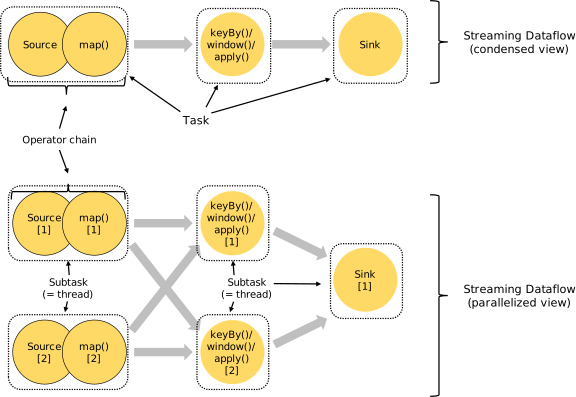
Flink Application Execution
- The jobs of a Flink Application can either be submitted to a long-running Flink Session Cluster, a dedicated Flink Job Cluster, or a Flink Application Cluster.
- The difference between these options is mainly related to the cluster’s lifecycle and to resource isolation guarantees.
Flink Session Cluster
- Cluster Lifecycle:
- In a Flink Session Cluster, the client connects to a pre-existing, long-running cluster that can accept multiple job submissions.
- Even after all jobs finishes, the cluster (and the JobManager) will keep running until we manually stop.
- The lifetime of a Flink Session Cluster is therefore not bound to the lifetime of any Flink Job.
- Resource Isolation:
- ResourceManager allocates the TaskManager slots on job submission and releases it once the job finishes.
- Because all jobs are sharing the same cluster, there is some competition for cluster resources — like network bandwidth in the submit-job phase.
- One limitation of this shared setup is that if one TaskManager crashes, then all jobs that have tasks running on this TaskManager will fail.
- In a similar way, if some fatal error occurs on the JobManager, it will affect all jobs running in the cluster.
Flink Job Cluster
- Cluster Lifecycle:
- In a Flink Job Cluster, the available cluster manager (like YARN) spins up a cluster for each submitted job.
- And this cluster is available to that job only.
- The client first requests resources from the cluster manager to start the JobManager and submits the job to the Dispatcher running inside this process.
- TaskManagers are then lazily allocated based on the resource requirements of the job.
- Once the job finishs, the Flink Job Cluster tores down.
- Resource Isolation:
- A fatal error in the JobManager only affects the one job running in that Flink Job Cluster.
Flink Application Cluster
- Cluster Lifecycle:
- A Flink Application Cluster is a dedicated Flink cluster that only executes jobs from one Flink Application and where the
main()method runs on the cluster rather than the client. - The job submission is a one-step process: we don’t need to start a Flink cluster first and then submit a job to the existing cluster session.
- Instead, we package our application logic and dependencies into a executable job JAR and the cluster entrypoint (
ApplicationClusterEntryPoint) is responsible for calling themain()method to extract the JobGraph. - This allows us to deploy a Flink Application like any other application on Kubernetes, for example.
- The lifetime of a Flink Application Cluster is therefore bound to the lifetime of the Flink Application.
- A Flink Application Cluster is a dedicated Flink cluster that only executes jobs from one Flink Application and where the
- Resource Isolation:
- In a Flink Application Cluster, the ResourceManager and Dispatcher scopes to a single Flink Application.
- It provides a better separation of concerns than the Flink Session Cluster.
Conclusion
- In this blog, we discussed the Flink Architecture and its execution use cases. The Flink job can be executed as Session Cluster, Application Cluster, and Job Cluster.
