



In the rapidly evolving landscape of modern technology, Kubernetes has emerged as the industry standard for container orchestration, offering unparalleled flexibility, scalability, and resilience. However, for many enterprises, the journey to K8s adoption can be fraught with challenges, including complexity, operational overhead, security concerns, and compliance requirements. In response to these challenges, Otomi emerges as a game-changer – a comprehensive adoption framework that simplifies and accelerates the transition to K8s, empowering organizations to embrace cloud-native computing with confidence and ease.
A Kubernetes adoption framework serves as a structured approach to support organizations in efficiently transitioning to K8s. It provides a set of guidelines, best practices, and tools to streamline the deployment, configuration, and management of K8s clusters. Essentially, a K8s adoption framework encompasses all the necessary components and processes required to successfully implement K8s within an organization. This includes defining governance policies, establishing security controls, designing architecture patterns, implementing automation workflows, and providing training and support for teams. By adopting a K8s adoption framework, organizations can ensure a consistent and standardized approach to Kubernetes deployment, enabling them to reap the full benefits of cloud-native computing while mitigating risks and complexities associated with adoption.
Understanding the Purpose for a Kubernetes Adoption Framework
K8s adoption presents several challenges for organizations, including:
Complexity
K8s is a complex platform with a steep learning curve, requiring specialized knowledge and expertise to deploy and manage effectively.
Operational Overhead
Managing K8s clusters involves various operational tasks such as provisioning, configuration, scaling, and monitoring, which can be time-consuming and resource-intensive.
Security and Governance
Ensuring security and compliance in K8s environments requires robust policies, configurations, and monitoring capabilities, adding another layer of complexity.
Developer Experience
Providing a seamless experience for developers to deploy and manage applications on K8s requires implementing best practices, tooling, and automation.
Introducing Otomi: A Comprehensive Adoption Framework for Kubernetes
Otomi addresses these challenges by providing a comprehensive adoption framework that streamlines K8s deployment, management, and operation. Built on top of Kubernetes, Otomi adds developer- and operations-centric tools, automation, and self-service capabilities, enabling organizations to unlock the full potential of cloud-native computing.
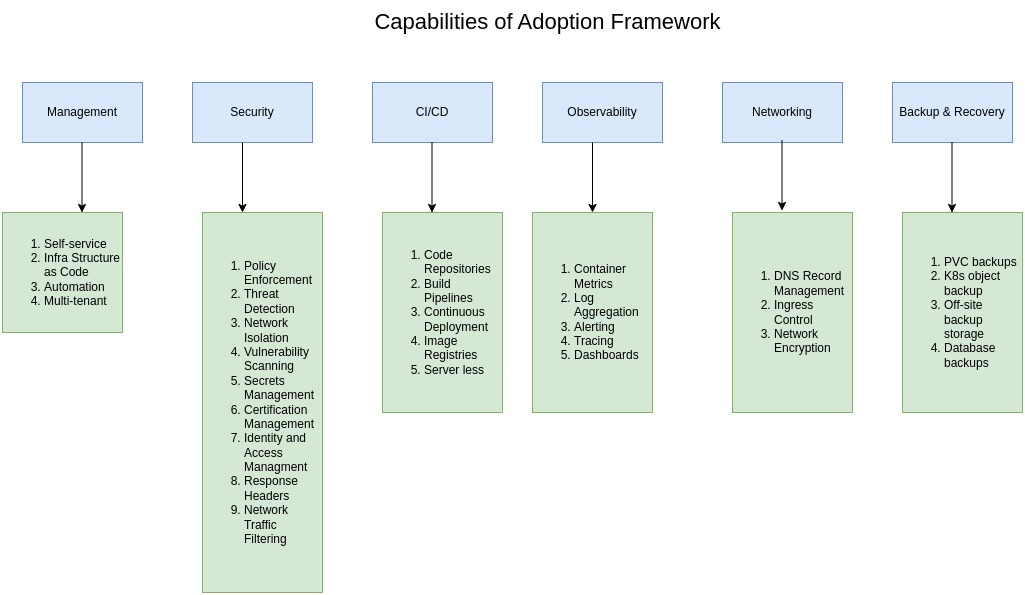
Key Features of Otomi
- Simplified Deployment: Otomi simplifies the deployment of K8s clusters by providing pre-configured Helm charts and automation scripts, reducing the time and effort required to set up a production-ready environment.
- Operational Efficiency: With built-in monitoring, logging, alerting, and automation capabilities, Otomi reduces the operational overhead associated with managing K8s clusters, allowing teams to focus on innovation rather than infrastructure.
- Security and Governance: Otomi incorporates production-ready security best practices, including workload isolation, image vulnerability scanning, policy enforcement, and RBAC, ensuring a secure and compliant K8s environment.
- Developer Experience: Otomi provides a user-friendly interface and self-service capabilities for developers to deploy, manage, and monitor applications on K8s, improving productivity and collaboration across teams.
Benefits of Using Otomi for Kubernetes Adoption
Organizations stand to benefit from using Otomi as the K8s adoption framework-
Compliance with Security Regulations
Otomi establishes clear boundaries within which developers operate, ensuring compliance with security regulations and minimizing the risk of non-compliance.
Speed and Scalability
Otomi accelerates the migration to K8s by significantly reducing preparation time, enabling faster time-to-market for new applications. Additionally, Otomi facilitates scalability, allowing easy expansion to new environments and the development of standard profiles for K8s clusters across different cloud platforms.
Enhanced Security and Compliance
Otomi prioritizes security and compliance, embedding them into the foundation of the IT infrastructure and minimizing the time spent on implementing complex configurations. This ensures that developers and engineers can safely operate containerized workloads on K8s while adhering to compliance regulations.
Cost Visibility and Control
Otomi provides better cost visibility, helping organizations maintain control over engineering expenses and avoid unexpected and unnecessary costs.
Standardization for Multi-Tenancy
Otomi enables the standardization of multi-tenancy, allowing organizations to enforce policies and access controls across different user groups, thereby ensuring a consistent and secure operating environment.
Conclusion
Otomi offers a comprehensive solution for Kubernetes adoption. By providing organizations with the necessary capabilities and controls to effectively deploy and manage containerized applications. By leveraging Otomi as their adoption framework, organizations can navigate the complexities of Kubernetes adoption with efficiency. Ultimately accelerating their journey towards cloud-native success. With Otomi, the transition to Kubernetes becomes not only feasible. But also streamlined, empowering organizations to embrace the transformative power of cloud-native technologies with ease.
Reference