



GraphQL in Microservices Architecture
In today’s software development landscape, microservices architecture stands out as a leading paradigm for crafting scalable, resilient, and maintainable applications. By decomposing intricate systems into smaller, autonomous services, developers gain enhanced agility and adaptability. However, as microservices gain traction, efficient data communication between services becomes paramount. Here’s where GraphQL steps in, offering a compelling solution to the challenges of data fetching and manipulation in a distributed environment.
Microservices Architecture
Before exploring GraphQL complexities, let’s first understand the nature of microservices architecture. In a microservices-based system, applications comprise multiple independent services, each tasked with a specific business function. These services maintain loose coupling and communicate through well-defined APIs. This architectural style fosters modularity, enabling teams to develop, deploy, and scale services independently, thus accelerating innovation.
Addressing Data Communication Challenges
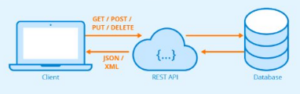
One of the primary challenges in microservices architecture is managing data communication between services. Traditional RESTful APIs have been the conventional solution. However, REST APIs often suffer from over-fetching or under-fetching of data, leading to performance bottlenecks and increased network overhead. Moreover, maintaining and versioning numerous REST endpoints can become cumbersome and error-prone as systems evolve.
Introduction of GraphQL
GraphQL, developed by Facebook in 2012 and open-sourced in 2015, addresses these challenges by providing a query language and runtime for efficiently fetching and manipulating data. Unlike REST APIs, which expose predefined endpoints, GraphQL enables clients to request precisely the data they need in a single query, reducing over-fetching and allowing clients to fetch related data in a nested manner, minimizing the number of network requests.
GraphQL is a query language for APIs and a runtime for fulfilling those queries with your existing data. GraphQL provides a complete and understandable description of the data in your API, gives clients the power to ask for exactly what they need and nothing more, makes it easier to evolve APIs over time, and enables powerful developer tools.
What is GraphQL?
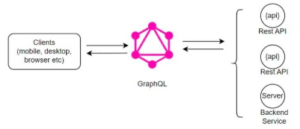
GraphQL is a query language for APIs, it gives power to the client to control the response on what they need instead of the server deciding what to respond.
It sits between clients and backend services and fulfills the query for clients. GraphQL can aggregate multiple resource requests into a single query.
Advantages of GraphQL in Microservices Architecture
1. Flexible Data Retrieval:
GraphQL empowers clients to specify their data requirements using a single query, eliminating the need for multiple round trips to fetch related data, especially advantageous in a microservices environment.
2. Schema Stitching:
GraphQL supports schema stitching, a technique for combining multiple GraphQL schemas into a single, unified schema, providing a seamless experience for clients.
3. Versioning and Evolution:
GraphQL schemas are inherently versioned, allowing incremental changes without breaking existing clients, ideal for a microservices ecosystem where services may evolve independently.
4. Performance Optimization:
GraphQL’s ability to fetch only required data optimizes performance by reducing unnecessary data transfer over the network. Additionally, features like caching and persisted queries further enhance performance.
5. Developer Experience:
GraphQL’s intuitive query language and self-documenting nature enhance the developer experience, providing clear insights into available data and operations, fostering collaboration among teams.
Implementing GraphQL in Microservices
Integrating GraphQL into a microservices architecture requires careful planning and consideration. Each microservice may expose its GraphQL schema, representing its domain-specific data and operations. These schemas can then be stitched together to create a unified API gateway, which serves as the entry point for client requests. Service-to-service communication can be achieved using traditional HTTP requests or more advanced protocols like gRPC.
Overview
Let’s explore a simplified example of how GraphQL can streamline data fetching in a microservices architecture. In this scenario, imagine a social media platform where users can retrieve information about posts and comments.
# Schema Definition

type Query {
  post(id: ID!): Post
}

type Post {
  id: ID!
  title: String!
  content: String!
  author: User!
  comments: [Comment!]!
}

type User {
  id: ID!
  username: String!
}

type Comment {
  id: ID!
  text: String!
  author: User!
}
Code breakdown:
- Schema Definition:
- We define a GraphQL schema with three types: Post, User, and Comment.
- Each type has its own set of fields representing the attributes of that entity.
- Query Type:
- The Query type defines a single field post (id: ID!), which allows clients to retrieve a post by its ID.
- When a client queries for a post, they specify the ID of the post they want to retrieve.
- Post Type:
- The Post type represents a social media post.
- It has fields for id, title, content, author and comments.
- The author field is of type User, representing the user who created the post.
- The Comments field is an array of Comment objects representing the comments on the post.
- User and Comment Types:
- The User type represents a user on the platform.
- It has fields for id and username.
- The Comment type represents a comment on a post.
- It has fields for id, text, and author.
The above example shows how GraphQL simplifies data fetching in a microservices architecture. With GraphQL, clients can specify their data requirements in a single query, reducing over-fetching and enabling efficient communication between microservices. As organizations continue to adopt microservices architecture, GraphQL serves as a valuable tool for building flexible and scalable systems.