



.NET 8 Features and Enhancements:
In the dynamic world of software development, Microsoft’s .NET framework has long been a favourite among developers and businesses. It offers a wide range of features and tools that streamline development processes. Moreover, its vibrant community and Microsoft’s ongoing innovations add to its appeal.
Over time, Microsoft has released several versions of the .NET framework, each aimed at improving its capabilities. The latest release, .NET 8, introduces numerous new features and advancements. In this article, we’ll dive deep into .NET 8, exploring its latest features and providing comprehensive insights into this significant release. From performance enhancements to new functionalities, .NET 8 is set to have a big impact on the development landscape.
Overview of .NET 8:
By building upon and enhancing the individual capabilities of both the .NET Framework and .NET Core, .NET 8 offers developers a unified and comprehensive platform for developing modern applications. Released on November 14, 2023, .NET 8 introduces greater performance, enhanced diagnostics and observability, extended cross-platform support, and advanced tooling and integration, among other features. This suite of capabilities empowers developers to construct more potent and dynamic applications effectively. Moreover, .NET 8 is an LTS (Long Term Support) version, ensuring continued support, updates, and fixes for at least three years. Consequently, developers and businesses can adopt .NET 8 as their primary development platform, maintaining a consistent application platform while continually benefiting from its numerous features.
Unveiling the Features and Enhancements of .NET 8:
Native Ahead-of-Time (AOT) Compilation
A revolutionary feature of .NET 8, Native Ahead-of-Time (AOT) Compilation propels the platform to new heights. Unlike Just-in-Time (JIT) Compilation, which converts code to machine code at runtime, Native AOT allows the compilation of code into native machine code during the build process. As a result, this feature provides profound benefits, including faster startup times, improved performance, and smaller application sizes. Consequently, .NET developers can effortlessly build high-end, fast, and responsive apps. Code Generation Enhancements
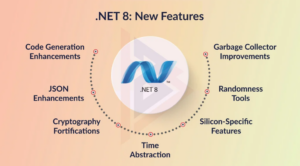
Efficient code generation is vital for optimizing software performance. .NET 8 introduces significant enhancements to its code generation techniques, including advanced memory management and optimized machine code generation. Notably, the compiler can now leverage hardware-specific instructions, such as SIMD (Single Instruction, Multiple Data) instructions, leading to significant performance improvements for applications managing large amounts of data.
Features of .NET 8
Garbage Collector Improvements:
Substantial enhancements to .NET’s garbage collector facilitate dynamic adjustment of a Cloud-native application’s memory limit. This improvement is particularly beneficial for platforms like Kubernetes.
JSON Enhancements
Improved JSON serialization and deserialization in .NET 8 include support for new numeric types like the half struct, facilitating seamless interaction with hardware accelerators and NPUs.
Randomness Tools
.NET 8 introduces new tools that directly use randomness as a selector, thereby streamlining processes like machine learning exploration and training.
Cryptography Fortifications
In order to enhance application security, .NET 8 actively supports the latest SHA-3 cryptographic technology, providing enhanced security compared to SHA-2.
Silicon-Specific Features
Leveraging modern hardware capabilities, .NET 8 significantly boosts the performance of data-driven software applications.
Time Abstraction
Time abstraction features in .NET 8 simplify the handling of time-related bugs in global applications across different time zones.
Changes to Windows Forms
While significant modifications have been made to Windows Forms’ pixel scaling mechanism, enhancing visual experiences for high-resolution displays, it’s crucial to conduct thorough UI testing to ensure compatibility.
Container Image Updates
Updates to Alpine Linux, used as the base for container images, have led to revamped .NET container images to ensure sustained compatibility and security.
Difference Between .NET 6, .NET 7, .NET 8
| Feature/Area | .NET 6 | .NET 7 | .NET 8 |
| Release Version | LTS (Long Term Support) | STS (Standard Term Support) | LTS (Long Term Support) |
| Performance | Introduced On-Stack Replacement (OSR) for improved dynamic method compilation. | Enhanced OSR for efficiency and introduced Dynamic Profile-Guided Optimization (DPGO) for runtime code optimization based on usage patterns. | Improved ARM64 architecture performance with optimized garbage collection and SIMD instruction generation. Supported AVX-512 and Vector 512 hardware intrinsics, along with optimizations for SSE and AVX2. |
| JSON Serialization | Enhanced | Improved with the inclusion of features like improved extensibility, contract customization, and polymorphic serialization | Augmented with support for new numeric types and serialization for members not present in the JSON payload |
| Generic Math | Introduced as a Preview Feature | Introduced with C# 11 | Refined with support for new numeric types and introduced optimizations |
| Regular Expressions | Various improvements | Improved with nonbacktracking mode and regex source generators | Numerous enhancements to the regex generator, simplified complex parsing, and Unicode property escapes, among others |
| .NET Libraries | Various improvements focused on performance, scalability, and overall efficiency | Further optimizations, including support for microseconds and nanoseconds | Improvements to the GC, new cryptography algorithms, incorporation of new methods, and performance focused-types in the system |
| Observability | Reliance on third-party tools and libraries for observability | Built around OpenTelemetry, introduced diagnostics middleware components, and optimized JIT compiler and GC | Incorporated built-in tools for improved diagnostic and observability and AI-powered insights |
| Software Development Kit (SDK) Features | Introduced to simplify project configuration and dependencies with basic tooling commands | Enhancements to the SDK, CLI tooling experience, central package management | Builds upon existing features to enhance capabilities and further optimized dotnet publish and dotnet pack commands to produce release assets by default |
| P/Invoke Source Generation | Introduced with basic source generation and simple functions | Introduced for better performance and AOT compilation | Introduced as a fully supported feature, with the addition of advanced features and enhanced performance |
| Related Products | – | Updates to products like Visual Studio 2022, C# 11, F# 7, .NET MAUI, and more | Alterations to bundled .NET container images, including default Linux distribution and non-root capabilities |
| .NET Platform | Strong focus on unifying the platform | Continued focus on the unification of the .NET ecosystem, with improvements to the overall potential | Enhancements to Native Ahead-of-Time (AOT) compilation, Code Generation, MAUI advancements, and more |
| Garbage Collector | – | – | New API that allows changing and adjusting application memory limit for cloud-native applications |
| Cryptography Tooling | – | – | Now supports SHA-3, the more secure and resistant to known attacks, as an alternative to the widely used SHA-2 |
| Time Abstraction | – | – | Introduced a local time-provider for different time zones, to simplify development of global apps and problem-solving of time-related bugs |
| Breaking Changes | – | – | Introduced, for planned deprecations or infrastructure support changes |
| Blazor Enhancements | – | – | Server-side rendering, enables interactivity for individual components with Blazor Server, new templates, Blazor Content Security Policy (CSP), and much more |
| Updates to ASP.NET Core | – | – | Enhanced debugging experience, servers, and middleware, efficient reconnection of SignalR, and API authoring, among others |
Stay tuned for more related Nash-Blogs.