


Introduction:-
API testing is indispensable for fostering business agility, enabling organizations to swiftly adapt to changing market demands. By rigorously validating API functionality, performance, and security, businesses can confidently iterate and deploy software updates, ensuring alignment with evolving customer needs and industry trends. This proactive approach minimizes the risk of disruptions and accelerates time-to-market for innovative solutions. In today’s fast-paced digital landscape, where responsiveness is key to success, robust API testing practices serve as a linchpin for maintaining agility, driving growth, and staying ahead of the competition.In this blog we will look into Architectural Insights-RESTful API Testing Strategies for Business Agility.
API testing is vital for ensuring a seamless user experience on platforms like movie streaming services. By validating features such as user authentication and playback control, API testing ensures scalability, security, and reliability. This contributes to long-term success by maintaining privacy, accuracy, and user satisfaction in a rapidly evolving digital landscape.
Highlights challenges of API testing and the need for effective strategies.
Challenges in API testing include dynamic data, dependency management, integration complexity, and security concerns. Architectural Insights-RESTful API Testing Strategies for Business Agility.
Need for Effective Strategies:
- Automation: Streamlining testing processes to cope with dynamic data and integration complexities.
- Mocking: Simulating dependencies for isolated testing and reducing reliance on external resources.
- Security Testing: Proactively identifying and mitigating security risks to safeguard sensitive data.
- Continuous Testing: Integrating testing into development pipelines for early defect detection and rapid feedback.
Understanding APIs:-
APIs, or Application Programming Interfaces, are essential in modern software development. They allow different applications to communicate and exchange information efficiently. In simple terms, APIs are the “glue” that holds various software components together.
There are several types of APIs, each with its unique features and testing considerations. Here are three common types:
| Feature | SOAP | REST | GraphQL |
| Protocol | SOAP is based on XML and uses HTTP, SMTP, or TCP as the transport protocol. | REST is based on HTTP and uses HTTP methods (GET, POST, PUT, DELETE) for CRUD operations. | GraphQL is based on HTTP and uses a single endpoint for all operations. |
| Data Format | SOAP uses XML for data transfer. | REST can use various data formats, including JSON, XML, and plain text. | GraphQL uses JSON for data transfer. |
| Complexity | SOAP is more complex and requires more extensive testing due to its use of XML and WSDL. | REST is simpler and more flexible than SOAP, making it easier to test and implement. | GraphQL is more complex than REST but provides more flexibility and efficiency in data retrieval. |
| Caching | SOAP does not support caching. | REST supports caching through HTTP headers. | GraphQL does not support caching out of the box but can be implemented using third-party libraries. |
| Scalability | SOAP is less scalable than REST and GraphQL due to its use of XML and WSDL. | REST is highly scalable and can handle a large number of requests. | GraphQL is highly scalable and can handle complex queries efficiently. |
| Testing Considerations | SOAP requires specialized testing tools and techniques due to its complexity. | REST can be tested using standard HTTP testing tools and libraries. | GraphQL requires specialized testing tools and techniques to ensure its performance and security. |
API Testing Strategies:-
1. Automated Testing:
Automated testing is crucial for improving business agility by reducing the time and effort required for manual testing. It tools and frameworks like Postman, RestAssured, and JMeter can help developers create, maintain, and execute automated tests. These tools can simulate various scenarios, including different HTTP methods, headers, and payloads, and can generate test reports for easy analysis.
import io.restassured.RestAssured;

import io.restassured.response.Response;

import io.restassured.specification.RequestSpecification;

import org.junit.Test;


import static org.hamcrest.Matchers.equalTo;


public class ApiTest {


    @Test

    public void testGetUser() {

        // Set up request

        RequestSpecification request = RestAssured.given();

        request.header("Content-Type", "application/json");


        // Send request and get response

        Response response = request.get("https://jsonplaceholder.typicode.com/users/1");


        // Assert response

        response.then()

                .statusCode(200)

                .body("id", equalTo(1))

                .body("name", equalTo("Leanne Graham"));

    }

}
2. Continuous Integration and Continuous Deployment (CI/CD):
CI/CD is essential for improving the speed and efficiency of the testing process. Tools like Jenkins, Travis CI, and CircleCI can help developers automate the build, test, and deployment process, ensuring that changes are tested and deployed quickly and reliably.
Example:
pipeline { agent any stages { stage('Build') { steps { sh 'mvn clean package' } } stage('Test') { steps { sh 'mvn test' } } stage('Deploy') { steps { sh 'mvn deploy' } } } }
3. Behavior-Driven Development (BDD):
BDD is a collaborative approach to software development that involves developers, testers, and business stakeholders. BDD tools like Cucumber and JBehave can help developers create tests that are easy to understand and maintain, improving collaboration and reducing miscommunication.
Feature: User registration

  As a new user

  I want to register for an account

  So that I can access the website


  Scenario: Successful registration

    Given I am on the registration page

    When I enter a valid email address

    And I enter a valid password

    And I confirm my password

    And I click the register button

    Then I should see a success message
4. Test-Driven Development (TDD):
TDD is a development practice that involves writing tests before writing code. TDD can help developers ensure that their code is testable, maintainable, and reliable.
Example:-
import org.junit.Test;

import static org.junit.Assert.assertEquals;

public class ApiTest {

    @Test

    public void testGetUser() {

        // Set up request

        RequestSpecification request = RestAssured.given();

        request.header("Content-Type", "application/json");

        // Send request and get response

        Response response = request.get("https://jsonplaceholder.typicode.com/users/1");

        // Assert response

        assertEquals(200, response.getStatusCode());

        assertEquals("Leanne Graham", response.jsonPath().getString("name"));

    }

}
Architectural Diagram of API Testing-
There are two ways to build the software-
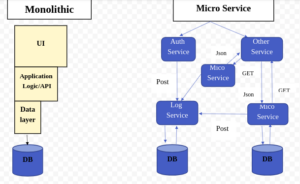
In a monolithic architecture, all components are tightly integrated and run as a single unit. The UI, Application Logic, Data Layer, and Logging are all part of the same application.
In a microservices architecture, smaller, independent services communicate with each other using lightweight protocols. Each service has its own API and communicates with other services through an API Gateway. This allows for greater flexibility, scalability, and maintainability compared to a monolithic architecture.
API Testing Best Practices:-
1. Test Data Management:
- Importance: Ensure realistic and representative data for comprehensive testing.
- Example: Generate test data using tools like Faker or create scripts to populate databases with diverse datasets.
2. Testing in Different Environments:
- Importance: Validate API functionality across various environments for reliability.
- Example: Use environment-specific configurations and deploy automated tests in CI/CD pipelines for consistent validation.
3. Monitoring and Logging:
- Importance: Track API calls for performance, error analysis, and optimization.
- Example: Implement logging frameworks like Log4j or ELK stack to capture API request/response data for analysis and troubleshooting.
Conclusion-
In conclusion, adopting effective RESTful API testing strategies enhances business agility, ensuring reliability and scalability. By prioritizing automation, integration, and security, organizations can thrive amidst evolving market demands and maintain competitive advantage.
References-