


Introduction:
In the ever-evolving landscape of software development, architectures that promote scalability, resilience, and responsiveness are paramount. Enter Event-Driven Architecture (EDA), a paradigm that emphasizes the production, detection, consumption, and reaction to events. In this guide, we’ll dive into the world of Event-Driven Architecture, exploring its principles, benefits, and how it empowers .NET applications to thrive in dynamic environments.
Understanding Event-Driven Architecture
At its core, Event-Driven Architecture revolves around the concept of events – occurrences of significant changes or state transitions within a system. Events can be anything from user actions, system notifications, sensor readings, to business transactions. In an event-driven system, components communicate primarily through events, enabling loose coupling, asynchronous communication, and flexibility.
Key Components of Event-Driven Architecture
Event-Driven Architecture comprises several key components:
- Event Producer: Entities responsible for generating and emitting events into the system. These can be user interfaces, backend services, IoT devices, or external systems.
- Event Broker: Middleware responsible for receiving, storing, and routing events to interested consumers. Popular event brokers include Apache Kafka, RabbitMQ, and Azure Event Hubs.
- Event Consumers: Components that subscribe to specific events and react accordingly. Consumers can be microservices, serverless functions, or other parts of the application.
- Event Stream: The flow of events within the system, often represented as a sequence or stream of events. Event streams provide a unified view of system interactions and facilitate event processing and analysis.
Benefits of Event-Driven Architecture
Event-Driven Architecture offers several benefits:
- Scalability: Components in an event-driven system can scale independently, allowing for horizontal scaling and better resource utilization.
- Flexibility: Loose coupling between components enables agility and flexibility in system design and evolution. New functionalities can be added or modified without impacting existing components.
- Resilience: Asynchronous communication and fault isolation enhance system resilience and fault tolerance. Failures in one component do not cascade to others, leading to more robust systems.
- Real-Time Processing: Event-driven systems excel in processing real-time data and reacting to events with minimal latency, making them suitable for use cases requiring real-time analytics, monitoring, and decision-making.
Event-Driven Architecture in .NET Applications
Implementing Event-Driven Architecture in .NET applications involves leveraging frameworks, libraries, and best practices tailored for the .NET ecosystem. Let’s look at an example scenario:
Scenario: Building an E-commerce Application
In our example, we’ll build an event-driven e-commerce application using .NET technologies:
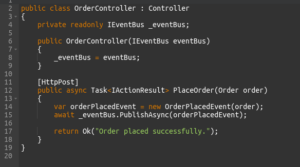
- Event Producer: ASP.NET Core Web Application
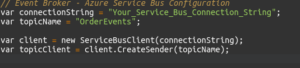
- Event Broker: Azure Service Bus
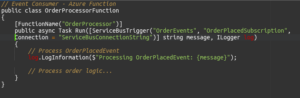
- Event Consumer: Azure Function
Conclusion
Event-Driven Architecture revolutionizes the way we design, build, and operate software systems, offering scalability, flexibility, and real-time capabilities. In the .NET ecosystem, Event-Driven Architecture empowers developers to create resilient, responsive applications that can adapt to changing business needs and evolving technology landscapes. By embracing Event-Driven Architecture principles and best practices, .NET applications can thrive in dynamic environments, delivering value to users and stakeholders alike.