



The Evolution of .NET Development
Historically, building web applications in .NET involved significant ceremony. Developers had to create controllers, models, and views, configure routing, and manage dependencies. While these practices provided flexibility and control, they also introduced boilerplate code and complexity, especially for smaller projects or rapid prototyping.
Recognizing the need for a more lightweight approach, Microsoft introduced Minimal APIs in .NET 6. This paradigm shift aims to simplify web development by reducing the amount of code required to create HTTP services and endpoints, allowing developers to focus on business logic rather than infrastructure.
What are Minimal APIs?
Minimal APIs in .NET provide a way to define HTTP endpoints using a concise syntax, often in a single file, without the need for a traditional MVC (Model-View-Controller) setup. They leverage the power of C# language features and ASP.NET Core routing to enable developers to define routes and handle requests with minimal ceremony.
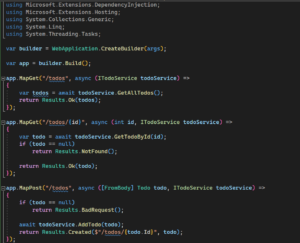
At the heart of Minimal APIs is the WebApplication class, which serves as the entry point for defining HTTP endpoints. Developers can use methods like MapGet, MapPost, MapPut and MapDelete to map HTTP methods to specific routes, passing in lambda expressions to define the request handling logic directly.
Simplifying Development with Minimal APIs
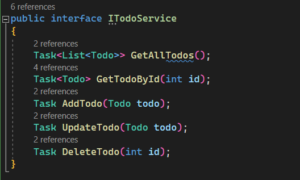
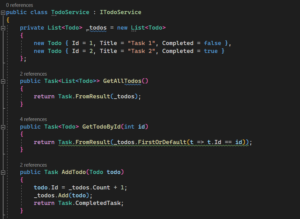
Let’s explore a simple example to illustrate the power of Minimal APIs. Suppose we want to create a basic API for managing tasks. In a traditional MVC setup, we might create controllers, models, and possibly views. However, with Minimal APIs, we can achieve the same functionality with significantly less code.


Benefits of Minimal APIs
- Reduced Boilerplate: Minimal APIs eliminate the need for boilerplate code associated with traditional MVC setups, leading to cleaner and more concise codebases.
- Faster Development: With less infrastructure to set up and manage, developers can prototype and iterate on ideas more quickly, accelerating the development cycle.
- Improved Performance: The lightweight nature of Minimal APIs can lead to improved performance, as there is less overhead involved in handling requests and responses.
- Easier Maintenance: By reducing complexity, Minimal APIs make codebases easier to understand and maintain, lowering the barrier to entry for new developers joining a project.
Conclusion
Minimal APIs in .NET represent a paradigm shift in web development, offering a simpler and more streamlined approach to building HTTP services and endpoints. By leveraging the power of C# language features and ASP.NET Core routing, developers can create powerful web applications with minimal ceremony, focusing on business logic rather than infrastructure.