



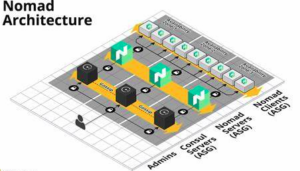
The Architecture of Nomad
Before we explore the features of Nomad, it is essential to understand its architecture. Nomad follows a client-server architecture, with the clients being responsible for running applications and the servers managing the cluster. This separation of responsibilities allows for a highly scalable and fault-tolerant system.
At the core of Nomad’s architecture is the Raft consensus algorithm, which ensures that all servers in the cluster have consistent information about the state of the cluster. This allows for seamless failover and resilience in case of server failures. The clients communicate with the servers through a thin, lightweight protocol, making it easy to add new clients to the cluster as needed.
The servers hold the cluster state and are responsible for orchestrating the deployment of applications on the clients. They also manage resources, handle scheduling, and monitor the health of the cluster. The clients, on the other hand, run the actual workloads and report back to the servers on their status. This architecture allows Nomad to achieve high availability and efficient resource utilization.
Components of Nomad
Nomad has several key components that work together to orchestrate workflows efficiently. These include:
- Job: A job is the most fundamental component of Nomad. It defines the tasks that need to be executed and the desired state of those tasks.
- Task: A task is a single unit of execution within a job. It represents a specific workload, such as a container or a virtual machine.
- Allocation: When a task is scheduled and assigned to a client, it is referred to as an allocation. Each allocation runs on a single client within a sandboxed environment.
- Client: Clients are nodes in the cluster that run the applications defined in the jobs. They register with the servers and receive tasks to execute.
- Server: Servers are responsible for managing the cluster state, scheduling tasks, and monitoring the health of the cluster.
- Region/DC: Nomad supports multi-region and multi-data center deployments, allowing you to distribute your applications globally.
- Nomad Enterprise: Nomad Enterprise is the commercial version of Nomad, offering additional features such as namespaces, advanced security, and enhanced support.
Real-World Applications of Nomad
Now that we have explored Nomad’s features and capabilities let us look at some real-world use cases where Nomad has proven to be a valuable tool.
1. Edge Computing
Edge computing is gaining popularity, and with the rise of Internet of Things (IoT) devices, organizations are looking for ways to deploy their applications closer to the end-users. Nomad’s multi-region and multi-cloud support make it an ideal solution for edge computing deployments. With Nomad, organizations can deploy their applications on servers located in different regions, allowing for efficient processing of data at the edge.
Furthermore, Nomad’s declarative configuration model is particularly useful for edge computing, as it simplifies the deployment and management of complex applications across multiple locations.
2. Hybrid Cloud Deployments
Many organizations have a mix of on-premises infrastructure and cloud providers, making it challenging to manage and deploy applications consistently. Nomad’s ability to handle deployments across diverse environments makes it an ideal choice for hybrid cloud deployments. Organizations can use Nomad to deploy applications on their on-premises servers and cloud providers like AWS or Azure seamlessly.
Additionally, Nomad’s federation feature allows for central management of all deployments, reducing the complexity of managing multiple clusters in different environments.
3. Microservices Architecture
Microservices architecture has become increasingly popular due to its flexibility and scalability. However, managing microservices can be complex, with multiple services running on different technologies. Nomad’s flexibility and support for diverse runtime technologies make it an excellent choice for deploying and managing microservices.
Nomad’s load balancing and auto-scaling capabilities are also essential for microservices deployments, ensuring efficient resource utilization and high availability.
Conclusion
HashiCorp Nomad has emerged as a versatile and robust workflow orchestrator that addresses the complexities of modern application deployment and management. Its flexibility, scalability, and advanced features make it a preferred choice for organizations looking to streamline their workflows across diverse environments.
In this comprehensive guide, we explored the scope of Nomad, its architecture, key features, and real-world applications. We hope this guide has provided you with a deep dive into Nomad and has given you a better understanding of its capabilities. With Nomad continuing to evolve and improve, it is undoubtedly a tool that will continue to play a vital role in the future of application deployment.
You can find more amazing blogs on this link and the official documentation.