


Natural Language Processing (NLP) is a critical component of modern AI applications, enabling machines to understand, interpret, and generate human language. The Microsoft Semantic Kernel SDK offers an array of tools to harness the power of NLP, making it easier for developers to create intelligent, language-aware applications. In this blog, we will explore various applications of the Semantic Kernel SDK in NLP and how it can revolutionize the way we interact with technology.
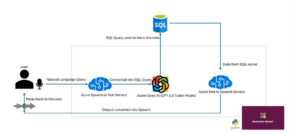
Key Applications of Semantic Kernel in NLP
Text Summarization
Text summarization is the process of distilling the most important information from a large body of text. This is particularly useful for quickly understanding long documents, articles, or reports. Text summarization can be abstractive, generating new phrases, or extractive, picking key sentences from the text.
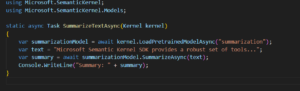
Use Cases:
-
- News Aggregation: Summarizing news articles for quick reads.
- Research Papers: Condensing lengthy academic papers for easier understanding.
- Meeting Minutes: Creating brief summaries of long meetings.
Sentiment Analysis
Sentiment analysis identifies the emotional tone behind a body of text, such as positive, negative, or neutral sentiment. This is widely used in customer feedback analysis, social media monitoring, and market research.
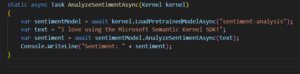
Use Cases:
-
- Customer Feedback: Understanding customer satisfaction and areas for improvement.
- Social Media Monitoring: Tracking public sentiment about a brand or product.
- Market Research: Analyzing consumer opinions and trends.
Named Entity Recognition (NER)
Named Entity Recognition identifies and classifies entities (like names of people, organizations, locations) within a text. NER is essential for information extraction and organizing unstructured data.
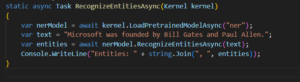
Use Cases:
-
- Information Extraction: Extracting key data points from articles and reports.
- Knowledge Graphs: Building structured representations of information.
- Document Classification: Categorizing documents based on recognized entities.
Language Translation
Language translation converts text from one language to another, enabling cross-lingual communication. This is critical for global applications and services.
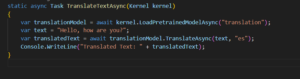
Use Cases:
-
- Global Communication: Bridging language gaps in international business.
- Content Localization: Translating content for different markets.
- Travel Assistance: Providing real-time translation for travelers.
Text Generation
Text generation models create coherent and contextually relevant text based on a given prompt. This can be used for content creation, chatbots, and automated report generation.
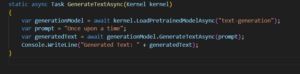
Use Cases:
-
- Content Creation: Automating the creation of articles, blogs, and marketing materials.
- Chatbots: Enhancing conversational agents with natural language responses.
- Report Generation: Automating the generation of business reports and summaries.
Document Classification
Document classification involves categorizing text into predefined groups. This is useful in organizing large volumes of text data, making it easier to manage and retrieve relevant information.
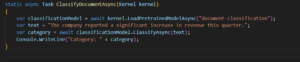
Use Cases:
- Email Filtering: Automatically categorizing incoming emails into folders such as “Work,” “Personal,” and “Promotions.”
- Legal Document Management: Classifying legal documents into categories like “Contracts,” “Litigations,” and “Compliance.”
- Content Management Systems: Organizing articles and blog posts into relevant topics.
Question Answering
Question answering models can provide precise answers to user queries based on a given context or knowledge base. This can enhance customer support systems and information retrieval applications.
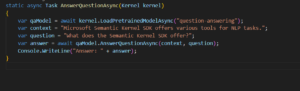
Use Cases:
- Customer Support: Providing instant answers to frequently asked questions.
- Educational Tools: Assisting students with homework by answering questions based on textbooks or study materials.
- Internal Knowledge Bases: Helping employees quickly find information within company documents.
Text Normalization
Text normalization involves converting text into a standard format. This is useful for preparing data for further processing, such as removing noise from user-generated content.
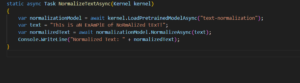
Use Cases:
- Data Cleaning: Standardizing text data in preparation for analysis.
- Social Media Monitoring: Normalizing user-generated content to improve sentiment analysis accuracy.
- Voice-to-Text Applications: Converting transcriptions into a consistent format.
Keyword Extraction
Keyword extraction identifies the most important words and phrases in a text. This helps in summarizing the main topics and can improve search engine optimization (SEO).

Use Cases:
- SEO Optimization: Identifying keywords to enhance website visibility on search engines.
- Content Tagging: Automatically tagging articles and blogs with relevant keywords.
- Research: Highlighting key terms in academic papers for easier reference.
Speech-to-Text and Text-to-Speech Integration
While primarily focused on text, integrating NLP with speech capabilities can broaden the scope of applications. Converting speech to text and vice versa can enhance accessibility and user interaction.
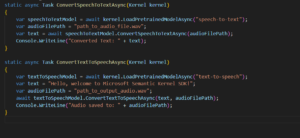
Use Cases:
- Accessibility Tools: Assisting users with disabilities by converting text to speech and vice versa.
- Virtual Assistants: Enhancing interaction with AI-powered assistants through voice.
- Customer Service: Providing voice responses to customer inquiries.
Real-World Applications
- Customer Support Automation
By integrating sentiment analysis and text generation, businesses can automate customer support, providing quick and relevant responses to customer queries while monitoring customer satisfaction. For example, an automated system can detect a negative sentiment in a customer complaint and generate a personalized apology response, improving customer experience and reducing response times.
- Content Summarization
News aggregators and research tools can utilize text summarization to provide concise summaries of lengthy articles and reports, saving users time and improving information consumption. For instance, a financial news app can offer summarized daily market reports, allowing users to stay informed without reading through long articles.
- Market Intelligence
Companies can use NER to extract key information from news articles, social media, and reports to stay informed about competitors, market trends, and potential business opportunities. This can help businesses make data-driven decisions and stay ahead of the competition.
- Multilingual Communication
Language translation capabilities enable applications to serve a global audience, breaking down language barriers and improving user experience across different regions. A global e-commerce platform can provide product descriptions and customer reviews in multiple languages, making it accessible to a wider audience.
- Enhanced Data Analysis
Combining NER with other NLP tasks, businesses can analyze vast amounts of unstructured data to gain insights and make informed decisions. For instance, a legal firm can use NER to extract relevant information from case documents, speeding up the research process and improving case management.
Conclusion
The Microsoft Semantic Kernel SDK empowers developers to integrate advanced NLP capabilities into their applications with ease. Whether it’s summarizing text, analyzing sentiment, recognizing entities, translating languages, or generating text, the SDK provides robust tools to unlock the potential of NLP. By leveraging these capabilities, businesses and developers can create more intelligent, responsive, and user-friendly applications.