


1. Introduction
As software systems become more complex, the need for effective and efficient automated testing is greater than ever. Traditional test automation tools like Selenium, Cucumber, and TestNG are essential for improving testing processes but creating complex test scenarios manually can be very time-consuming and can often lead to human errors. Automated test script generation involves the creation of scripts that will perform several actions through an AUT. Deep learning automates this process by handling the coverage of the application under test with less time and minimum effort.
2. How Deep Learning Enhances Test Script Generation
Deep learning algorithms consider a huge number of data and find the pattern, which is ideal for generating test scripts.
Some key benefits include:
- Automation of Scenario Generation
- Handling Complex Data Structures
- Natural Language Processing (NLP)
- Continuous Learning and Adaptation
3. Optimizing Deep Learning Models
To maximize the potential of deep learning models in test script generation, the following optimization techniques are essential:
- Transfer Learning: Leverages a pre-trained model built on existing knowledge, which is especially useful in specialized testing areas where there isn’t much labelled data.
- Data Augmentation: This strategy tackles the common issue of having limited training data for test generation.
- Ensemble Learning: Combines predictions from multiple models for better results thus improving reliability.
- Hyperparameter Optimization: Tuning parameters like learning rate, batch size, and model architecture is crucial for getting the best performance from the model
4. Implementing Deep Learning in Test Script Generation
To illustrate the steps for integrating deep learning in test script generation, let’s create complex scenarios by training a model using raw data.
4.1 Data Collection
This step gathers data from existing test cases, application logs, and user interactions or simply provides raw data for preparing the data for model training.
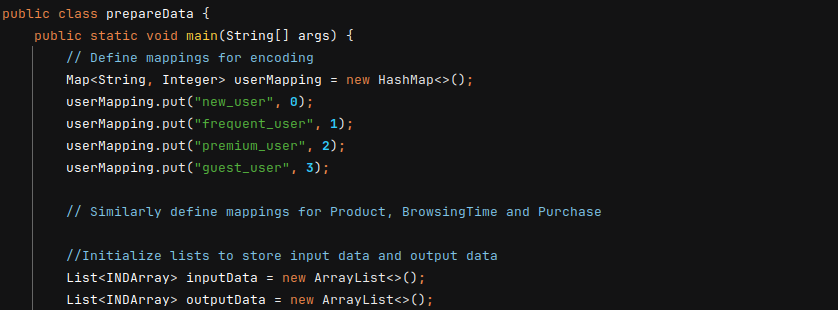
- Define dictionaries to convert categorical text data into numerical values and initialize lists to store the encoded input features and output labels.
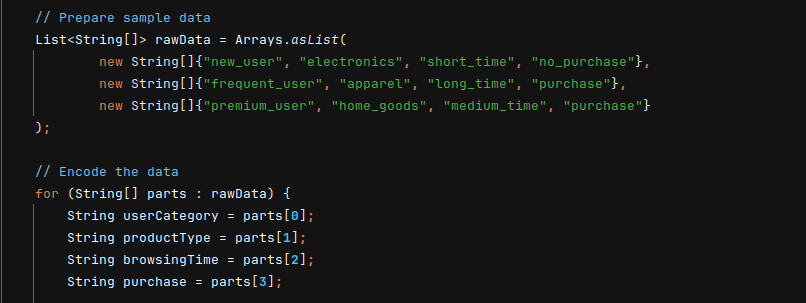
- Prepare sample data by creating a list and encoding each raw data entry into a numerical format using the defined mappings.
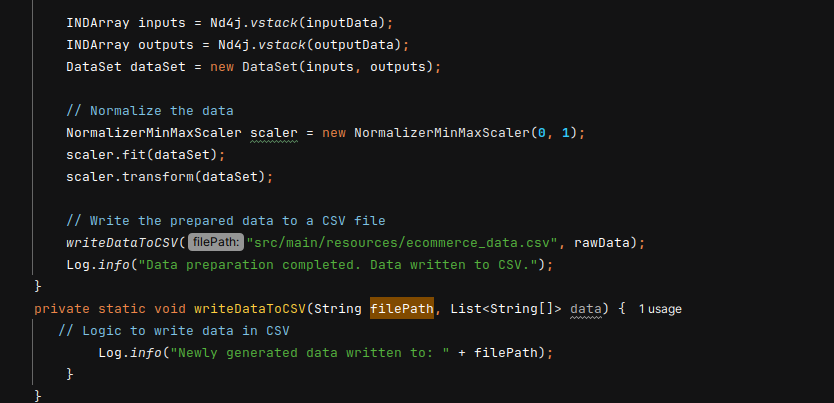
- Create a dataset object by combining all input and output data in single arrays and the program normalizes and writes it to a file.
4.2 Model Training
Train a deep learning model using the collected data. Before performing the model training, we need to add the following dependencies to pom.xml:
- deeplearning4j-core: a popular open-source deep learning library for the Java Virtual Machine (JVM) that provides the main functionality for building and running deep learning models.
- nd4j-native-platform: a part of the ND4J (Numerical Data for Java) ecosystem, which serves as the computational backend for DeepLearning4j.
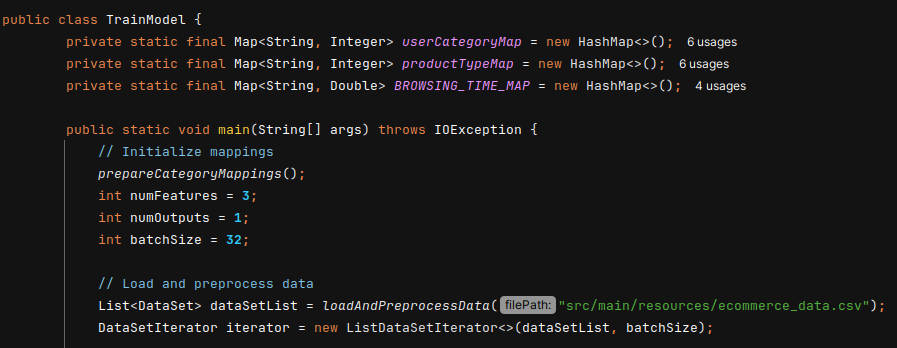
- Initialize the mappings, define key parameters for the neural network and load data from the CSV file.
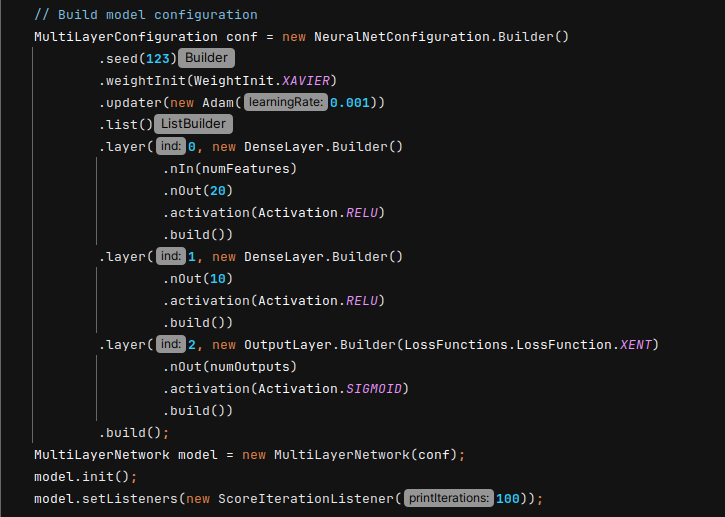
- Define and initialize the model along with its architecture.
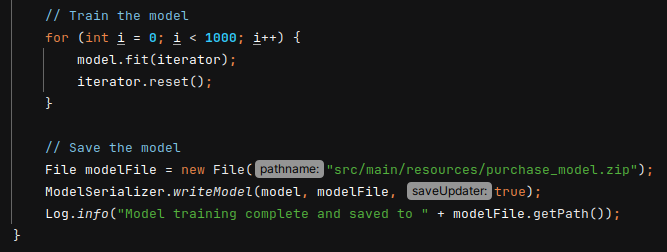
- Now train the model and save it for further use in scenario generation based on its learning
4.3 Test Scenario Generation
After model training, it can generate test scripts based on the learned patterns. For instance, when using Cucumber, the model can produce Gherkin syntax scripts.
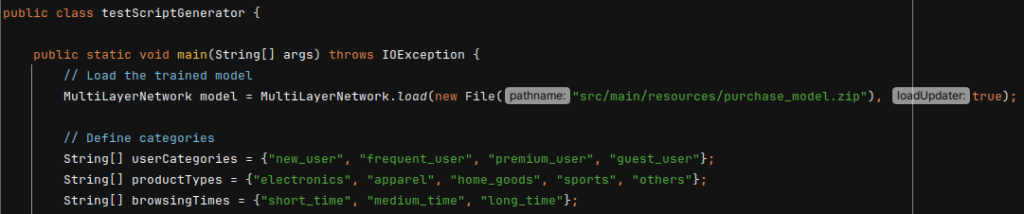
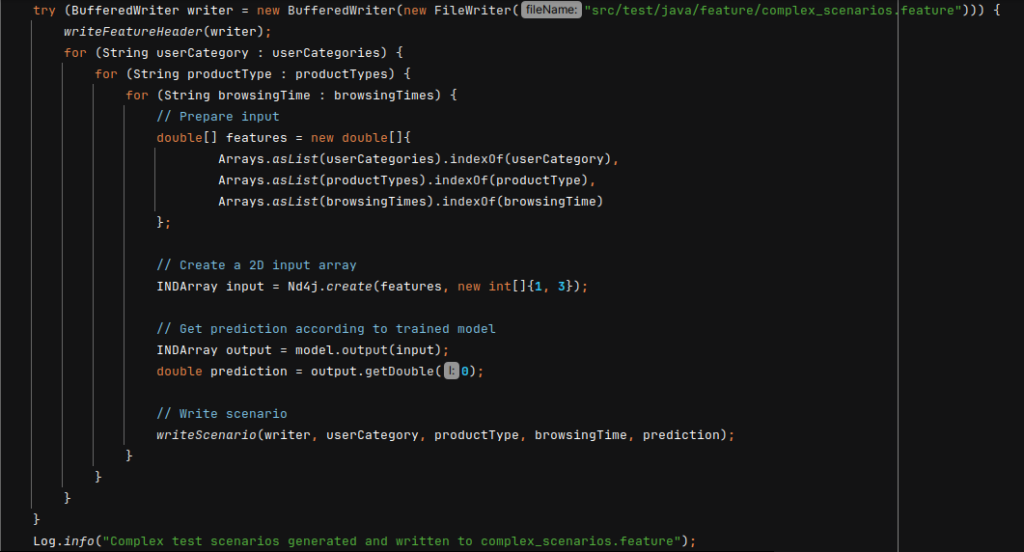
- Load the previously trained neural network model and define arrays of possible values for each feature category.
- The trained model generates complex scenarios, which are written in the Cucumber Feature file.
4.4 Generated Test Scenarios and its Execution
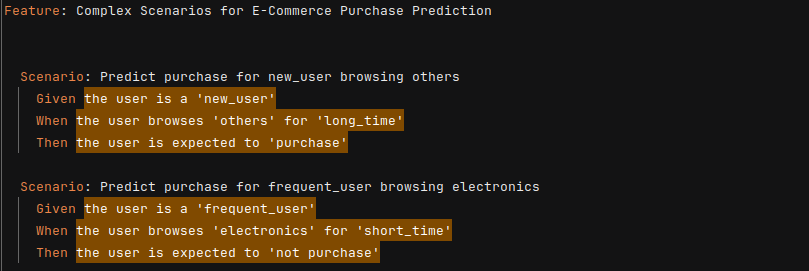
The trained model generates the scenarios, for which tests can be defined and executed using the runner class with TestNG.
5. Conclusion
Using deep learning is a major breakthrough in software testing because by merging the strengths of AI with traditional testing tools, one can create testing processes that are more thorough, efficient, and flexible. As this technology keeps advancing, it is set to change how software quality assurance is handled, which will result in stronger and more reliable applications.