Introduction to Time Travel and Fail-Safe in Snowflake
Introduction
Snowflake is a cloud-based data warehousing platform that offers unique features for data storage, processing, and management. Among these features, Time Travel and Fail-Safe stand out as powerful tools for data protection, recovery, and auditability. This blog provides an in-depth exploration of these capabilities, explaining how they work, their benefits, and practical use cases.
Time Travel in Snowflake
What is Time Travel?
Time Travel in Snowflake allows users to access historical data at any point within a defined retention period. This feature enables the restoration of data that may have been accidentally modified or deleted, as well as the ability to query previous versions of data for audit and comparison purposes.
Key Features of Time Travel
Historical Data Access: Users can query and restore data as it existed at a specific point in time within the retention period. Data Protection: Time Travel provides a safety net against accidental data changes or deletions. Data Audit: It allows for easy auditing of data changes by comparing current data with historical versions.
How Time Travel Works
Time Travel leverages Snowflake's unique architecture, which separates compute and storage. It maintains a history of data changes by tracking all modifications, including inserts, updates, and deletes. This historical data is stored in a secure and efficient manner, enabling quick access and recovery.
Configuring Time Travel
Snowflake provides flexible options for configuring the retention period for Time Travel, which can range from one day to 90 days. The retention period can be set at the account, database, schema, or table level, offering granular control over data retention policies.
Practical Use Cases
Accidental Data Deletion: If data is accidentally deleted, Time Travel can restore it to its previous state, minimizing data loss. Data Auditing and Compliance: Organizations can use Time Travel to audit data changes and ensure compliance with regulatory requirements. Testing and Development: Developers can use historical data to test and validate changes without affecting current data.
Fail-Safe in Snowflake
What is Fail-Safe?
Fail-Safe is a data recovery feature in Snowflake that provides an additional layer of protection beyond Time Travel. It ensures that data can be recovered in the event of a catastrophic failure or other extreme scenarios. Fail-Safe is designed to protect against data loss due to unforeseen circumstances.
Key Features of Fail-Safe
Extended Data Protection: Fail-Safe provides a seven-day period during which data can be recovered after the Time Travel retention period has expired. Disaster Recovery: It ensures data can be restored even in extreme situations, such as hardware failures or other catastrophic events. Automatic and Managed by Snowflake: Fail-Safe is fully managed by Snowflake, requiring no manual configuration or maintenance.
How Fail-Safe Works
Fail-Safe is automatically enabled for all Snowflake data and starts after the Time Travel retention period ends. During the Fail-Safe period, Snowflake retains a read-only copy of the data, ensuring it can be recovered if needed. However, Fail-Safe is not intended for regular data access or querying; it is strictly for recovery purposes in exceptional situations.
Practical Use Cases
Disaster Recovery: In the event of a severe failure, Fail-Safe provides a final safety net to recover critical data.
Flow of Data
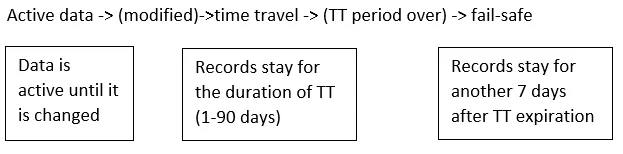
Now we know about the travel time and fail-safe. Lets see how the data flows in the snowflake.
This flow of data from active to time travel to fail-safe is called snowflake’s Continuous Data Protection Lifecycle.
Conclusion
Time Travel and Fail-Safe are powerful features in Snowflake that provide robust data protection, recovery, and audit capabilities. By leveraging these features, organizations can ensure data integrity, meet compliance requirements, and protect against data loss in various scenarios. Understanding and effectively utilizing Time Travel and Fail-Safe can significantly enhance an organization's data management strategy, providing peace of mind and operational resilience.