


What is Data Mesh?
Data Mesh is a modern data architecture designed to overcome the challenges of traditional, centralized data management systems. Conventional systems frequently have a central team in charge of data, which causes delays, bottlenecks, and scaling issues. With the help of Data Mesh, a decentralized, domain-oriented strategy is introduced. This allows any corporate domain, such as sales, marketing, and finance, to fully own its data. This change allows domain teams to manage their data as a tailored product that meets specific needs. Data Mesh increases agility by enabling scalability, flexibility and responsiveness through decentralized data ownership. This approach improves data access and quality and also aligns data management with business goals.
Why Data Mesh Came into the Picture?
In response to the mounting difficulties that organisations using traditional data architectures were facing, Data Mesh was established. Data in these traditional systems is usually centralised and controlled by a single, all-encompassing data platform. Although this centralised method frequently results in large bottlenecks, it may initially appear efficient. These platforms struggle with growing data volumes, resulting in slow processing and limited scalability. They are often unable to effectively manage different data requirements. Centralized management creates a gap between data managers and subject matter experts. This gap hinders data accessibility and affects data quality.
In order to solve these issues, Data Mesh decentralises data ownership and gives domain experts control over data management. They are better suited to handle the data because they have direct access and context. This decentralised approach boosts the effectiveness of data use throughout the company, facilitating quicker, more accurate decision-making and encouraging innovation. This approach also improves the efficiency of data operations.
What We Were Using before Data Mesh:
Before Data Mesh, organizations primarily relied on databases, data warehouses, and data lakes for data management. Here’s a brief overview of each:
Database:
- Definition: A database is a collection of structured data organized for easy access, management, and updating.
- Use Case: Databases are used for transactional systems where quick, real-time data operations are essential (e.g., customer management systems).
- Limitations: Limited scalability for large volumes of data and not ideal for complex analytical queries.
Data Warehouse:
- Definition: A data warehouse is a centralized repository for storing large volumes of structured data from multiple sources, optimized for querying and analysis.
- Use Case: Used for business intelligence and reporting, allowing organizations to run complex queries on historical data (e.g., sales analysis).
- Limitations: High maintenance costs, difficulty in handling unstructured data, and potential bottlenecks in data processing.
Data Lake:
- Definition: A data lake is a storage system that holds vast amounts of raw, unprocessed data in its native format until needed.
- Limitations: Challenges in data governance, quality, and security; can become a “data swamp” if not managed properly.
- Use Case: Ideal for storing large volumes of diverse data types, including structured, semi-structured, and unstructured data (e.g., IoT data).
Principles of Data Mesh:
Data Mesh is built on four core principles:
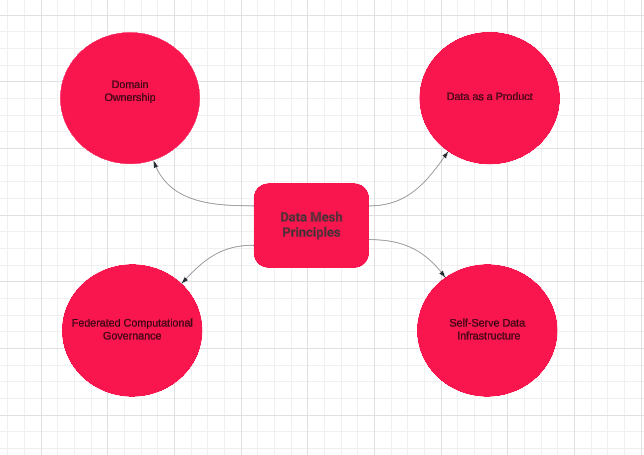
1. Domain-Oriented Decentralized Data Ownership and Architecture:
All organisational data is usually under the authority of a single team or platform in traditional data management. Bottlenecks and a disconnection between domain specialists and the data they most understand might result from this centralisation. This is altered by Data Mesh, which decentralises data ownership. Every area, including product development, finance, and marketing, owns and controls its data, handling it as a “data product.”
Data Mesh makes sure that the individuals who are most knowledgeable with the data are in charge of managing it by tying ownership of the data to particular domains. Because domain specialists can promptly respond to changes, maintain data quality, and guarantee that the data satisfies the demands of its users, this domain-oriented approach enables faster, more relevant data handling.
For instance: In a retail company, the sales team is in charge of ensuring that sales data is correct and up to date, whereas the marketing team is in charge of consumer engagement data, which is tailored for personalised marketing campaigns.
2. Data as a Product.
Traditionally, data has been viewed as a byproduct of business processes rather than a valuable asset. However, Data Mesh emphasizes that data should be treated as a product. This includes clear responsibilities, defined quality standards and a focus on supporting users, whether they are internal teams, applications or external partners.
Treating data like a product requires that it be dependable, well-documented, easily available, and maintained with a consumer-first perspective. Each data product has an owner who is accountable for ensuring that the data is reliable and meets the demands of its users.
For example, healthcare systems treat patient data as a product. They enforce strict governance to ensure accuracy and security and make them easily accessible to medical staff to provide quality care.
3. Self-Serve Data Infrastructure.
To enable domain teams to handle their data independently, they require access to a powerful and user-friendly data infrastructure. Data Mesh advocates for self-service data infrastructure, which includes tools and platforms that enable teams to develop, manage, and analyse data products without relying on a central IT team.
A self-serve data architecture empowers domain teams by providing them with the resources they need to manage their data independently. This comprises data pipelines, storage, processing, and analytics platforms that are simple to use and require no technical knowledge. Organisations can accelerate data operations and minimise the workload on central IT personnel by decentralising access to data infrastructure.
For example, an e-commerce company provides its product teams with an easy-to-use data platform that allows them to create dashboards, run analysis, and manage data pipelines without the need for regular IT support.
4. Federated Computational Governance.
While Data Mesh encourages decentralisation, consistent governance across all domains is critical to ensuring data quality, security, and compliance. Federated computational governance provides a framework that enables each domain to adhere to shared norms and procedures while maintaining autonomy.
Federated governance means that, while each domain has responsibility over its own data, there are overarching norms and policies that maintain consistency and interoperability throughout the organisation. This governance is implemented using automated tools and processes. And allow domains to conform with standards while maintaining their freedom. This ensures that data remains secure, meets legal requirements and maintains high quality throughout the company.
For example, a financial institution creates governance guidelines to guarantee that all domain teams follow data protection standards, such as GDPR, while also allowing each team to manage and innovate with their data.
Conclusion:
Data Mesh is an immense change in how organisations handle and use their data. Data Mesh addresses the limits of traditional, centralised data architectures by decentralising data ownership and making it more accessible to domain specialists. This method improves scalability, agility, and data quality, allowing organisations to respond faster to changing business needs and innovate more effectively.
As businesses continue to generate and rely on massive volumes of data, Data Mesh’s principles—domain-oriented ownership, treating data as a product, self-service infrastructure, and federated governance—provide a solid foundation for managing data in a way that meets modern demands. Whether you work in banking, healthcare, retail, or any other area, Data Mesh can help your organisation unleash the full potential of its data, resulting in better decision-making and more efficient achievement of business objectives.