


1. What is omnichannel?
a. The original omnichannel term
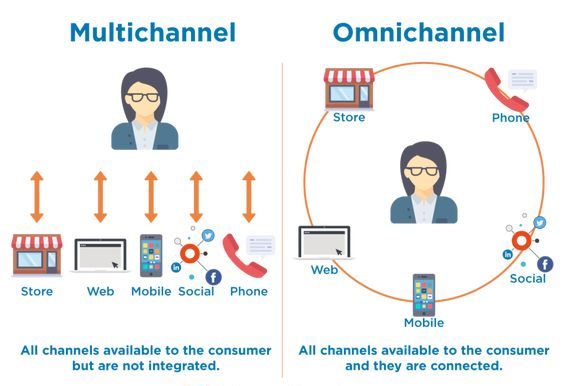
Regarding IGI Global, “Omnichannel is a multichannel approach to sales that seeks to provide the customer with a seamless shopping experience whether the customer is shopping online from a desktop or mobile device, by telephone or in a bricks and mortar store.”
b. Omnichannel in learning
When it comes to learning, omnichannel can be defined as “a multichannel approach to learning that seeks to provide the learner with a seamless learning experience whether the learner is learning online from a desktop or mobile device, by telephone or in a physical classroom.”
In other word, omnichannel elevates the multichannel approach by offering a seamless learning experience across any preferred channel. The purpose is to enhance the overall learning experience, enabling learners to study anytime, anywhere, and at their own pace. It integrates both online and offline methods, allowing learners to interact with their tutor in person, receive instant feedback, access course materials, and submit assignments wherever they are.
2. The evolution of omnichannel learning
a. Digital transformation
The 21st century, with the explosion of technology, has witnessed a significant transformation in education. Innovations such as online courses, digital textbooks, and educational apps have expanded learning opportunities beyond traditional classrooms. Students can now find information anytime and anywhere, allowing for learning that fits their individual needs and paces. Interactive tools like virtual simulations and collaborative platforms foster engagement and teamwork, while data analytics help educators track progress and adjust their teaching methods.
b. Covid-19 pandemic promotes hybrid learning
The COVID-19 pandemic has accelerated the shift towards hybrid learning, combining online and in-person education. As schools and universities faced closures and restrictions, educators quickly adopted digital tools to continue teaching remotely. This experience highlighted the benefits of blending virtual and face-to-face learning, allowing for greater flexibility and accessibility. As a result, in the post-pandemic scenario, educational institutes are increasingly adopting the hybrid model which will reshape the entire educational landscape. Edtech companies are taking the opportunity to use omnichannel learning—both online and offline—to innovate education and introduce new teaching methods.
c. Digital natives generation
From a young age, the “digital natives” generation has naturally adapted electronic devices in their homes, schools, and workplaces, interacting with various environments through computer technologies. These characteristics often make them more likely to pursue virtual education programs or supplementary courses to advance their professional skills. Although virtual learning environments are not new, the use of computer technologies for virtual or digital education is rapidly increasing and therefore requires innovative development. This approach enables global access, allowing learners worldwide to collaborate and share knowledge, fostering inclusivity.
3. The benefit of omnichannel learning
a. Flexibility and accessibility
Omnichannel learning offers flexibility by allowing learners to access materials anytime and anywhere—whether through online courses, mobile apps, or in-person classes. This makes it easier for people to fit education into their busy lives and learn in the way that suits them best.
b. Enhanced engagement
By using various formats like videos, interactive activities, and traditional readings, omnichannel learning keeps students engaged and interested. Different types of content cater to different learning styles, making the educational experience more dynamic and enjoyable.
c. Continuous learning
Omnichannel approaches support ongoing education by offering multiple ways to learn and develop skills. By connecting various channels—such as e-learning platforms, social media, mobile apps, and in-person sessions—omni-channel learning ensures that knowledge acquisition is uninterrupted and easily accessible. This enables learners to continuously build and upgrade their level in a way that fits their personal and professional lives.
d. Improved Collaboration:
Whether students are in a physical classroom, engaging in a virtual discussion, or working on a group project through a collaborative app, omni-channel strategies ensure that all communication and resources are synchronized. This continuity fosters a more dynamic and flexible learning environment where students can easily connect, exchange ideas, and support each other, regardless of their location or the devices they are using. The result is a more cohesive and interactive learning experience that encourages deeper collaboration and peer learning.
e. Scalable and Global
By leveraging a combination of digital platforms, virtual classrooms, and interactive content, educational institutions can scale omnichannel learning to accommodate a growing number of learners without compromising the quality of education. This approach enables global access, allowing learners worldwide to collaborate and share knowledge, fostering inclusivity.
4. Case study: MITx MicroMasters programs
a. MicroMaster program – a seamless learning experience
The MicroMasters program credential from MIT (Massachusetts Institute of Technology) Open Learning is a professional and academic credential for online learners from anywhere in the world who seek focused, accelerated advancement. The programs focus on providing in-depth, specialized knowledge in specific areas, such as data science, supply chain management, or artificial intelligence. It contains 100% online courses which enables learners to access and learn on their own pace. The learners can earn a program credential by completing the course and passing one or more proctored exams.
b. Benefits of MicroMaster program
- No admission required: Unlike almost Master degrees, this program does not require any admission or prerequisites for enrollment. This allows a large number of students from wide range of age. In fact, this program attracts learners aged from 18 to 90 years old after launching publicly.
- Specialized courses: each program contains about 5 courses which are considered the fundamental knowledge required for the corresponding areas. The learners can easily apply the knowledge acquired from these courses directly to their day-to-day job.
- Valuable credential: after completing the program, the learners earn credentials that are approved by MIT or many partner institutions, making them eligible to apply for Master program or become more competitive in the job market.
- Network enrichment: enrolling MicroMaster program makes the learners become an affiliate of the MIT Alumni Association. They will be able to interact and network with fellow credential holders.
5. Future trend: “Hybrid” is the new normal
The edtech-related innovations have empowered educators to combine various forms of learning and resources including AI, blended learning, interactive learning, and experiential approach to provide a new experience to the learners. The future of learning is hybrid, because parents these days are believing that hybrid is an effective format that bridges the gap between traditional classroom learning, and online and offline educational resources. By integrating these tools, educators can enrich the classroom experience and effectively address the skills gap. In a hybrid format, course content can be delivered in various ways, both synchronously and asynchronously, optimizing the strengths of digital instruction and real-time interaction.
6. Conclusion
To wrap up, omnichannel learning represents a significant shift in the way education is approached. By harnessing the power of technology and data, educational institutions can create seamless and personalized learning experiences that foster flexibility, accessibility, engagement, and lifelong learning. In a connected world, omnichannel learning is crucial for preparing learners for success in the digital age.