


MongoDB is a popular NoSQL database known for its flexibility, scalability, and ease of use. Unlike traditional SQL databases, MongoDB does not rely on tables and rows; instead, it uses a document-oriented model, making it ideal for handling large amounts of unstructured data.
What is MongoDB?
MongoDB is an open-source, document-oriented NoSQL database developed by MongoDB, Inc. Its unique data model stores data in flexible, JSON-like documents rather than rows and columns, allowing developers to easily manage and manipulate complex data structures. This approach suits applications where data structures evolve over time, as MongoDB’s schema flexibility allows seamless updates without extensive migration.
Key Features of MongoDB
- Document-Oriented Storage: MongoDB stores data in BSON (Binary JSON) documents, which enables a more flexible and expressive structure compared to relational databases.
- Scalability: MongoDB supports horizontal scaling through a feature known as “sharding.” This capability distributes data across multiple servers, ensuring optimal performance and availability even as data volume increases.
- Schema Flexibility: Unlike relational databases, MongoDB doesn’t enforce a predefined schema, allowing documents within a collection to have different fields.
- Replication: MongoDB’s replication feature, called replica sets, ensures high availability by creating multiple copies of data across different servers.
- High Performance: Its document-based nature allows for faster read and write operations compared to traditional relational databases.
- Aggregation Framework: MongoDB has a powerful aggregation framework, enabling efficient data processing and transformation within the database itself.
MongoDB Architecture Overview
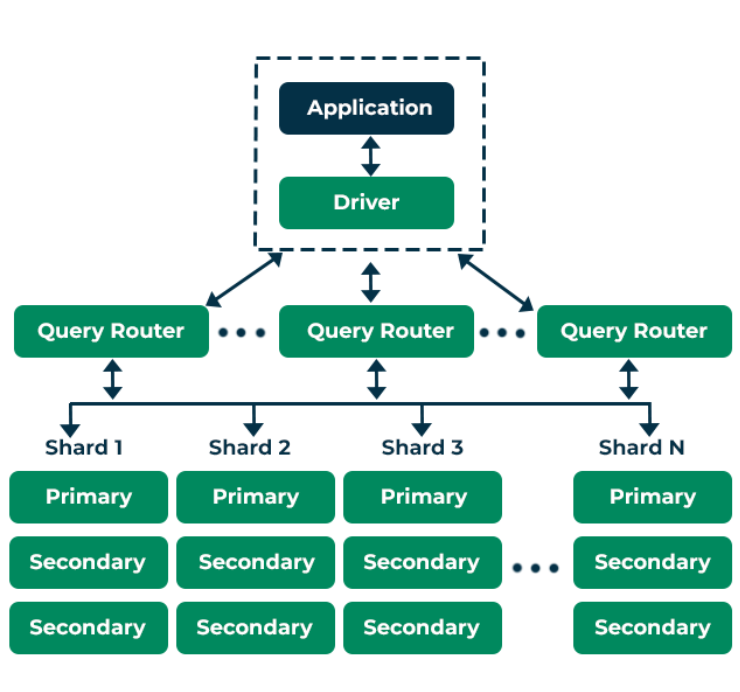
The core architecture of MongoDB includes several components:
- Database: In MongoDB, a database is a container for collections. Each database has its own set of files on the file system.
- Collections: Collections are akin to tables in relational databases. They store groups of related documents. Unlike SQL tables, collections don’t enforce a rigid schema, allowing for greater flexibility.
- Documents: The building blocks of MongoDB, documents are key-value pairs stored in a JSON-like structure. Each document is assigned a unique _id field to distinguish it within a collection.
- Replica Sets: MongoDB’s primary mechanism for ensuring redundancy and data availability, replica sets consist of a primary node and multiple secondary nodes. Changes are written to the primary node and then replicated to secondary nodes, ensuring resilience.
- Sharding: For distributed storage and scaling, MongoDB uses sharding, which breaks down large datasets into smaller, manageable pieces across multiple machines.
MongoDB Data Model
In MongoDB, the data model relies on collections and documents. Unlike SQL databases that use schemas to enforce structure, MongoDB collections contain documents that can vary in structure. Each document is a JSON-like format with key-value pairs, which makes it ideal for hierarchical data or objects containing subfields. This flexibility allows for nesting data, which is helpful for applications that require complex data structures.
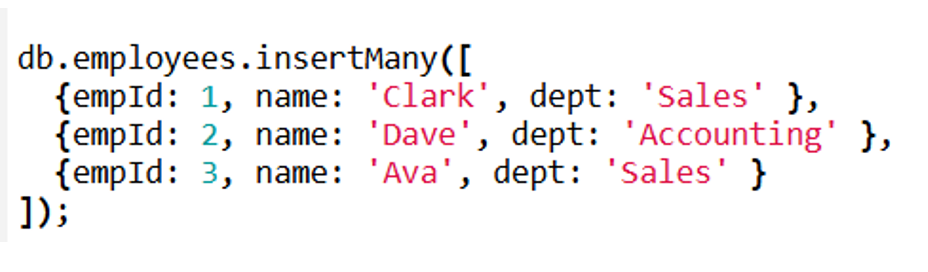
Here’s an example of a simple MongoDB document:
Insert new records
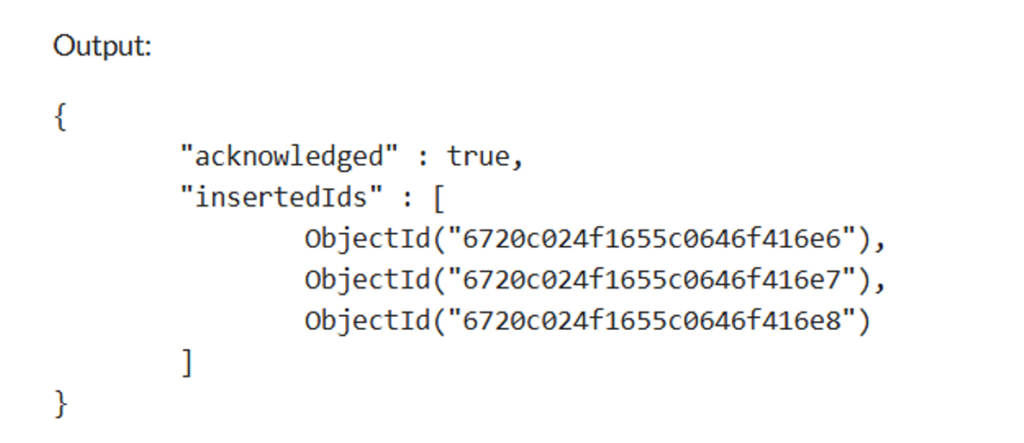
Find existing records:


MongoDB Query Language (MQL)
MongoDB Query Language (MQL) is MongoDB’s native query language, allowing users to retrieve, filter, and manipulate data within documents. MQL supports a variety of operations including:
- Basic CRUD: Create, Read, Update, and Delete operations.
- Aggregation: MQL includes advanced aggregation capabilities, such as grouping, sorting, and filtering.
- Indexing: MongoDB supports indexing to improve query performance. Users can create indexes on any field, making it highly efficient for read-heavy applications.
Advantages of MongoDB
- Flexibility: MongoDB’s schema-less nature allows for flexible data models, making it ideal for agile development and rapid prototyping.
- Scalability: Sharding enables MongoDB to scale horizontally, distributing data across clusters.
- Developer-Friendly: BSON and JSON document formats are easy for developers to understand and work with, enabling faster development cycles.
- High Availability: Replica sets provide redundancy and ensure data availability in case of hardware or network failures.
- Performance: MongoDB offers faster data access and lower latency for applications that handle large datasets, thanks to efficient indexing and document-based storage.
Conclusion
MongoDB’s flexibility, scalability, and developer-friendly features make it a popular choice for modern applications requiring agility and scalability. It is well-suited for applications with dynamic or unstructured data, real-time analytics, or complex data structures. While it may not replace SQL databases in scenarios requiring high data consistency and complex transactions, MongoDB remains a powerful tool for a broad range of applications in today’s data-driven world.