


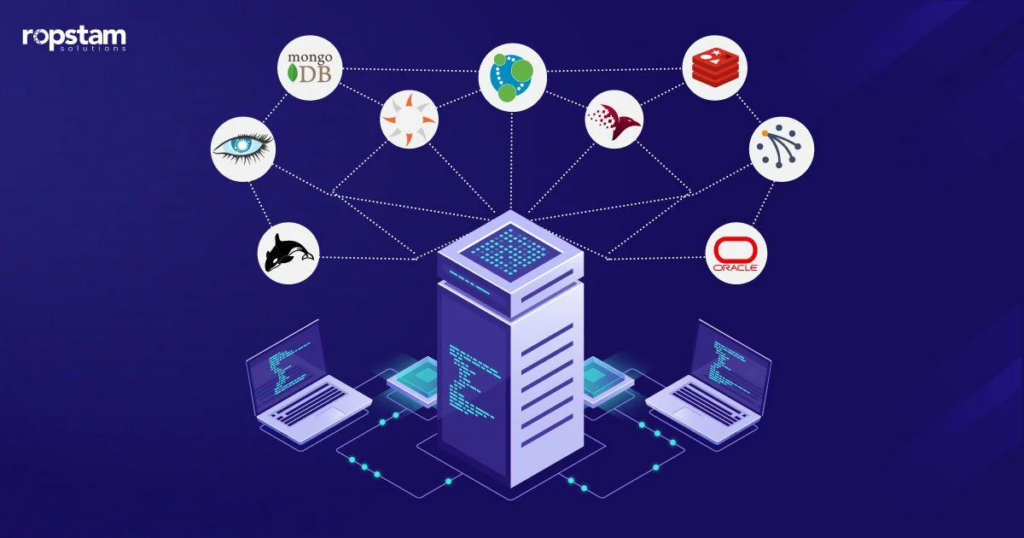
What is NoSQL Database?
When individuals say “NoSQL database,” they’re usually referring to every database that isn’t relational. Some people think “NoSQL” means “non-SQL,” while others say it means “not exclusively SQL.” In any case, most people believe that NoSQL databases are libraries that don’t use relational tables to store information.
NoSQL databases store data in a single data format, including a JSON document, rather than the traditional table structure of a relational database. Because this non-relational database architecture doesn’t really need a structure, it can quickly handle massive, often unorganized data sets.
Differences Between SQL and NoSQL
| Aspect | SQL (Relational) | NoSQL (Non-relational) |
|---|---|---|
| Data Structure | Tables with rows and columns | Document-based, key-value, column-family, or graph-based |
| Schema | Fixed schema (predefined structure) | Flexible schema (dynamic and adaptable) |
| Scalability | Vertically scalable (upgrading hardware) | Horizontally scalable (adding more servers) |
| Data Integrity | ACID-compliant (strong consistency) | BASE-compliant (more available, less consistent) |
| Query Language | SQL (Structured Query Language) | Varies (e.g., MongoDB uses its own query language) |
| Performance | Efficient for complex queries and transactions | Better for large-scale data and fast read/write operations |
| Use Case | Best for transactional systems (banking, ERP, etc.) | Ideal for big data, real-time web apps, and data lakes |
| Examples | MySQL, PostgreSQL, Oracle, MS SQL Server | MongoDB, Cassandra, CouchDB, Neo4j |
The Benefits of the NoSQL Database
Many current applications, such as smartphones, online, and gaming, demand versatile, accessible, high-performance, and fully capable databases that deliver excellent customer experiences. This is where NoSQL comes in very handy. Therefore, let us see what the features of the NoSQL Database that we need to consider are:
- Flexibility: In general, NoSQL databases have flexible structures that allow for rapid and much more iterative improvement. Because of its flexible data format, NoSQL databases are suitable for semi-structured and unstructured information.
- Scalability: NoSQL databases are usually designed to expand by employing dispersed hardware groups rather than expanding higher by introducing costly and resilient servers. Like a service software, several cloud services perform these activities behind the lines.
- High-performance: NoSQL databases are designed for specific data structures and associated metadata, resulting in faster responsiveness than attempting to provide equivalent functionality using relational databases.
- Enhanced functionality: NoSQL databases offer purpose-built data types which offer distinct data models and also a highly functioning Interfaces.
Why should we use NoSQL?
There are several uses of the NoSQL Database. Therefore, let us see some of the benefits of the NoSQL Database.
- NoSQL databases frequently enable developers to customize the data format. They are well suited to contemporary Agile production techniques centred on sprints, fast modifications, and frequent software releases.
- It can be time-consuming for a programmer to request a SQL database operator to modify the database structure and afterwards discharge and then reload the data.
- NoSQL databases are frequently more suitable for collecting and analyzing organized, semi-structured, and unstructured data in a centralized database.
- NoSQL databases frequently store information in a format comparable to the entities used during applications.
- Minimizing the requirement for translation between the format in which the information is stored to the format in which the data appears in code.
- As part of its core architecture, NoSQL databases originally were designed to manage large amounts of information.
- Whenever SQL databases are utilized to run web-scale applications, there is no additional engineering required. The road to data scalability is well-defined and straightforward.
- NoSQL databases are frequently built on a scale-out method, which enables scaling to enormous data volumes far less expensive than the scale-up method used by SQL databases.
- Several NoSQL databases utilize a scale-out method, which gives a straightforward way to increase the volume of traffic a library can manage.
- Scale-out structures also provide advantages such as updating or modifying the database structure with no interruption.
- Scale-out architecture is among the most cost-effective methods of handling high traffic levels.
Different types of NoSQL databases
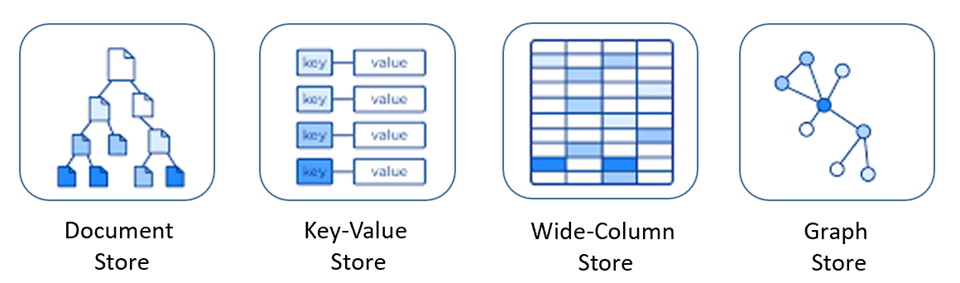
NoSQL also has several database types, giving us the flexibility to choose what’s the best fit for our data and objectives. The main types are:
Key-value databases
Key-value databases are some of the least complex NoSQL databases, as all their data consists of an indexed key and a value. They use a hashing mechanism such that given a key, the database can quickly retrieve an associated value. Hashing mechanisms provide constant time access, which means they maintain high performance even at large scale. The keys can be any type of object, but are typically a string. The values are generally opaque blobs (i.e., a sequence of bytes that the database does not interpret). They make it easy to store large amounts of data and quickly perform lookup queries.
Examples: Redis, Amazon DynamoDB, Riak, Oracle NoSQL
Some tabular NoSQL databases, like Cassandra, can also service key-value needs.
Document databases
Document databases expand on the basic idea of key-value stores where “documents” are more complex, in that they contain data and each document is assigned a unique key, which is used to retrieve the document. These are designed for storing, retrieving, and managing document-oriented information, often stored as JSON. Each document can contain different types of data. Groups of documents are called collections. Each document in a collection can have a different structure.
Since the document database can inspect the document contents, the database can perform some additional retrieval processing. Unlike RDBMSs which require a static schema, Document databases have a flexible schema as defined by the document contents.
Examples: MongoDB, CouchDB
Note that some RDBMS and NoSQL databases outside of pure document stores are able to store and query JSON documents, including Cassandra.
Tabular databases
Tabular databases organize data in rows and columns, but with a twist from the traditional RDBMS. Also known as wide-column stores or partitioned row stores, they provide the option to organize related rows in partitions that are stored together on the same replicas to allow fast queries.
Unlike RDBMSs, the tabular format is not necessarily strict. For example, Apache Cassandra™ does not require all rows to contain values for all columns in the table. Like key-value and document databases, tabular databases use hashing to retrieve rows from the table.
Examples: Cassandra, HBase, Google Bigtable
Graph databases
Graph databases store their data using a graph metaphor to exploit the relationships between data. Nodes in the graph represent data items, and edges represent the relationships between the data items. Graph databases are designed for highly complex and connected data, which outpaces the relationship and join capabilities of an RDBMS. Graph databases are often exceptionally good at finding commonalities and anomalies among large data sets.
Examples: DataStax Graph, Neo4J, JanusGraph, Amazon Neptune
Multi-model databases
Multi-model databases are an emerging trend in both the NoSQL and RDBMS markets. They are designed to support multiple data models against a single, integrated backend. Most database management systems are organized around a single data model that determines how data can be organized, stored, and manipulated. By contrast, a multi-model database allows an enterprise to store parts of the system’s data in different data models, simplifying application development.
Get start with Neo4j Sandbox or Aura
- Launch the Free Sandbox: https://neo4j.com/sandbox/
- Sign up / log in.
- Choose a Project Template (E.g Movies)
- Click on Create and Download credentials to initialize Sandbox
- Once the Sandbox is set up, we’ll be directed to the Neo4j Browser with username and password
- Now we can practice with Neo4j. Syntax can see in Discovering Neo4j: Simplifying Data Management – NashTech Insights (nashtechglobal.com)
Conclusion
NoSQL databases provide a variety of benefits, including flexible data models, horizontal scaling, lightning-fast queries, and ease of use for developers. NoSQL databases come in a variety of types, including document stores, key-values databases, wide-column stores, graph databases, and multi-model databases.
I hope this post will provide a general understanding of NoSQL databases and the simplest method for learning more about them.
Reference
Image: https://www.ropstam.com/best-open-source-nosql-databases/
https://neo4j.com/docs/getting-started/graph-database/