


Introduction
Testing is essential for maintaining application reliability and stability in software development. Although conventional testing methods have been the foundation of quality assurance for many years. Basically, Chaos testing has surfaced as an effective strategy to tackle contemporary systems’ dynamic and unpredictable characteristics. Whereas both testing approaches seek to enhance software quality, they vary considerably in their goals, methodologies, and implementation. This blog will brief the fundamental distinctions between chaos and traditional testing, highlighting their respective methodologies, applications, and advantages.
Understand Traditional and Chaos Testing
Often structured or deterministic, traditional testing employs a methodical approach to assess software applications against established conditions and criteria. This framework encompasses a range of testing methodologies, including unit testing, integration testing, system testing, and acceptance testing. Moreover, each category targets distinct facets of the software, thereby facilitating a thorough evaluation:
1. Unit Testing: This type of testing focuses on individual components or units of code to verify their expected functionality in isolation. It assists in identifying problems during the initial phases of development.
2. Integration Testing: Integration testing examines the interactions between different modules or components. It guarantees that the various components of the system operate in unison.
3. System Testing: This testing method assesses the system’s overall functionality, confirming that it aligns with the specified requirements.
The process takes place in an environment that closely resembles the actual production setting.
4. Acceptance Testing:
Acceptance testing is performed to assess whether the software fulfils the defined business requirements and is ready for deployment. This process typically involves end-users or stakeholders to validate the system’s performance.
Traditional testing methodologies are meticulously organized and offer a definitive framework for identifying and rectifying defects. Nevertheless, they operate on the premise that the environment remains stable and predictable, which may not always be true in practical situations.
Key Objectives of Traditional Testing
- Confirm that the software aligns with established specifications.
- Detect and resolve issues before deployment.
- Guarantee optimal system performance under anticipated conditions.
Methodology of Traditional Testing
- Thoroughly organized and methodical.
- Based on established test cases, scenarios, and scripts.
- Executed in regulated environments to maintain consistency and reliability.
Chaos Testing: Embracing the Unpredictable
Chaos testing, often called chaos engineering, adopts a fundamentally different methodology. Also, it entails intentionally introducing faults and disruptions within a system to assess its resilience and capacity to endure unforeseen circumstances. The primary objective is to uncover vulnerabilities that conventional testing may fail to detect by simulating scenarios that reflect real-world incidents.
1. Fault Injection: Chaos testing incorporates the deliberate introduction of failures into the system, which may include shutting down servers, dropping network packets, or impairing system performance. These disruptions are instrumental in evaluating the system’s response under duress.
2. Monitoring and Observation: Comprehensive monitoring is crucial during chaos testing to track the system’s behaviour and collect data on its reactions to failures. This information yields significant insights into potential weaknesses.
3. Continuous Learning and Improvement: Chaos testing is a cyclical process. The insights gained from each experiment guide subsequent testing and system design, promoting a culture of ongoing enhancement.
Chaos testing challenges prevailing assumptions regarding system stability and compels teams to extend their thinking beyond established test cases. It aids in identifying vulnerabilities that traditional testing may overlook, particularly in how a system manages rare yet significant events.
Core Principles of Chaos Testing
Accept Failure: Recognize that failures are a natural part of the process and concentrate on reducing their effects.
Hypothesis-Oriented: Develop hypotheses regarding the system’s expected behaviour during failure events.
Managed Disruption: Introduce faults or disturbances systematically to study the system’s response.
Objectives of Chaos Testing
- Instil confidence in the system’s robustness and ability to withstand faults.
- Reveal latent weaknesses that conventional testing may overlook.
- Improve strategies for incident response and recovery.
How It Functions
- Identify essential components of the system (such as servers, databases, and networks).
- Outline possible failure scenarios, including server outages, network delays, or database failures.
- Implement disruptions (chaos) utilizing tools such as Chaos Monkey, Gremlin, or Litmus.
- Monitor system performance and evaluate whether it aligns with the expected results.
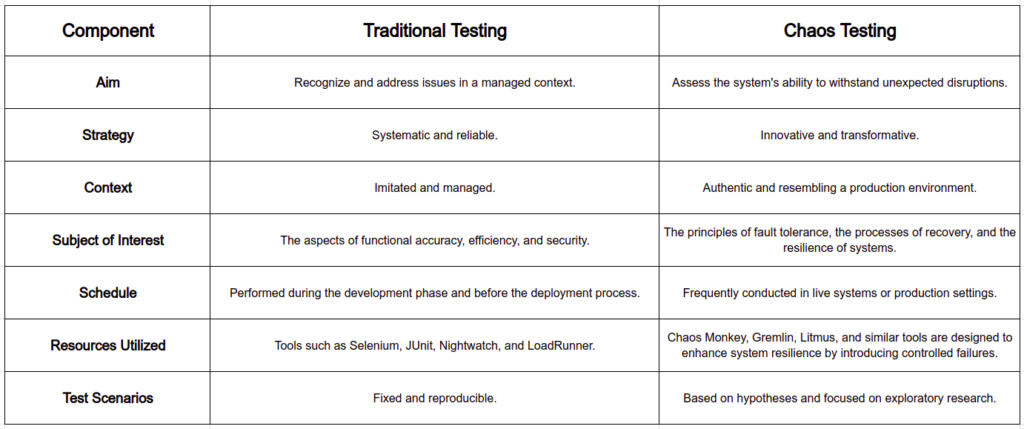
Differences in Traditional and Chaos Testing
Advantages and Disadvantages of Chaos Testing
Advantages
Enhanced Resilience: Chaos testing aids in pinpointing and rectifying vulnerabilities, thereby strengthening system robustness.
Proactive Issue Resolution: By replicating typical issues before their impact on operational processes, chaos testing significantly reduces the occurrence of bugs.
Boosted Assurance: Conducting chaos tests regularly fosters greater confidence in the system’s capacity to manage disruptions, thereby enhancing overall functionality.
Improved Incident Management: In particular, Chaos testing refines incident management strategies by effectively demonstrating the system’s responses to stressors and highlighting areas that require adjustments.
Disadvantages
Resource Demands: However, Chaos testing can be demanding in terms of resources, necessitating specialized personnel, time, and infrastructure.
Risk of Disruption: There exists a possibility that certain tests may interfere with production systems, which requires the implementation of controlled testing environments.
Complication: Furthermore, the design and analysis of chaos tests can be intricate, necessitating a comprehensive understanding of the system along with the capability to effectively interpret the results.
Obstacles and Constraints
Traditional Testing
- May fail to recognize vulnerabilities arising from unforeseen disruptions.
- Does not prioritize system recovery and resilience.
- Frequently restricted to pre-production environments.
Chaos Testing
- Demands a significant degree of proficiency and meticulous preparation.
- If not implemented correctly, however, it can interfere with operational systems.
- Might be excessive for minor or non-essential applications.
Conclusion
In conclusion, Software testing has progressed to address the increasing intricacy of contemporary systems. Conventional testing primarily focuses on verifying functionality and performance. However, Chaos testing, therefore, improves the ability to withstand unexpected failures. The integration of these methodologies establishes a comprehensive strategy for dependable applications.
In short, in the context of fault-tolerant systems, chaos testing is not merely beneficial, it is crucial. As a result, the combination of these two approaches enables organizations to provide software that fulfils requirements and excels in unpredictable environments.