



Introduction:
Publish-subscribe messaging is a fundamental concept in distributed systems, enabling efficient communication between different components of an application. On Google Cloud Platform (GCP), Pub/Sub is the go-to service for building scalable and flexible messaging architectures. In this guide, we’ll explore how .NET developers can harness the power of Pub/Sub on GCP to build resilient and scalable systems.
What is Pub/Sub Messaging?
Pub/Sub, short for Publish-Subscribe, is a messaging pattern where publishers send messages to topics, and subscribers receive messages from these topics. This decouples the producers of data (publishers) from the consumers (subscribers), allowing for better scalability, reliability, and flexibility in building distributed systems.
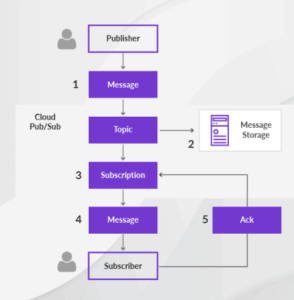
Key Concepts of Pub/Sub on GCP:
- Topics: Topics are named resources to which messages are sent by publishers. Each topic can have multiple subscribers.
- Subscriptions: Subscriptions represent the connection point for receiving messages from a topic. Subscribers can have different configurations, such as pull or push subscriptions.
- Publishers: Publishers are entities that send messages to topics. They can be applications running on GCP or external systems.
- Subscribers: Subscribers consume messages from topics. They can process messages asynchronously and independently from each other.
- Message Ordering: Pub/Sub guarantees message ordering within a single partition, ensuring that messages are delivered to subscribers in the order they were published.
Integrating Pub/Sub with .NET:
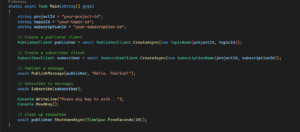
Google Cloud offers a client library for .NET that makes it easy to integrate Pub/Sub into your applications. Here’s how you can get started:
- Setting up Authentication: Before interacting with Pub/Sub, you need to authenticate your .NET application with GCP. You can do this using service account credentials or other authentication methods supported by Google Cloud.
- Creating Topics and Subscriptions: Use the client library to create topics and subscriptions programmatically or through the GCP Console.
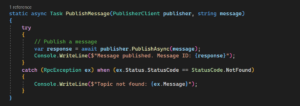
- Publishing Messages: With the client library, publish messages to topics from your .NET application. Messages can be simple strings or complex objects serialized to JSON.
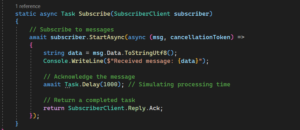
- Subscribing to Topics: Subscribe to topics to start receiving messages in your .NET application. You can configure subscriptions for pull or push delivery.
- Processing Messages: Implement message processing logic in your .NET application to handle messages received from Pub/Sub. You can perform actions such as data processing, analytics, or triggering other workflows based on the message content.
- Error Handling and Retries: Handle errors gracefully in your .NET application, including transient errors like network issues or rate limiting. Implement retry mechanisms to ensure message processing reliability.
Best Practices and Considerations:
- Scalability: Design your Pub/Sub architecture for horizontal scalability to handle varying message volumes efficiently.
- Reliability: Ensure message durability and reliability by configuring Pub/Sub for at-least-once message delivery and implementing idempotent message processing.
- Monitoring and Logging: Utilize GCP’s monitoring and logging capabilities to track Pub/Sub metrics, such as message throughput, subscription lag, and error rates.
- Security: Follow GCP’s best practices for securing Pub/Sub resources, including proper IAM roles and permissions, encryption, and network controls.
Conclusion:
Pub/Sub messaging on Google Cloud Platform provides .NET developers with a robust and scalable solution for building distributed systems. By leveraging Pub/Sub, you can design resilient architectures that decouple components, scale effortlessly, and ensure reliable message delivery. With the .NET client library, integrating Pub/Sub into your applications becomes seamless, allowing you to focus on building great software while GCP handles the heavy lifting of messaging infrastructure.