



Introduction:
In the digital age, where sensitive information is exchanged over networks daily, secure communication protocols are paramount. Among the most trusted protocols is SSL (Secure Sockets Layer) and its successor, TLS (Transport Layer Security), which establish secure connections between clients and servers. Central to their functionality is a sophisticated encryption mechanism, comprising both asymmetric and symmetric key encryption. In this comprehensive guide, we’ll explore SSL/TLS encryption, dissect the SSL/TLS handshake process, and understand how encryption secures data transmission.
Understanding SSL/TLS Encryption:
SSL/TLS encryption provides a robust framework for securing communication over untrusted networks, ensuring data confidentiality, integrity, and authenticity. It leverages two fundamental encryption mechanisms:
Asymmetric Key Encryption:
Asymmetric encryption, also known as public-key cryptography, relies on pairs of keys: a public key and a private key.
Mechanism:
Public Key: Widely distributed and used for encryption, messages encrypted with the public key can only be decrypted by the corresponding private key.
Private Key: Kept secret by its owner, the private key is used for decryption.
Strengths:
Key Exchange: Facilitates secure key exchange without pre-shared secrets, crucial for establishing secure connections between parties.
Authentication: Digital signatures, generated using private keys and verified with public keys, authenticate data integrity and origin.
Symmetric Key Encryption:
Symmetric encryption uses a single key for both encryption and decryption.
Mechanism:
Single Key: Symmetric encryption algorithms employ a single key shared securely between communicating parties.
Strengths:
Efficiency: Significantly faster and more efficient than asymmetric encryption, making it suitable for encrypting large volumes of data.
Confidentiality: Ensures confidentiality once a secure channel is established, allowing only authorized parties to decrypt transmitted data.
Integrating Encryption in SSL/TLS:
SSL/TLS combines asymmetric and symmetric encryption to achieve its security objectives:
Asymmetric Encryption: Used during the handshake phase for secure key exchange and authentication.
Symmetric Encryption: Employed for data transmission once a secure connection is established, ensuring confidentiality and efficiency.
The SSL/TLS Handshake Process:
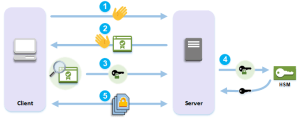
The SSL/TLS handshake process is crucial for establishing a secure connection between clients and servers:
1 Client Hello: The client initiates the handshake by sending a “Client Hello” message, specifying supported cryptographic algorithms and parameters.
2 Server Hello: The server responds with a “Server Hello” message, selecting a cipher suite and sending its digital certificate containing its public key.
3 Certificate Verification: The client verifies the server’s digital certificate, ensuring its authenticity and extracting the server’s public key.
- The client performs the following actions:
a) Verifies that the SSL/TLS server certificate is signed by a root certificate that the client trusts.
b) Extracts the public key from the server certificate.
c) Generates a premaster secret and encrypts it with the server’s public key.
d) Sends the encrypted premaster secret to the server.
4 Key Exchange: To decrypt the client’s premaster secret, the server sends it to the HSM. The HSM uses the private key in the HSM to decrypt the premaster secret and then it sends the premaster secret to the server. Independently, the client and server each use the premaster secret and some information from the hello messages to calculate a master secret.
5 Session Establishment: The handshake process ends. For the rest of the session, all messages sent between the client and the server are encrypted with derivatives of the master secret. The client and server derive a shared secret (session key) using the exchanged cryptographic information, enabling symmetric encryption for data transmission.
Conclusion:
SSL/TLS encryption, powered by a combination of asymmetric and symmetric encryption mechanisms, forms the cornerstone of secure communication on the internet. Understanding SSL/TLS encryption and the handshake process is essential for implementing robust security measures and safeguarding sensitive information in today’s interconnected world. As we continue to rely on digital communication, SSL/TLS encryption remains instrumental in ensuring that our data remains protected and our communications secure.