


Introduction
Actor Model distributed systems are increasingly used to build scalable, resilient, and concurrency-safe backend platforms. Traditional shared-memory concurrency often leads to race conditions and deadlocks, while the Actor Model eliminates these issues using message-driven computation.
This article explores:
- Actor Model fundamentals
- Akka (Java/Scala)
- Proto.Actor (Java port)
- Using Spring Cloud Task for orchestration around actor-based workloads
Actor Model Distributed Systems: Core Concepts
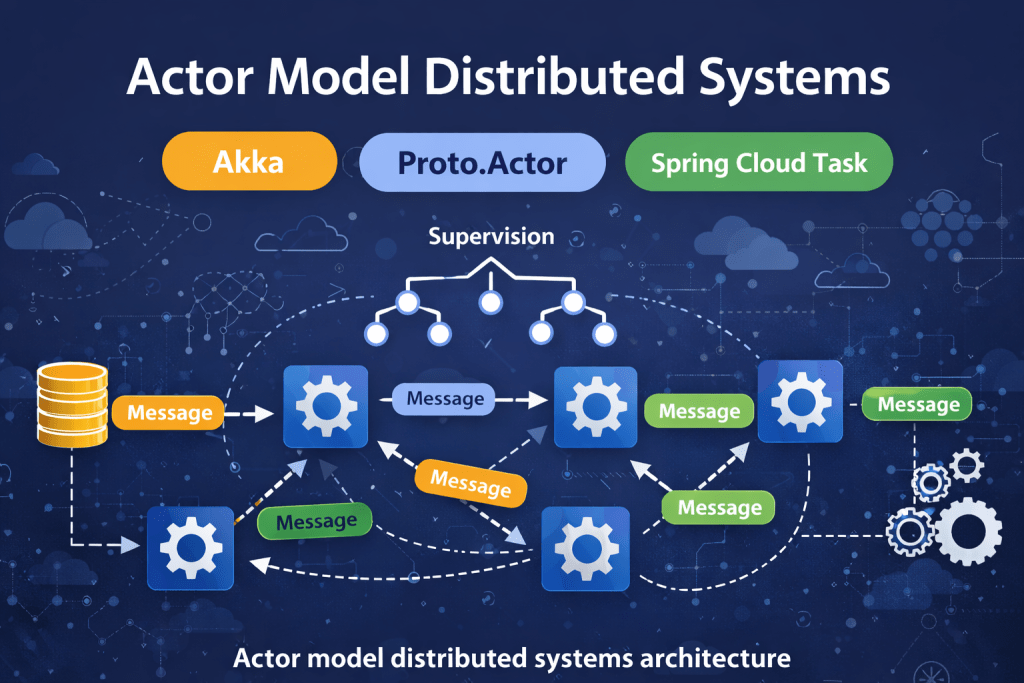
The Actor Model structures computation around independent actors that communicate exclusively via asynchronous messages.
Key Principles
- Encapsulation
Each actor owns its state completely. No other actor can directly access or modify it. - Message Passing
Actors communicate only by sending immutable messages, avoiding shared memory. - Concurrency by Design
- An actor processes one message at a time, eliminating the need for locks.
- Fault Isolation & Supervision
- Failures are isolated and handled through parent-child supervision strategies.
Where the Actor Model Fits Best
- High-concurrency systems
- Event-driven architectures
- Distributed microservices
- Real-time processing pipelines
Akka for Actor Model Distributed Systems (Java / Scala)
Akka is the most mature and widely adopted JVM-based actor framework. It provides a complete ecosystem for building distributed, reactive systems.
Core Components
- Actors & ActorSystem
- Supervision hierarchies
- Akka Cluster (node discovery, sharding, failover)
- Akka Persistence (event sourcing, snapshots)
- Akka Streams (reactive stream processing)
Strengths
- Battle-tested at scale
- Strong fault tolerance model
- Rich clustering and persistence capabilities
- Excellent Scala support with robust Java APIs
Trade-offs
- Steep learning curve
- Licensing considerations for advanced features
- Heavier operational complexity
Ideal Use Cases
- Distributed stateful services
- Financial and trading platforms
- Real-time analytics systems
- Telecom-grade infrastructure
Proto.Actor in Actor Model Distributed Systems
Proto.Actor is a lightweight, high-performance actor framework inspired by Akka, designed with simplicity and portability in mind. It supports multiple languages, including Go, C#, and Java.
Core Features
- Minimal actor runtime
- High-throughput mailboxes
- Pluggable clustering providers
- Explicit lifecycle control
Strengths
- Simpler mental model than Akka
- Lower runtime overhead
- Easy to embed into existing services
Limitations
- Smaller ecosystem
- Less mature tooling
- Fewer built-in abstractions
Ideal Use Cases
- High-throughput message processing
- Embedded actor systems inside microservices
- Low-latency systems with minimal complexity
Orchestrating Actor Model Distributed Systems with Spring Cloud Task
Why Orchestration Is Needed
Actor frameworks excel at long-running, message-driven workloads, but enterprise environments often require:
- Controlled execution flows
- Scheduled or triggered jobs
- CI/CD Integration
- Clear start and end boundaries
This is where Spring Cloud Task fits naturally.
Role of Spring Cloud Task
- Executes short-lived, bounded tasks
- Tracks execution metadata (start time, end time, status)
- Integrates with Spring Batch, Kubernetes, and schedulers
- Acts as an orchestration layer around actor workloads
Benefits
- Clear separation of orchestration and execution
- Improved observability and retry handling
- Cloud-native scheduling and scaling
Conclusion
The Actor Model is a powerful abstraction for building concurrent and distributed systems.
- Akka provides a feature-rich, enterprise-grade actor ecosystem.
- Proto.Actor offers a lightweight, high-performance alternative.
- Spring Cloud Task adds orchestration and lifecycle control for production workloads.
Together, they enable systems that are highly concurrent, fault tolerant, operationally manageable, and cloud native.
For more Tech related blogs refer to Nashtech blogs