


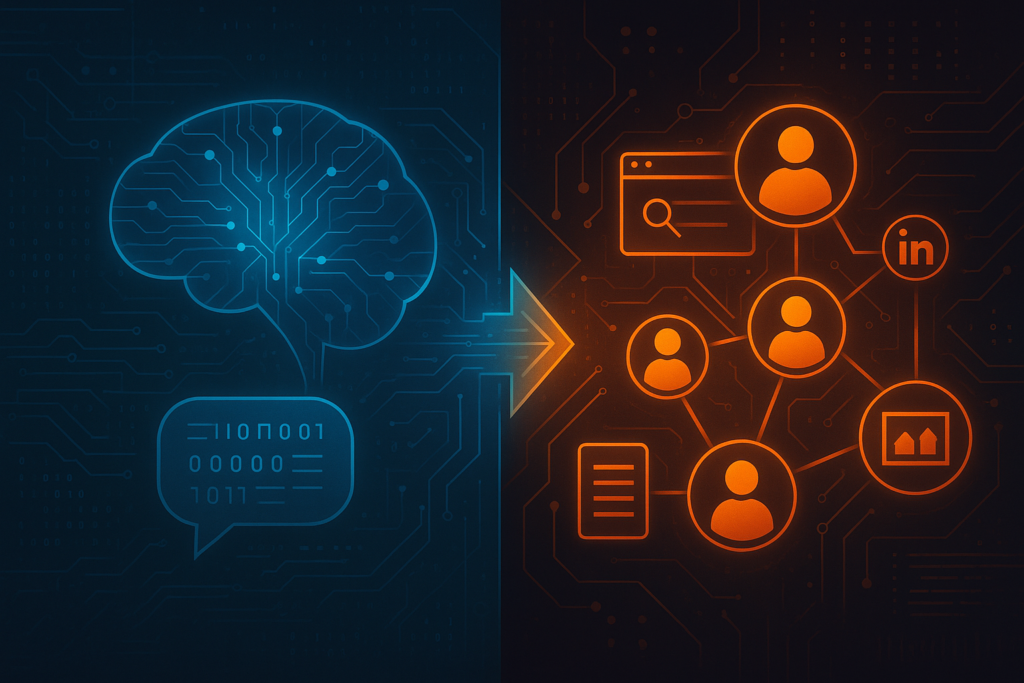
In the rapidly evolving landscape of artificial intelligence, we’re witnessing a significant shift from simple language models to sophisticated agent-based systems. This blog explores the fundamental differences between traditional Large Language Models (LLMs) like ChatGPT and agent-based AI systems like the LinkedIn post generator built with CrewAI, examining their capabilities, limitations, and real-world applications.
Understanding Traditional LLMs vs Agent-Based Systems
| Feature | Traditional LLMs (ChatGPT, Claude) | Agent-Based Systems (CrewAI) |
|---|---|---|
| Architecture | Single model handling all tasks | Multiple specialized agents working together |
| Workflow | One-step generation from prompt to output | Multi-step process with task dependencies |
| External Tools | Limited or recent integration | Native tool usage (search, scraping, etc.) |
| Research Ability | Basic web search in modern versions | Deep multi-source research with cross-referencing |
| Error Handling | Minimal recovery from failures | Robust error handling and logging |
| Transparency | “Black box” reasoning | Visible step-by-step thought process |
| Specialization | General-purpose capabilities | Role-specific expertise per agent |
| Autonomy Level | Responds to user prompts | Takes initiative within defined goals |
Traditional Large Language Models such as ChatGPT, Claude, or Gemini are powerful text generators trained on vast amounts of internet data. They excel at generating coherent text based on prompts, answering questions from their training data, and performing simple tasks defined within a single conversation. Recently, many have gained web search capabilities to access up-to-date information.
However, these systems have inherent limitations compared to agent-based approaches. They typically work within a single conversation context, lack the ability to execute complex multi-step workflows autonomously, and often struggle with coordinating between different specialized tasks.
Case Study: LinkedIn Post Generator with CrewAI – An Agentic AI System in Action
The provided code exemplifies a true agentic AI system designed specifically for creating LinkedIn posts about technical topics. What makes it “agentic” is its ability to act autonomously on behalf of the user, making decisions and taking actions to accomplish a complex goal with minimal human intervention. This LinkedIn post generator demonstrates the core characteristics of agentic AI:
1. Specialized Agents with Defined Roles
The system deploys two distinct agents:
research_agent = Agent(
    role='Web Research Specialist',
    goal='Find and extract detailed information about specific events from the web',
    backstory="""Expert at web research with keen attention to detail...""",
    tools=[self.search_tool, self.scrape_tool],
    # Additional parameters
)

writer_agent = Agent(
    role='Content Writer and Analyst',
    goal='Create a compelling LinkedIn post from research findings',
    backstory="""Experienced content writer and analyst...""",
    # Additional parameters
)
Each agent has a specific role (researcher or writer), personalized goals, and a backstory that shapes its approach to tasks.
2. Tool Integration for Enhanced Capabilities
The research agent can utilize external tools:
self.search_tool = SerperDevTool(n_results=2)
self.scrape_tool = ScrapeWebsiteTool()
These tools empower the agent to search the web and extract content from websites autonomously.
3. Sequential Task Dependencies
The system enforces a logical workflow:
summary_task = Task(
    # Task details
    dependencies=[search_task]
)
The writing task depends on the completion of the research task, ensuring information flows properly.
4. Robust Error Handling
The system incorporates comprehensive error handling:
try:
    # Operation code
except Exception as e:
    logger.error(f"Error in research process: {str(e)}")
    # Graceful fallback
This ensures the system remains reliable even when facing unexpected challenges.
5. Autonomous Agency in Action
The sample output demonstrates the system’s agency – its ability to independently work toward goals through planning, reasoning, and execution:
# Agent: Web Research Specialist
## Task:
    Search Task:
    1. Use SerperDevTool to search for: How AI on edge devices is transforming the healthcare industry
    2. Extract relevant URLs from search results
    3. Use ScrapeWebsiteTool to fetch content from each URL
    4. Compile key information from all sources
    ...

# Agent: Web Research Specialist
## Thought: I need to search the internet for information on how AI on edge devices is transforming the healthcare industry. Then I will read the content of the most relevant websites to gather the necessary details.
## Using tool: Search the internet
## Tool Input:
"{\"search_query\": \"How AI on edge devices is transforming the healthcare industry\"}"
## Tool Output:
Search results: Title: Edge AI in Healthcare | Revolutionizing Patient Care at the Edge
Link: https://www.xenonstack.com/blog/edge-ai-in-healthcare
Snippet: Edge AI in Healthcare enables real-time data processing, enhancing patient outcomes, diagnostics, and personalized care with advanced, ...
...
This output reveals the transparent, step-by-step reasoning process each agent employs, showcasing the system’s ability to methodically approach complex tasks. Unlike traditional LLMs that simply respond to prompts, these agents demonstrate true agency by:
- Setting sub-goals: Breaking down the main objective into actionable steps
- Planning: Determining which tools to use and in what sequence
- Executing: Carrying out planned actions using integrated tools
- Evaluating: Assessing the information gathered before proceeding
- Adapting: Adjusting strategies based on intermediate results
This agency – the capacity to act independently toward goals – is what fundamentally separates this LinkedIn post generator from standard LLM interactions. The system doesn’t just answer questions; it performs real work by searching the web, reading articles, extracting relevant information, synthesizing findings, and crafting polished content – all with minimal human guidance beyond the initial query.
Key Advantages of Agent-Based Systems Over Traditional LLMs
| Advantage | Description | Impact on Content Creation |
|---|---|---|
| Enhanced Research | Deep research across multiple sources with cross-referencing | More accurate, comprehensive, and up-to-date content |
| Specialized Expertise | Each agent optimized for specific roles (research, writing) | Higher quality in each aspect of the content creation process |
| Process Transparency | Visible reasoning, tool usage, and decision-making | Users understand how conclusions were reached |
| Enhanced Reliability | Structured error handling and task dependencies | More consistent results with automatic recovery from failures |
| Customizability | Flexible architecture allowing new agents and tools | System can adapt to various content types and requirements |
Real-World Applications
Agent-based systems like the LinkedIn post generator excel in scenarios requiring:
- Deep Research: When content must be based on thorough investigation rather than general knowledge
- Fact-Checking: When accuracy and source verification are critical
- Specialized Content: When writing must follow specific formats or standards
- Multi-Stage Workflows: When content creation involves distinct phases
- Transparent Reasoning: When users need to understand how conclusions were reached
Limitations to Consider
Despite their advantages, agent-based systems have their own challenges:
- Increased Complexity: These systems require more complex setup and maintenance
- Higher Resource Requirements: Running multiple agents consumes more computational resources
- Longer Processing Time: Multi-stage workflows typically take longer to complete
- API Dependencies: External tools often rely on third-party APIs that may change
The LinkedIn Post Generator as a True Agentic System
| Agentic Characteristic | Implementation in LinkedIn Post Generator | Traditional LLM Comparison |
|---|---|---|
| Autonomous Operation | Operates independently after receiving query | Requires continuous user prompting |
| Tool Integration | Actively uses search and scraping tools | Limited to capabilities within the model |
| Memory & Context | Maintains context across research and writing phases | Often limited to single conversation context |
| Goal-Directed Behavior | Each agent pursues specific objectives | Responds directly to prompts without planning |
| Self-Monitoring | Includes logging and error recovery | Limited error detection and recovery |
| Delegation | Tasks assigned to specialized agents | Single model handles all aspects |
| Emergent Intelligence | Combined system exceeds capabilities of components | Capabilities limited to single model |
This represents a fundamental shift in how AI assists with content creation – from passive text generation based on prompts to active participation in the research and writing process.
The Future of Content Creation
As agentic AI continues to evolve, we can expect these systems to become increasingly sophisticated:
- More Specialized Agents: Future systems might incorporate editors, fact-checkers, and style specialists
- Advanced Tool Usage: Agents will leverage more sophisticated tools for research and content creation
- Improved Collaboration: Enhanced inter-agent communication will lead to more cohesive outputs
- Personalization: Systems will adapt to individual user preferences and writing styles
Conclusion
While traditional LLMs remain powerful tools for straightforward content generation, agent-based systems represent the next frontier in AI-powered content creation. By breaking complex tasks into manageable components handled by specialized agents, these systems produce higher-quality, better-researched, and more reliable content.
The LinkedIn post generator built with CrewAI exemplifies this approach, demonstrating how multiple agents working together can transform a simple query into a well-researched, engaging LinkedIn post. As these technologies continue to mature, they will reshape our expectations of what AI can accomplish in content creation and beyond.
For organizations and individuals seeking to leverage AI for content creation, understanding the distinctions between traditional LLMs and agent-based systems is crucial for selecting the right technology for specific use cases. While LLMs offer simplicity and speed, agent-based systems provide depth, accuracy, and transparency that make them ideal for professional content creation workflows.