



Testing everything in a project is nearly impossible. That’s why we need a smart way to organize and plan our testing. The Agile Testing Quadrants are a helpful tool that divides testing into four clear categories. They help testers figure out what to test and how to test it.
The best part? These quadrants are flexible. You can use them in different ways depending on your project’s needs.
In this post, we’ll explain each quadrant in a simple way and share real examples to help you apply them. If you want to build a better testing strategy, this guide is for you!
The origins of the ‘Marick Test Matrix’
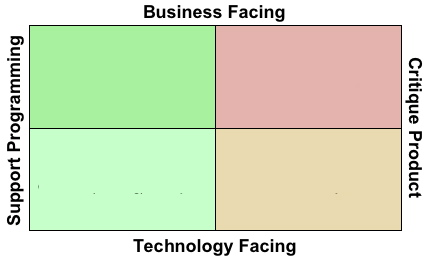
In 2003, software consultant Brian Marick introduced the Agile Testing Quadrants (originally called the Marick Test Matrix) to help structure Agile testing. He created a simple grid that grouped different types of tests into four quadrants, laying the groundwork for a clearer understanding of how to approach testing in Agile projects.
What are the Agile Testing Quadrants?

The Agile Testing Quadrants, an evolution of Brian Marick’s Agile Testing Matrix, serve as a compass for tailoring your testing approach based on the specific business context. There are four quadrants, each emphasizing a different aspect:
Quadrant 1: Technology-Facing Tests That Support the Team
Q1 focuses on automated tests like unit tests and component tests that help improve the code and support the development team. These tests are run frequently during each sprint to give fast feedback, catch issues early, and keep the code quality high. Since they’re usually the first tests to run, Q1 is a good starting point in the Agile testing process.
Example:
Writing unit tests for a calculateTax(orderTotal) function in an e-commerce application.
Testing logic in a React component to make sure clicking the “Submit” button sends the correct API request.
Quadrant 2: Business-Facing Tests That Support the Team
Q2 includes tests that help the team and make sure the product meets business needs, like client requirements. It involves functional testing, story testing, and prototype testing. Some tests can be automated, but others need to be done manually, especially when working with prototypes or simulations. These tests help improve both the product and the team’s understanding of the business goals.
Example:
Writing test cases for the user story:
“As a user, I want to log in to my account.”
Automating an end-to-end scenario: browse product → add to cart → checkout → place order.
Quadrant 3: Business-Facing Tests That Critique the Product
Q3 focuses on finding bugs in business-related features by trying to break the product. It’s about testing from a user’s point of view, often using manual methods like exploratory testing, UAT, or beta testing. These tests help uncover problems that automation might miss.
Example:
Doing exploratory testing on the shipping address form by entering invalid or edge-case inputs.
Checking user experience (UX) for app navigation speed and layout clarity on mobile.
Quadrant 4 (Q4): Technology-Facing Tests That Critique the Product
Q4 focuses on using advanced tools to test the system’s non-functional aspects, like performance, security, and load. The goal is to stress the system and find weaknesses, not just check if it works. It’s similar to Q3 but uses technology to test how the system behaves under pressure.
Example:
Conducting a load test with 1,000 concurrent users searching for products.
Using OWASP ZAP to test for security vulnerabilities like SQL Injection and XSS.
Running JMeter to simulate sending 10,000 orders to the backend API.
How to Use the Agile Testing Quadrants?
| Quadrant | Purpose | When to Use | Who’s Involved |
|---|---|---|---|
| Q1 | Ensure code correctness | During development | Developers |
| Q2 | Validate business functionality | During sprint & CI/CD | Testers, Product Owner |
| Q3 | Explore system behavior | After builds / before release | Testers, UX, PO |
| Q4 | Test performance & security | Before release & in CI pipeline | DevOps, Performance team |
Benefits of Using Agile Testing Quadrants Model
1. Comprehensive Test Coverage
Ensures all aspects of testing—functional, non-functional, technical, and business-facing—are covered.
2. Better Planning and Test Strategy Alignment
Helps teams decide what types of tests to perform at each stage of the development process.
3. Improved Collaboration Across Roles
Encourages collaboration between testers, developers, product owners, and DevOps.
4. Supports Continuous Delivery and Agile Principles
Facilitates early, continuous, and automated testing aligned with Agile values.
5. Promotes Balanced Testing Focus
Prevents over-reliance on automation or neglect of performance/usability testing.
6. Helps Identify Gaps in Testing Early
Teams can visualize and spot missing areas in their test coverage early.
7. Enables Risk-Based Testing Prioritization
Quadrants help focus efforts on the most critical areas based on business and technical risks.
8. Guides Continuous Improvement
The model can be reviewed and adapted after each sprint to improve testing efforts.
9. Clarifies Roles and Responsibilities
Defines which quadrant each team role contributes to, making responsibilities clear.
10. Provides a Shared Language for Quality
Helps the whole team (dev, test, PO) communicate better about test scope and goals.
Conclusion
In conclusion, Agile Testing Quadrants offer a valuable toolset for agile teams to strategize and execute testing effectively. By categorizing testing types and guiding their application based on context, these quadrants enhance focus, communication, and test coverage, ultimately contributing to the success of agile projects.
Reference
https://www.istqb.org/certifications/certified-tester-foundation-level-ctfl-v4-0
https://www.onpathtesting.com/blog/what-are-agile-testing-quadrants
https://lisacrispin.com/2024/10/11/the-agile-testing-quadrants/