


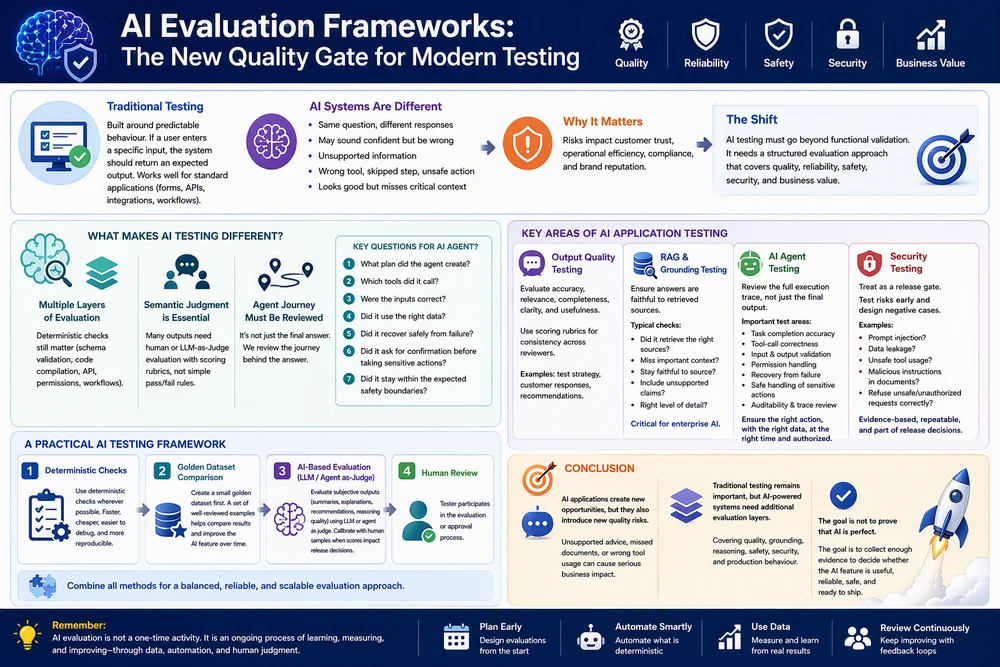
Why Traditional Testing Is Not Enough for AI Applications
Traditional testing is built around predictable behaviour. If a user enters a specific input, the system should return an expected output. This works well for standard applications such as forms, APIs, integrations, and business workflows.
AI systems are different.
In practice, that means two users can ask the same question and still get answers with different levels of accuracy. A chatbot may provide information that is not supported by the source data. An AI agent may call the wrong tool, skip an important step, or take an unsafe action. A generated summary may look professional but miss critical business context.
For one customer-support assistant, unsupported answers increased re-opened tickets, directly affecting trust and SLA compliance.
That is why AI testing needs to go beyond functional validation. It needs a structured evaluation approach that covers quality, reliability, safety, security, and business value.
What Makes AI Testing Different?
The mistake most teams make is treating AI testing like API testing with a few extra prompts. That is usually not enough. For example, a JSON response should follow the expected schema. Generated code should compile, pass linting rules, and meet test coverage expectations. APIs, permissions, and workflows still require standard functional testing; however, many AI outputs also need semantic evaluation. A summary, recommendation, defect explanation, test strategy, or customer response cannot always be validated with a simple pass or fail rule. It needs evaluation criteria, scoring rubrics, and sometimes human review or LLM-as-Judge techniques.
For AI agents, the final answer is not enough. We also need to review the journey behind the answer:
- What plan did the agent create?
- Which tools did it call?
- Were the inputs correct?
- Did it use the right data?
- Did it recover safely from failure?
- Did it ask for confirmation before taking sensitive actions?
- Did it stay within the expected safety boundaries?
This is a major shift for testing teams. We are no longer only testing screens and APIs. We are testing decisions, reasoning paths, data grounding, and autonomous behaviour.
Key Areas of AI Application Testing
Output Quality Testing
AI responses need to be evaluated for accuracy, relevance, completeness, clarity, and usefulness.
For example, if an AI assistant generates a test strategy, we should check whether it covers the right scope, risks, assumptions, testing levels, environments, and acceptance criteria. If it creates a customer response, we need to validate whether the tone, facts, and recommendations are appropriate.
This type of testing often requires clear scoring rubrics so different reviewers can evaluate outputs consistently.
RAG and Grounding Testing
Retrieval-augmented generation, or RAG, is commonly used when AI systems need to answer based on enterprise documents, policies, knowledge bases, or product data.
In one pilot, 3 of 10 fluent answers cited irrelevant documents, so we added a grounding check to verify each claim against retrieved evidence. Testers should separate retrieval quality from generation quality. This helps identify whether the issue comes from missing documents, poor retrieval, wrong ranking, or unsupported generation.
Typical checks include:
- Did the system retrieve the right source documents?
- Did it miss important context?
- Did the answer stay faithful to the source?
- Did it include unsupported claims?
- Did it provide the right level of detail for the user’s question?
In an enterprise setting, one unsupported answer can trigger rework, compliance review, and a loss of trust from business users.
AI Agent Testing
AI agents can perform multi-step tasks, use tools, access systems, and make decisions. This makes agents powerful but harder to validate, so teams should assess more than the final output.
For agent-based solutions, testers should not approve the feature based only on the final output. The full execution trace should be reviewed, including planning, tool usage, retries, failure handling, and confirmation steps.
Important test areas include:
- Task completion accuracy
- Tool-call correctness
- Input and output validation
- Permission handling
- Recovery from tool failure
- Safe handling of sensitive actions
- Auditability and trace review
For example, if an AI agent can create a ticket, update a record, or trigger a workflow, testing must confirm that it performs the right action, with the right data, at the right time, and only when authorized.
Security Testing
We made AI security a release gate after a red-team test bypassed tool restrictions in staging, exposing why end-phase checks were too late. Prompt injection, data leakage, unsafe tool use, and sensitive-data exposure are serious risks in AI-powered systems.
Testing teams should design negative test cases early in the delivery lifecycle.
Examples include:
- Can a user manipulate the prompt to bypass restrictions?
- Can the AI reveal sensitive internal information?
- Can the agent be tricked into calling an unsafe tool?
- Can the system follow malicious instructions hidden inside retrieved documents?
- Does the AI refuse unsafe or unauthorized requests correctly?
Security testing for AI applications should be evidence-based, repeatable, and included in release readiness decisions.
A Practical AI Testing Framework
A practical AI evaluation framework should combine different testing methods instead of relying on one approach only.
Deterministic Checks
Start with deterministic checks for schema, permission, and tool-call validation; these checks usually catch repeatable failures before semantic review begins.
Golden Dataset Comparison
Create a small golden dataset first. It does not need to be large at the beginning. A small set of well-reviewed examples can help the team learn, compare results, and improve the AI feature over time.
AI-Based Evaluation
LLM & Agent as-Judge can help evaluate subjective outputs such as summaries, explanations, recommendations, and reasoning quality. However, it should be calibrated with human samples when the score affects release decisions
Human Review
Human reviewers should verify high-impact outputs against evidence, policy, and risk thresholds before approval.
Conclusion
AI applications create new opportunities, but they also introduce new quality risks.
A chatbot that gives unsupported advice, a RAG system that misses key documents, or an AI agent that uses the wrong tool can all create serious business impact. Traditional testing remains important, but AI-powered systems need additional evaluation layers covering quality, grounding, reasoning, safety, security, and production behaviour.
The practical goal is release confidence: enough evidence to show the feature is useful, reliable, safe, and ready for production.