


1. Introduction
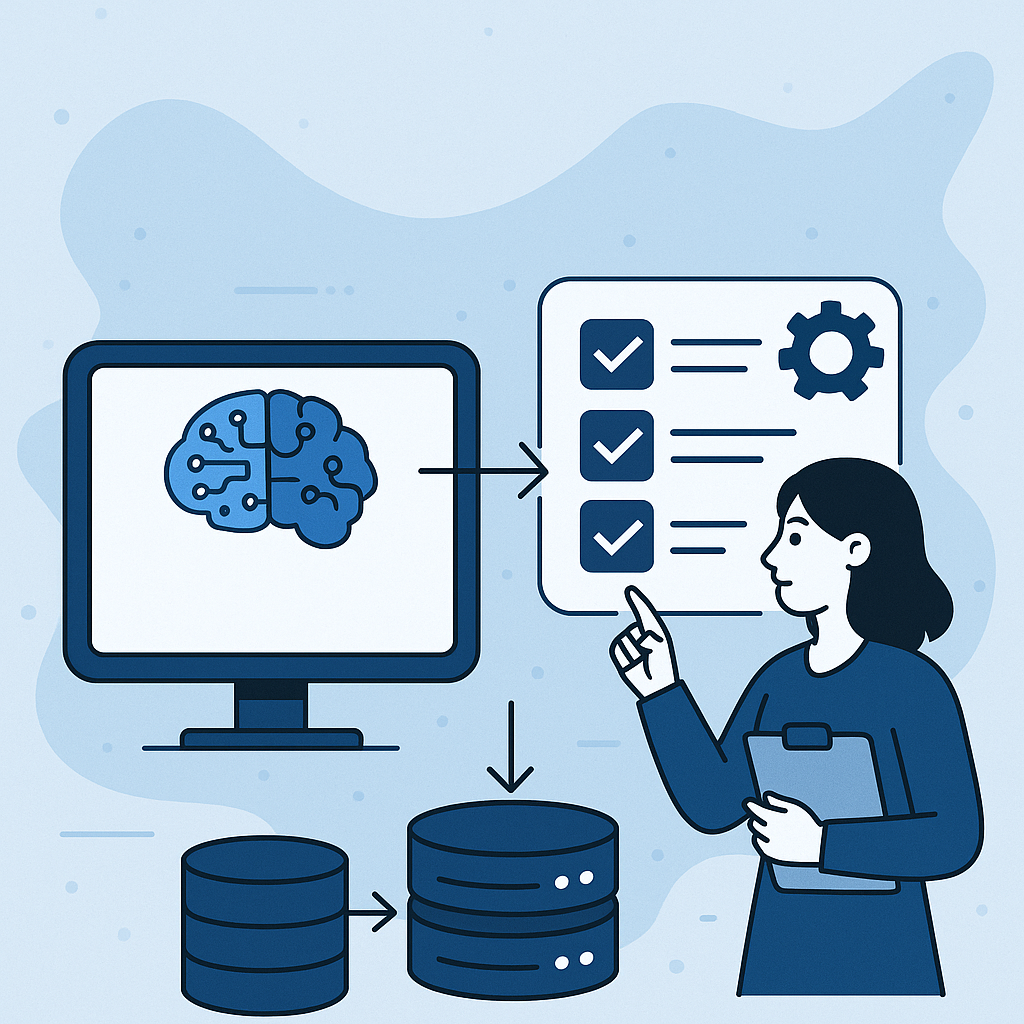
Data migration is always a high-stakes project. But when security policies prohibit access to production data, testing becomes especially challenging. In this blog post, we’ll explore how AI-enabled test case generation helped our team overcome these limitations—ensuring test quality without exposing real data.
2. Project Overview
- Type: Data Migration
- From: Legacy SQL Server
- To: Cloud-based PostgreSQL Data Warehouse
- Constraint: No access to production data due to compliance (GDPR)
Goal: Ensure correctness of transformation logic, data mapping, and referential integrity—without using real data.
3. The Testing Challenge
Manual test case design was:
- Time-consuming
- Prone to gaps in logic
- Unscalable across 100+ tables and mappings
Key limitations:
- No access to production-like data
- Complex transformation rules
- Limited time and QA resources
4. How AI Helped
We implemented an AI-driven test case generation framework that enabled us to create comprehensive, safe test cases based on metadata, mappings, and inferred logic.
4.1. Metadata Analysis
- AI analyzed source and target schemas
- Automatically generated test cases for:
- Data type mismatches
- Constraint violations
- Primary/foreign key consistency
Let’s assume the following schema snapshot: Source Table: orders (SQL Server)
| Column Name | Data Type | Constraints |
| order_id | INT | PRIMARY KEY |
| customer_id | INT | FOREIGN KEY → customers.id |
| amount | DECIMAL | CHECK > 0 |
| status | VARCHAR | NOT NULL |
Target Table: migrated_orders (PostgreSQL)
| Column Name | Data Type | Constraints |
| order_id | TEXT | PRIMARY KEY |
| customer_id | TEXT | FOREIGN KEY → migrated_customers.customer_id |
| amount | NUMERIC | |
| status | TEXT | NOT NULL, NOT NULL, CHECK IN (‘NEW’, ‘PAID’, ‘CANCELLED’) |
Based on these differences, AI-generated test cases included:
- Validate order_id conversion from INT to TEXT does not lose uniqueness.
- Insert order with NULL status → Expect failure (NOT NULL constraint)
- Insert order with amount = -100 → Expect failure (CHECK > 0 rule from source)
- Insert order with status = ‘PENDING’ → Expect failure (violates target CHECK constraint)
- Insert order with missing customer_id → Expect failure (foreign key violation)
With the following prompt from AI: Based on the metadata comparison below, generate 7 detailed test cases to validate:
- Data type mismatches
- Constraint violations (NOT NULL, UNIQUE, CHECK)
- Primary and foreign key consistency
Here the sample test cases generated by AI:
| TC_ID | Description | Input | Expected Result |
| MGR_01 | Validate order_id type conversion from INT to TEXT | Source: order_id = 1001 → Target: order_id = ‘1001’ | Record successfully inserted; order_id stored as string |
| MGR_02 | Validate NOT NULL constraint on status column | status = NULL | Insert fails, error due to NOT NULL violation |
| MGR_03 | Validate CHECK constraint on amount from source | amount = -50.00 | Insert fails; violates source rule CHECK amount > 0 |
| MGR_04 | Validate CHECK constraint on status in target | status = ‘PENDING’ | Insert fails; violates CHECK (status IN ‘NEW’, ‘PAID’, ‘CANCELLED’) |
| MGR_05 | Validate valid foreign key relationship | customer_id = ‘CUST001’ (exists in migrated_customers) | Insert succeeds |
| MGR_06 | Validate foreign key failure with missing customer | customer_id = ‘UNKNOWN’ | Insert fails, FK constraint violation |
| MGR_07 | Validate correct amount and status insertion | amount = 250.00, status = ‘NEW’ | Insert succeeds |
4.2. Transformation Rule Inference
- NLP engine parsed mapping documents & SQL logic
- Converted mappings into rule-driven test cases
Example:
“Target.CustomerID = ‘CUST-‘ + Source.ID”
⇨ Generated expected outputs: “CUST-001”, “CUST-999”
4.3. Synthetic Data Generation with Context
- AI created synthetic data that mimicked:
- Valid email patterns
- Realistic names, dates, and IDs
- Ensured no use of production data
Result: Validated business logic without breaching privacy
4.4. Coverage-Driven Test Prioritization
- Grouped and ranked test cases by:
- Rule coverage
- Constraint verification
- Edge case detection
Allowed targeted testing in high-risk areas first
5. Results & Outcome

6. Key Lessons Learned
- AI accelerates test case design but doesn’t replace human QA
- Rich metadata = better test generation
- Synthetic data is a viable alternative in secure environments
- Start with pilot tables and scale based on value observed
7. Conclusion
When sensitive data is off-limits, AI offers a safe and scalable alternative to traditional testing. In this migration project, AI-powered test case generation enabled us to meet quality, coverage, and compliance goals—without ever touching real data.
If you’re running a data migration or modernization effort, it’s time to consider AI-driven test design as a core part of your strategy.
📌 Want to explore this approach in your own project? Our team is happy to share practical examples—just get in touch.